AI Agents: Architecting and Automating Autonomous Systems
Contents 9 sections

Module 1 Fundamentals of Autonomous AI Agents

What Are AI Agents — From Copilot to Autonomous Systems in 2026

Lesson 1 of 30 55 min read Free preview, no account needed
Save Notes Quiz In the course
The AI Professor knows this lesson Select any passage and get the explanation on the spot. Try it now in the demo.

A chatbot waits to be asked. An agent waits for no one — it sets its own steps, calls the tools it needs, and keeps going until it reaches its goal, even after you have closed your laptop. This seemingly subtle difference is the most significant paradigm shift in applied artificial intelligence since the emergence of transformer models in 2017: an AI agent is no longer an assistant that answers, but a software system that perceives its environment, plans sequences of actions, uses external tools, and operates autonomously until it achieves a defined objective. And the boundary between "a clever LLM call" and "a real agent" is exactly where most projects either generate real economic value or burn money with nothing to show for it.

From Chatbot to Agent: A Taxonomy of Autonomy

To understand what AI agents are, we must first establish a clear taxonomy of autonomy levels in systems built on large language models (LLMs). This taxonomy is not merely academic — it dictates the architectural decisions, the operating costs, and the risk profile of every system.

Level 0 — The LLM as a pure function (Stateless Completion). At this level, a model such as Claude Opus 5.5 or GPT-6.2 Sol receives a prompt and returns a response. There is no memory between calls, no tools, no planning. Example: an API endpoint that translates text from English into Romanian. Every request is independent. Cost is predictable (input tokens + output tokens), and risk is minimal because the output triggers no action in the real world.

Level 1 — Copilot (permanent Human-in-the-Loop). GitHub Copilot, Cursor, or Claude Code in interactive mode operate at this level. The model suggests, but the human decides. Every potentially destructive action (deleting a file, executing a command) requires explicit approval. The system may have access to tools (terminal, file system), but delegation is granular and supervised.

Level 2 — Semi-autonomous agent (Human-on-the-Loop). The agent executes sequences of actions without individual approval, but operates under strict constraints: a maximum token budget, an allowlist of permitted tools, timeouts, and an escalation mechanism when uncertainty exceeds a threshold. The human monitors and intervenes only when the agent flags an exceptional situation. Most enterprise deployments in 2026 operate at this level.

Level 3 — Autonomous agent with self-governance. The agent sets sub-goals, allocates resources, selects strategies, and self-corrects without human intervention. This level is still experimental in production, except in low-risk domains (content generation, non-critical data analysis). Recent 2026 research from Anthropic and Google DeepMind explores formal verification mechanisms that would enable full autonomy in critical domains.

Level 4 — Multi-agent systems with coordinated emergence. Multiple autonomous agents collaborate, negotiate, and coordinate to solve complex problems. Each agent has specialized competencies, and the emergent collective behavior exceeds individual capabilities. The 2026 pilot projects (for example, the fully-agentic software development systems from Anthropic and OpenAI) demonstrate the potential of this level.

┌─────────────────────────────────────────────────────────┐
│  THE AUTONOMY TAXONOMY FOR LLM-BASED SYSTEMS            │
├─────────────────────────────────────────────────────────┤
│  Level 0: Stateless LLM    │  prompt → completion       │
│  Level 1: Copilot          │  suggestion → human OK     │
│  Level 2: Semi-Auto Agent  │  goal → supervised exec    │
│  Level 3: Autonomous Agent │  goal → self-governance    │
│  Level 4: Multi-Agent      │  mission → coordination    │
├─────────────────────────────────────────────────────────┤
│  Risk:    ▓░░░░  →  ▓▓▓▓▓                              │
│  Control: ▓▓▓▓▓  →  ▓░░░░                              │
│  Value:   ▓░░░░  →  ▓▓▓▓▓                              │
└─────────────────────────────────────────────────────────┘


The rest of the lesson is in the course

Unlock the rest of this lesson and the 29 other lessons.

  • 30 lessons, with a quiz in every lesson
  • AI Professor in every lesson, fair use
  • Publicly verifiable Certificate of Completion
  • Instant access; stop the renewal anytime from your account

What's next in this lesson

  • The Agentic Stack: The 5 Fundamental Components
  • Comparison with Traditional Automation
  • Applied Scenario: Autonomous DevOps Incident Resolution
  • Common Pitfalls: Anti-patterns in Agent Development
  • Official Guides: Perspectives from Anthropic and OpenAI
  • Complete Pseudocode: The Architecture of an Agent with Budget Enforcement
  • Industry Examples: AI Agents in Production (2026)
  • Recap and Preparation for the Next Lesson

Interactive demo

Your account, before you pay

The real app, in a sample account with no subscription: the home page, the subscriptions, the learning paths, the catalog. Nothing is saved and you don't need an account.

courses-ai.com/app Interactive demo · sample account

In every lesson

The AI Professor starts from the lesson you have open

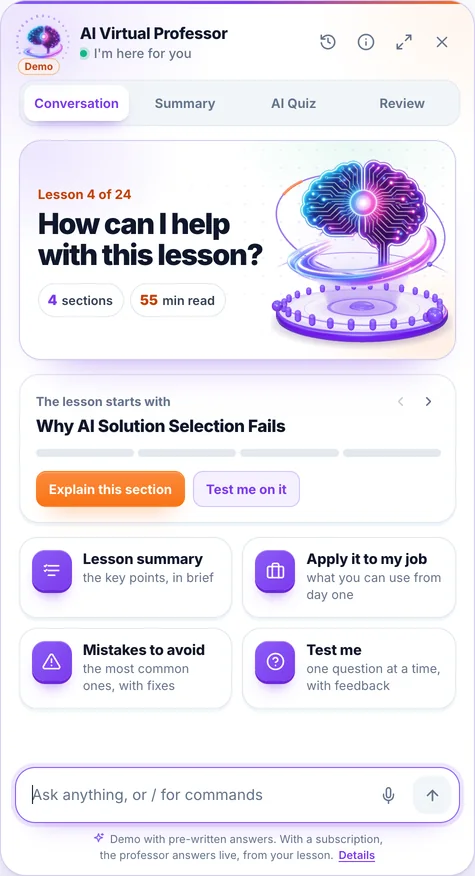
You ask it in writing or by voice, right from the lesson, and you can listen to the answer on request. Where needed, it fills in from general knowledge. When you select a passage, a bar appears with “Explain this to me”, “Give me an example”, “Why does it matter?” and “My own question”.

Its panel has four tabs:

  • Conversation: you ask, it answers starting from the lesson
  • Summary: the key ideas of the lesson, point by point
  • AI Quiz: 3, 5 or 10 new questions from the lesson, with explanations
  • Review: flashcards made from the lesson

Included in every subscription and in single-course access, within a fair-use limit.

Screenshot from the app: the AI Professor panel, open in a lesson.

The demo opens on a lesson from the course “AI for Business Leaders”, with prepared answers; voice is off in the demo.

It is an artificial intelligence system, not a human teacher; its answers may contain errors. Details in the Terms & Conditions.

Course curriculum

Everything you'll learn in this course

11 modules · 30 lessons · about 26 hours of reading · advanced level

1 Fundamentals of Autonomous AI Agents 3 lessons
  • What Are AI Agents — From Copilot to Autonomous Systems in 2026 Reading now 55 min
  • The Architecture of Thinking: ReAct, Plan-and-Execute, and Reflexion 55 min
  • Perception and Action: Function Calling and the Tool Ecosystem 55 min
2 Memory, State and Advanced Reasoning 3 lessons
  • Memory Architecture: How Agents Think Long-Term 55 min
  • Advanced Reasoning: Chain-of-Thought, Tree-of-Thought, and Self-Consistency 55 min
  • Hierarchical Planning and Decomposing Complex Tasks 55 min
3 Frameworks and SDKs for AI Agents 4 lessons
  • The LangChain Ecosystem and the Evolution Toward LangGraph 55 min
  • OpenAI Agents SDK: Native Multi-Agent Architecture 55 min
  • CrewAI and Multi-Agent Systems: Managing Digital Teams 55 min
  • Anthropic Claude Agent SDK and Google ADK: Enterprise Alternatives 55 min
4 Model Context Protocol (MCP) and Interoperability 3 lessons
  • Model Context Protocol (MCP): Standardizing AI Connections 55 min
  • Building Custom MCP Servers: A Complete Practical Guide 55 min
  • The MCP Ecosystem: Popular Servers and Enterprise Integrations 55 min
5 Workflow Automation with AI 3 lessons
  • n8n — Self-Hosted AI Automation: Architecture and Implementation 55 min
  • Make.com and Zapier Central: No-Code Automation in the AI Era 55 min
  • Custom Workflow Engines with Python: Absolute Control 55 min
6 Agentic Design Patterns for Production 3 lessons
  • Agentic Design Patterns: Router, Evaluator, and Parallelization 55 min
  • Human-in-the-Loop and Enterprise Approval Workflows 55 min
  • Multi-Model Orchestration: Intelligent LLM Routing 55 min
7 Security, Guardrails and Compliance 2 lessons
  • AI Agent Security: Attack Vectors and Defence in Depth 55 min
  • Advanced Guardrails, Sandboxing, and AI Act Compliance 55 min
8 Observability, Evaluation and Testing 3 lessons
  • Semantic Observability: Tracing, Metrics, and Alerting 55 min
  • Automated Testing for AI Agents: Eval Sets and CI/CD 55 min
  • LLM-as-a-Judge and Continuous Evaluation in Production 55 min
9 Deployment and Scaling in Production 2 lessons
  • Deployment Strategies: Shadow Mode, Canary, and Instant Rollback 55 min
  • Scaling, Cost Optimization, and Multi-Region Architectures 55 min
10 Case Studies and Hands-On Project 3 lessons
  • Hands-On Project: Build a Complete Multi-Agent System 55 min
  • AGENTS.md: The Open Standard for Guiding Coding Agents 16 min
  • Official Resources, 2026 Updates, and Learning Paths 22 min
11 Final Quiz — AI Agents and Automation 1 lesson
  • Final Assessment — AI Agents and Automation 2026 30 min

At the end

You leave with proof anyone can check

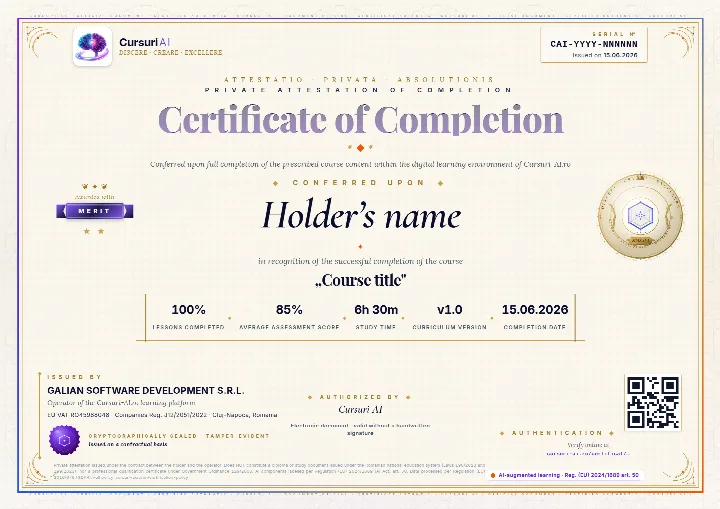
The Certificate of Completion for “AI Agents: Architecting and Automating Autonomous Systems”: a private attestation with a unique number and a QR code. A recruiter confirms it is authentic on the public verification page, with no account and no cost.

Example of a Cursuri AI Certificate of Completion with sample data: the serial number and the issue date in the top-right corner, the holder’s name, the course, the tier awarded, the percentage of lessons, the average score, the study time, the course version, the issuer and the verification QR code
The real document, an A4 PDF, shown here with sample data. Yours carries your name, the course “AI Agents: Architecting and Automating Autonomous Systems”, the serial number, the issue date and the tier you earned; the QR code in the image is decorative.
  • Anyone can verify it

    Public verification page, QR code and cryptographic fingerprint, with no account for the person checking.

  • You show it where it counts

    Add it to your CV and LinkedIn profile; a recruiter confirms authenticity with one click.

  • It says exactly what it attests

    The course, the tier you earned (Pass, Merit or Distinction), the serial number and the issue date, plus the percentage of lessons completed.

Frequently asked questions

Good to know before you start

How do I get access to the course?

You can read the beginning of the first lesson right on this page, with no account. For the course you create an account, pick how many courses you want each month — from 1 course to the full catalog — and get access immediately after your payment is confirmed. Everything happens 100% online.

Can I stop my subscription anytime?

Yes. You stop the renewal straight from your account, in just a few clicks. Your access stays active until the end of the period you have already paid for, and nothing more is charged after that.

What does the subscription for this course include?

All 30 lessons in the course, interactive quizzes, the AI Professor built into every lesson (select a passage and choose “Explain this to me”), within a fair-use limit, personal notes, automatically saved progress and content updates included.

Is there a fixed learning schedule?

No. You learn at your own pace, on any device. Lessons are structured step by step, and the platform saves your progress automatically, so you can pick up right where you left off — anytime.

Ready to unlock all the content?

Just this course, €99 / month, VAT included, or 3 courses with this one included, €199 / month, VAT included. You change your courses at every renewal, and the AI Professor is included in your subscription. Your Certificate of Completion stays yours after you stop the subscription.

Instant access Stop the renewal anytime Secure payment via Stripe
From €99 / month, VAT included · Stop the renewal anytime
Unlock the full course

Pick up where you left off, when you have time

We email you the link back to this lesson and what comes next in the course.

  • The link back to this exact lesson
  • What comes next in the course
  • How the AI Professor helps inside every lesson
  • Unsubscribe with one click
  • Address deleted automatically if you do not confirm