The course’s skills. The same ones appear on your Certificate of Completion, so you can show what you covered.
Foundations: Why Recommendation Matters in 2026
Content-Based Filtering
Collaborative Filtering
Matrix Factorization
Deep Learning Recommenders
Sequential and Session-Based Recommendation
Recommendation at Scale
Cold Start and Evaluation
About the course
A premium, complete and hands-on course on modern recommender systems, updated for 2026. You will start from why recommendation is one of the highest-leverage applications of machine learning, then build up every major family of models with real Python code. You will master content-based filtering with TF-IDF and embeddings, memory-based collaborative filtering (user-based and item-based neighborhoods), and matrix factorization with SVD, ALS and Bayesian Personalized Ranking using the implicit and LightFM libraries. You will learn the crucial difference between explicit and implicit feedback and why it changes both your model and your loss. From there you will build deep learning recommenders — neural collaborative filtering, embeddings, and the two-tower retrieval architecture — and sequential and session-based models with self-attention (SASRec, BERT4Rec). You will design the two-stage candidate-generation-plus-ranking architecture that powers recommendation at scale, serve it with approximate nearest neighbor search, and solve the cold-start problem. You will evaluate systems correctly with precision@k, recall@k, MAP and NDCG, understand why offline and online metrics diverge, and run trustworthy A/B tests. The final modules cover how large language models reshape recommendation in 2026, how to build for diversity, serendipity and fairness, and how to stay compliant with the GDPR when you profile user behavior. Includes a comprehensive final assessment. This deepened edition adds factorization machines, graph neural networks (LightGCN, PinSage), multi-armed and contextual bandits with off-policy evaluation, and a dedicated lesson on the EU Digital Services Act's recommender transparency duties - around 30 in-depth lessons of university-level, practice-first material.
Who it is for
For developers, engineers and technical professionals who build or integrate AI solutions. It belongs to Deep Learning & AI Models, on the IT track.
What you need
Advanced level: assumes hands-on experience with AI in the course’s field.
Neural Collaborative Filtering and Embeddings50 min11 questions
The Two-Tower Architecture for Retrieval50 min11 questions
Feature-Rich Ranking Models50 min11 questions
Graph Neural Networks for Recommendation50 min11 questions
6
Module 6: Sequential and Session-Based Recommendation
2 lessons · 1 h 40 min · 24 questions
Sequential Recommendation: Order Matters50 min12 questions
Self-Attention for Recommendation: SASRec and BERT4Rec50 min12 questions
7
Module 7: Recommendation at Scale
2 lessons · 1 h 40 min · 24 questions
The Two-Stage Architecture: Candidate Generation and Ranking50 min12 questions
Serving at Scale: ANN Search, Feature Stores, and Caching50 min12 questions
8
Module 8: Cold Start and Evaluation
4 lessons · 3 h 20 min · 47 questions
The Cold-Start Problem50 min12 questions
Offline Evaluation: Precision@k, Recall@k, MAP, and NDCG50 min12 questions
Online Evaluation and A/B Testing50 min12 questions
Exploration and Bandits: Learning What You Cannot Yet Know50 min11 questions
9
Module 9: Modern Frontiers and Responsible Recommendation
4 lessons · 3 h 20 min · 47 questions
Large Language Models in Recommender Systems50 min12 questions
Diversity, Serendipity, and Fairness50 min12 questions
Privacy, the GDPR, and Ethical Recommendation50 min12 questions
Regulating the Feed: The DSA and Recommender Transparency50 min11 questions
10
Module 10: Deployment and the Production Lifecycle
2 lessons · 1 h 40 min · 24 questions
Deploying and Serving a Recommender in Production50 min12 questions
Monitoring, Retraining, and the RecSys Lifecycle50 min12 questions
11
Module 11: Final Quiz — Recommender Systems with AI
1 lesson · 40 min · 24 questions
Final Assessment — Recommender Systems with AI40 min24 questions
By email
Email me the course syllabus
Modules and lessons in order, plus the link to the preview of lesson 1 — so you can decide at your own pace.
Check your inbox
We sent a confirmation email to . One click there and we send you the course syllabus.
Not there? Check Spam or Promotions and move it to Inbox.
How you learn
You read the lesson, ask the AI Professor right on the page and check what you remember.
Lesson 1 · 50 min
Why Recommender Systems Matter in 2026
Every day, billions of people interact with recommender systems without ever naming them. The film you were nudged toward, the next track that started playing on its own, the product placed at the top of a store page, the post at the top of a feed, the code completion your editor suggested, and the document your enterprise search surfaced first — all of these are recommendations.
The first lines of lesson 1 of this course.
Read the free preview, no account needed.
You read the lesson at your own pace
Written lessons, with examples and exercises. Your progress is saved automatically, so you can pick up where you left off.
You ask the AI Professor inside the lesson
Select a passage and it explains it, gives you an example or tells you why it matters. You can type or talk to it, in English.
You check what you remember
Every lesson has its own quiz, with explanations for the answers: 355 questions across the course. The professor also summarizes the lesson and prepares review flashcards.
You get the Certificate of Completion
Once you complete the lessons and reach the minimum quiz score, you issue it from your account, with a unique number, publicly verifiable.
The AI Professor is included in your subscription, per-course access included, with a monthly fair-use limit. It is an AI system, not a human teacher, and its answers may contain errors; details in the Terms. See how the AI Professor works.
You leave with proof anyone can check
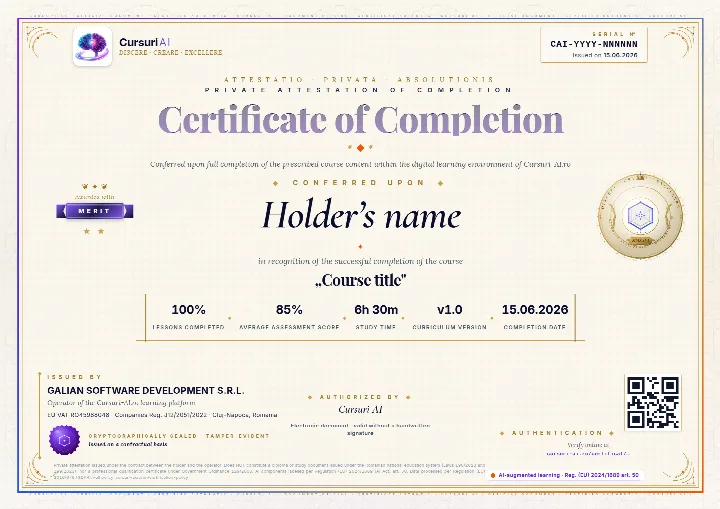
The Certificate of Completion for “Recommender Systems with AI: From Collaborative Filtering to Deep Learning”: a private attestation with a unique number and a QR code. A recruiter confirms it is authentic on the public verification page, with no account and no cost.
The real document, an A4 PDF, shown here with sample data. Yours carries your name, the course “Recommender Systems with AI: From Collaborative Filtering to Deep Learning”, the serial number, the issue date and the tier you earned; the QR code in the image is decorative.
Anyone can verify it
Public verification page, QR code and cryptographic fingerprint, with no account for the person checking.
You show it where it counts
Add it to your CV and LinkedIn profile; a recruiter confirms authenticity with one click.
It says exactly what it attests
The course, the tier you earned (Pass, Merit or Distinction), the serial number and the issue date, plus the percentage of lessons completed.
A private attestation of course completion. It is NOT a diploma or a state-recognised qualification under Romanian Laws 198/2023, 199/2023 or Government Ordinance 129/2000; employers may take it into account at their own discretion. Certification policy.
Pricing
Just this course, or more with this one included
A subscription by number of courses: 1, 3, 5, 10, 15 or 25 courses a month, or the full catalog. You pick them and can change them at every renewal; your progress and certificates stay. Billed monthly or yearly (12 months for the price of 10), in EUR. You can stop the renewal anytime from your account, and access starts right after payment. Prices are totals, with VAT included at the rate of your country.
How many courses a month?
This course goes first on your list; you pick the others in your account and can change them at every renewal.
Total prices, VAT included. Move up anytime and pay only the difference for the days left; move down at renewal. Renews automatically, you stop it anytime from your account; your progress and certificates stay. Digital content with immediate access: see the withdrawal terms.
About the course, the price, the AI Professor and the certificate.
What will I learn in “Recommender Systems with AI: From Collaborative Filtering to Deep Learning”?
A premium, complete and hands-on course on modern recommender systems, updated for 2026. You will start from why recommendation is one of the highest-leverage applications of machine learning, then build up every major family of models with real Python code. You will master content-based filtering with TF-IDF and embeddings, memory-based collaborative filtering (user-based and item-based neighborhoods), and matrix factorization with SVD, ALS and Bayesian Personalized Ranking using the implicit and LightFM libraries. You will learn the crucial difference between explicit and implicit feedback and why it changes both your model and your loss. From there you will build deep learning recommenders — neural collaborative filtering, embeddings, and the two-tower retrieval architecture — and sequential and session-based models with self-attention (SASRec, BERT4Rec). You will design the two-stage candidate-generation-plus-ranking architecture that powers recommendation at scale, serve it with approximate nearest neighbor search, and solve the cold-start problem. You will evaluate systems correctly with precision@k, recall@k, MAP and NDCG, understand why offline and online metrics diverge, and run trustworthy A/B tests. The final modules cover how large language models reshape recommendation in 2026, how to build for diversity, serendipity and fairness, and how to stay compliant with the GDPR when you profile user behavior. Includes a comprehensive final assessment. This deepened edition adds factorization machines, graph neural networks (LightGCN, PinSage), multi-armed and contextual bandits with off-policy evaluation, and a dedicated lesson on the EU Digital Services Act's recommender transparency duties - around 30 in-depth lessons of university-level, practice-first material.
The course has 11 modules and 30 lessons, with 355 quiz questions. The full curriculum, module by module, is shown on the course page.
Do I need prior experience for this course?
Yes. The course is Advanced level and assumes hands-on experience with AI in its field.
How long does the course take?
The estimated duration is about 25 hours, across 30 lessons. You learn at your own pace, and your progress is saved automatically at every lesson, so you can pick up where you left off.
How much does it cost, and which plan do I need?
This course alone: the 1 course plan, €99 per month. The course fits into every plan of the subscription, next to other courses you choose: for example 3 courses for €199, 10 courses for €319 (recommended) or the full catalog for €499 per month.
You pick your courses after paying and can change them at every renewal; starting from here, this one is already picked. Plans are billed in EUR, monthly or yearly (pay for 10 months, get 12). Every price is a total, with VAT included at the rate of your country. See all plans.
Can I read part of the course before paying?
Yes. You can read a free preview of lesson 1, “Why Recommender Systems Matter in 2026”, without an account. The preview shows you how the lesson is written; the rest of the lesson and the other lessons open after payment.
How does the AI Professor help me in this course?
The AI Professor is built into every lesson and starts from the lesson you have open: it explains the passages you select, gives you examples, summarizes the lesson, tests you with a quiz and prepares review flashcards. You can type or talk to it, in English.
It is included in every plan of your subscription, with a fair-use limit. It is an AI system, not a human teacher, and its answers may contain errors; details in the Terms.
Do I get a certificate when I finish the course?
When you meet the completion thresholds shown on the platform (lessons completed and the minimum quiz score), you can issue your Certificate of Completion for “Recommender Systems with AI: From Collaborative Filtering to Deep Learning” from your account, with a unique number, publicly verifiable on the site.
It is a private attestation of course completion, issued by GALIAN SOFTWARE DEVELOPMENT SRL. It is NOT a diploma or a state-recognised qualification under Romanian Laws 198/2023, 199/2023 or Government Ordinance 129/2000; employers may take it into account at their own discretion. Details in the Certification policy.
Does the subscription renew automatically? How do I stop it?
Yes. The subscription renews automatically at the end of each monthly billing period. You can see the next renewal date in your account at any time.
You can stop the renewal at any time, from your account or by email, with no other formality. Access stays active until the end of the period already paid for, and no pro-rata refund is made for a period already started, except in the cases provided by law. Your progress stays saved in your account. Details in the Terms & Conditions, section 5.5.
Can my company buy this course for a team?
Yes. With the team library, the company admin picks 3, 5, 10, 15 or 25 courses a month, or the full catalog, for the whole team, from €49 per member per month, excl. VAT, for 5 members or more. A dashboard shows each member’s progress and manages seats centrally. Price it for your team.
From the same track
Similar courses
You can pick them together with this one in a 3, 5 or 10-course subscription (3 courses for €199 a month), and the full catalog includes them all. A single course is €99 a month.
Master fine-tuning of open-source LLMs: LoRA, QLoRA, datasets, DPO, quantization (GGUF/GPTQ/AWQ) and self-hosting with Ollama and vLLM. Advanced course, 2026.
“Recommender Systems with AI: From Collaborative Filtering to Deep Learning”: 30 lessons and about 25 hours of content, with your progress saved at every lesson.
Instant access after payment, on computer, tablet or phone.
AI Professor in every lesson, included in your subscription.
Certificate of Completion, publicly verifiable.
1-course subscription
€99/month
VAT included · stop the renewal anytime from your account
ChatGPT, OpenAI, Claude, Anthropic, Gemini, Google, Microsoft 365 Copilot, Cursor, Midjourney and the other product and company names mentioned are trademarks or trade names of their respective owners. Cursuri-AI.ro is an independent training provider and is not affiliated with, sponsored by or endorsed by any of them.