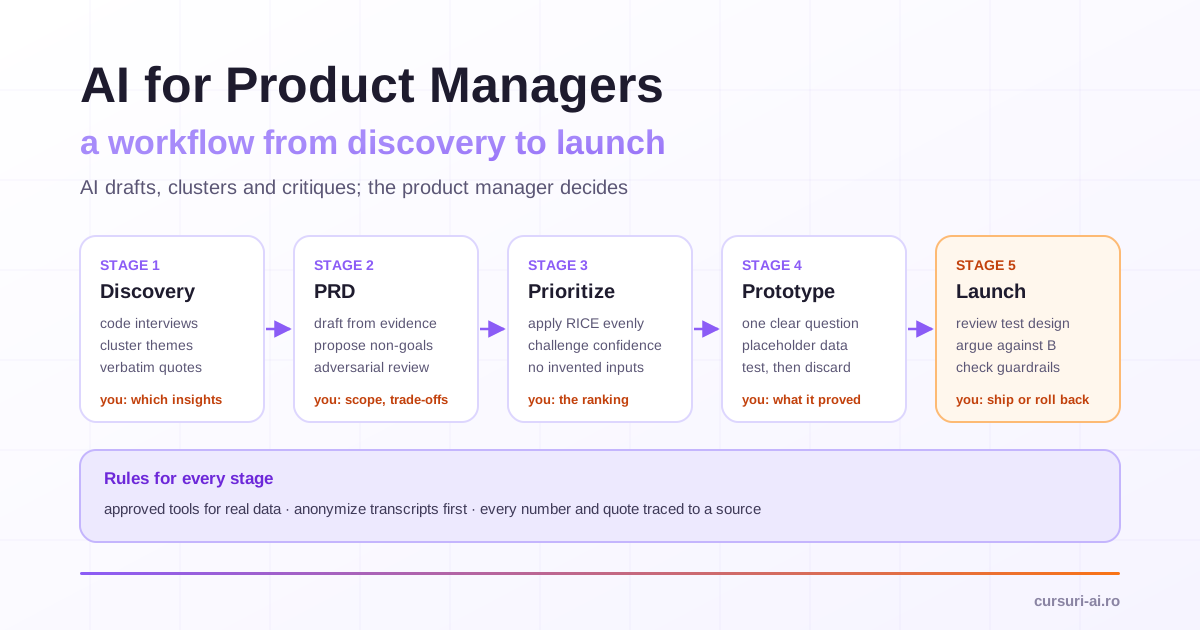
AI for product managers is most useful when it is treated as a workflow, not a chatbot you open when you are stuck. Used well, it compresses the slow, mechanical parts of the job (coding interview notes, drafting a first PRD, structuring a prioritization debate, building a throwaway prototype, writing up an experiment) so you can spend more time on the part nobody can automate: deciding what to build and why. This guide walks through that workflow from discovery to launch, with the prompts, checks and boundaries that keep the output trustworthy.
Where AI fits in product management, and where it does not
A product manager's work is a chain of artifacts and decisions: research notes become insights, insights become a problem statement, the problem statement becomes a PRD, the PRD competes for a slot on the roadmap, a prototype tests the riskiest assumption, and an experiment tells you whether the launch worked. AI is good at the artifacts. It drafts, summarizes, clusters, reformats and critiques quickly. It is not accountable for the decisions, and it does not know your customers, your strategy or the conversation your CEO had last Tuesday unless you tell it.
That leads to one working rule for the whole lifecycle: AI proposes, the product manager decides, and every factual claim is checked against a source before it reaches a stakeholder.
It also helps to distinguish two kinds of tools:
- Grounded tools answer from a specific body of data you control: an analytics assistant querying your event data, an AI feature inside your wiki or issue tracker answering from your own pages and tickets. Their typical failure is a misread query or a misinterpreted metric, so you verify the interpretation.
- General assistants such as Claude, ChatGPT or Gemini reason and write well but know nothing about your product except what you paste in. Asked a factual question about your business without data, they guess. You verify the facts themselves.
Route factual questions about your product to grounded tools, or paste the real data in. Use general assistants for synthesis, drafting and critique. The complete lifecycle, with templates for each artifact and workflows for common delivery and analytics tools, is covered in AI for Project and Product Management; the sections below give you the core of it.
Before you start: the data rules for product work
Product work is full of personal data. Interview transcripts, survey answers, support tickets and session notes are about identifiable people, and in the EU that brings the General Data Protection Regulation (GDPR) into play. Four points from the regulation map directly onto everyday AI use:
- Anonymize before synthesis. Recital 26 of the GDPR says the principles of data protection do not apply to anonymous information. It also says that pseudonymised data, which can be re-attributed with additional information, still counts as information about an identifiable person. Replacing a name with "Participant 7" while leaving the job title, employer and city in the transcript is not anonymization.
- Send only what the task needs. Article 5(1)(c) requires personal data to be "adequate, relevant and limited to what is necessary" for the purpose: data minimisation. The themes in fifty interviews rarely require anyone's email address.
- New tools for sensitive data may need an impact assessment. Article 35 requires a data protection impact assessment before processing that is likely to result in a high risk to people's rights, "in particular using new technologies". Rolling out a new AI tool for research data is a conversation to have with your data protection officer first.
- Keep decisions about people human. Article 22 gives individuals the right not to be subject to a decision based solely on automated processing that significantly affects them. Using AI to sort feedback is fine; letting it decide which customers lose a feature or get flagged is a different matter.
The practical default: use the AI tools your organization has approved and governed for anything that touches real customer or product data, anonymize transcripts before they reach any model, and keep consumer chatbots for public or generic material. This article is general information, not legal advice; your privacy team owns the specifics for your organization.
Stage 1: Discovery and research synthesis
Synthesis is where AI saves the most time and where it can do the most damage, because a confident summary looks like evidence. Work up the synthesis ladder in explicit steps instead of asking for "the key insights" in one go.
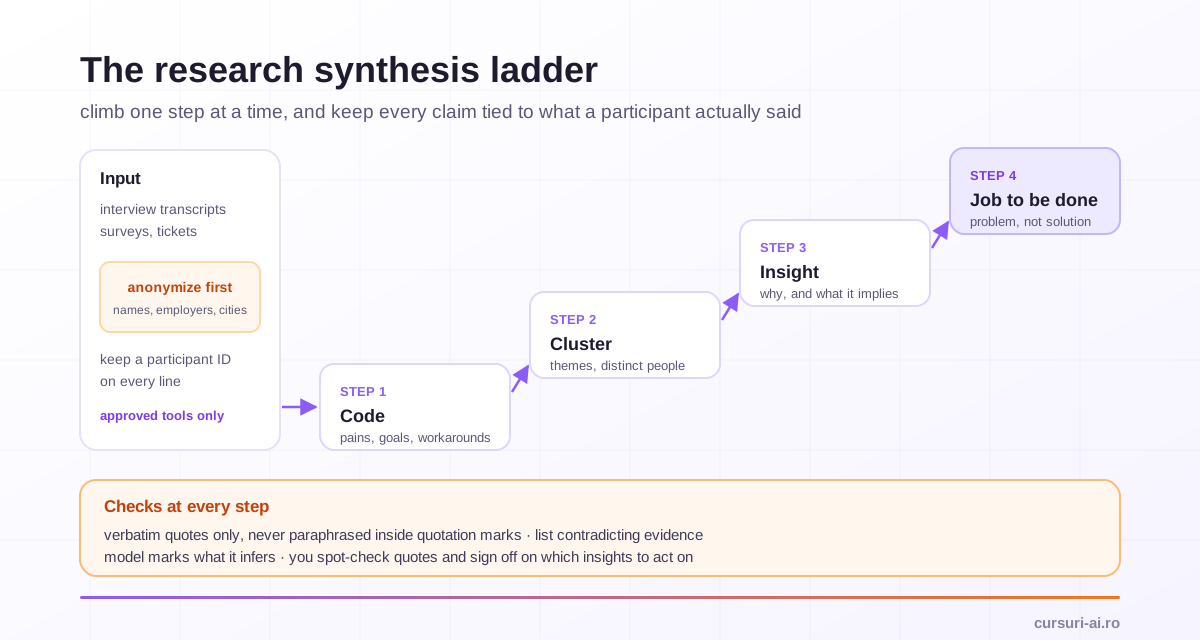
Step 1: code the material. Give the model anonymized transcripts and ask it to tag each passage with codes (pain point, workaround, goal, emotion, feature request), keeping the participant ID on every snippet.
Step 2: cluster into themes. Ask for themes built from the coded snippets, with the number of distinct participants behind each one. Counting participants rather than mentions stops one talkative customer from becoming a trend.
Step 3: turn themes into insights. A theme is "people struggle with exports". An insight explains why and what it implies: "Finance users export because our reports cannot be filtered by cost center, so they rebuild the view in a spreadsheet every month."
Step 4: frame jobs to be done. Rewrite the strongest insights as the job the customer is trying to get done, which keeps the problem separate from any particular solution.
A synthesis prompt that builds the safeguards in:
You are helping a product manager synthesize customer interviews.
Input: 14 anonymized transcripts, each line prefixed with a participant ID.

1. Extract verbatim quotes relevant to how participants prepare monthly reports.
   Use only exact text from the transcripts. Never paraphrase inside quotation marks.
2. Group the quotes into themes. For each theme, list the participant IDs
   and the number of distinct participants.
3. For each theme, list any quotes that contradict or complicate it.
4. Mark anything you are inferring rather than reading directly from the text.
   If the transcripts do not support a claim, say so.
Each instruction maps to a known way of reducing hallucinations. Anthropic's guidance on reducing hallucinations recommends giving the model permission to say it does not know, extracting word-for-word quotes before analyzing long documents, and having it back every claim with a supporting quote, retracting any claim it cannot support. The same guidance is explicit that these techniques reduce hallucinations without eliminating them, so spot-check a sample of quotes against the transcripts yourself before you present anything.
The final step is human: you decide which insights are strong enough to act on. Disconfirming evidence, small samples and the participants you did not reach are exactly what a model will not weigh for you.
Stage 2: PRDs and specs
A PRD exists to align people on a problem, a goal and the boundaries of a solution. AI is very good at producing PRD-shaped text, which is the danger: a fluent document that nobody needed to think hard about. Use it to speed up the thinking, not to skip it.
Start from evidence, not a blank page. Paste the insights from Stage 1 and your problem statement, and ask for a draft in your team's template. A model that drafts from evidence writes a narrower, more honest PRD than one asked to "write a PRD for a reporting feature".
Force explicit non-goals. Ask the model to propose what the feature will not do, then argue with the list. Non-goals prevent more scope creep than any requirement does.
Describe the what, not the how. Ask for requirements written as user-facing outcomes and acceptance-shaped statements, and leave implementation choices to engineering.
Run an adversarial review. This is the single most valuable PRD prompt:
Act as a skeptical staff engineer and a skeptical designer reviewing this PRD.
List the ambiguities, unstated assumptions, missing edge cases, missing
non-functional requirements (performance, accessibility, security, privacy)
and any requirement that cannot be tested. Do not rewrite the PRD.
Rank the issues by how likely they are to cause rework.
End with open questions and success metrics. A good PRD says how you will know it worked: the primary metric, the guardrail metrics that must not get worse, and the decision you will make at each outcome.
What the model cannot supply is the hidden context: the commitment made to a key account, the platform migration that makes one approach expensive, the reason the last attempt failed. Add that yourself, and send the PRD under your name only when you can defend every line of it.
Stage 3: Prioritization support
Frameworks exist to make trade-offs explicit, and AI helps by applying a framework consistently and pointing out where you are scoring on enthusiasm instead of evidence. It should never invent the inputs.
Take RICE, introduced by Sean McBride at Intercom in the article RICE: Simple prioritization for product managers. Each candidate gets four estimates:
| Factor | Question | Scale in the original method |
|---|---|---|
| Reach | How many people will this affect in a given period? | People or events per time period, ideally from product metrics |
| Impact | How much will it affect each person? | 3 massive, 2 high, 1 medium, 0.5 low, 0.25 minimal |
| Confidence | How sure are you of the estimates? | 100% high, 80% medium, 50% low |
| Effort | How much work will it take? | Person-months across product, design and engineering |
Reach, Impact and Confidence are multiplied and divided by Effort, giving what the original article calls "total impact per time worked".
A prompt that keeps AI in its lane:
Here are 8 candidate features, with the evidence we have for each.
Help me reason through RICE for each one.
- Reach: use only the numbers I provide. Do not estimate user counts.
- Impact: propose a value on the 3 / 2 / 1 / 0.5 / 0.25 scale and justify it from the evidence.
- Confidence: propose a level and state what evidence would raise or lower it.
- Effort: do not estimate. Mark it "needs engineering input".
Flag every factor where the evidence is too thin to score honestly.
The most useful output is usually the confidence check. A favorite feature tends to get high confidence on the same evidence as a feature you are lukewarm about; asking the model "is my stated confidence justified by the evidence I gave you?" surfaces that bias quickly, because the model has no stake in your favorite idea. The same approach works for MoSCoW (ask the model to challenge every "Must") and for Kano-style questions about which features are expected versus delightful.
Two cautions. First, a precise score built on guesses is still a guess; do not let a spreadsheet full of decimals end a strategic debate. Second, sequencing, dependencies, commitments and strategy sit outside any formula. The framework informs the decision; the product manager makes it and explains it.
Stage 4: Prototyping with AI
AI prototyping tools let a product manager turn a description into a clickable prototype in an afternoon. That changes how quickly you can test an idea, as long as you use prototypes for what they are good at.
- Start with the question. "Will finance users understand a cost-center filter without training?" is a question a prototype can answer. "Build the reporting feature" is not.
- Pick the lowest fidelity that answers it. A static mock is enough for comprehension; a clickable flow is needed for navigation; realistic placeholder data is needed for anything involving judgment.
- Test with real people. A handful of sessions with target users teaches more than any number of internal opinions about the demo.
- Capture the learning and throw the prototype away. The output of a prototype is evidence, not code.
The guardrails are strict, because prototypes concentrate risk:
- Never connect a prototype to real customer data, production systems or credentials. Use realistic placeholder data.
- Label what is real and what is mocked, so stakeholders do not commit to capabilities that do not exist.
- Do not ship it. Generated prototype code has had no security, accessibility, performance or privacy work. Engineering owns production, and the prototype informs their build rather than replacing it.
Stage 5: Launch and experiment analysis
Launches end in a question: did it work? AI can help you design an experiment that can answer that, and then read the results without fooling yourself.
Before launch, use AI as a design reviewer. Give it your hypothesis, primary metric and guardrail metrics, and ask what could make the result uninterpretable: an underpowered test, a primary metric chosen after the fact, a novelty effect, a population mismatch between test and rollout. Decide the primary metric, the minimum effect worth detecting, and the sample size and duration before the test starts. Your analytics or data team should own the power calculation.
After launch, the traps are well known, and AI makes some of them easier to fall into:
- Statistical versus practical significance. A statistically significant lift can be too small to matter, and a real effect can fail to reach significance in an underpowered test.
- Multiple comparisons. Test enough metrics or segments and something will look significant by chance. Asking a model to "find what was significant" is a reliable way to find false positives.
- Correlation presented as causation, especially in analytics summaries outside the experiment.
- The model declaring a winner. A summary that says "variant B won" may be ignoring a guardrail metric that dropped or a segment where B lost.
Use AI as a devil's advocate, not a judge:
Here are the experiment results, the pre-registered primary metric
and the guardrail metrics. Give me the strongest reasons NOT to conclude
that variant B is better. Check: was the sample size reached, did any
guardrail metric move, could this be a novelty effect, and which
segments behave differently? Do not recommend a decision.
When you use an analytics assistant that queries your event data directly, check the query definition behind every chart it produces: the event, the filter, the time window and the user definition. A correct number for the wrong question is the most common failure of grounded tools.
The ship or roll-back decision belongs to a person who can be held accountable for it, informed by the experiment and by everything the experiment did not measure.
Stakeholder communication: drafts, not dispatches
Status updates, release notes, executive summaries and meeting follow-ups are where most product managers first feel the time savings. A useful pattern: write the substance yourself in rough bullet points, then ask the model to reshape it for a specific audience ("a two-paragraph update for the executive team: decision needed first, then risks, then progress"). Verify every number, date and name against the source before sending, and never let a model send anything on your behalf. Executives judge product managers on the accuracy of what they report, and a fabricated figure in an update costs more trust than the time it saved. The leadership side of this, including how to set expectations for AI use across functions, is covered in AI for Business Leaders: A Practical Playbook for 2026.
Where human judgment stays
The boundary is easiest to hold when it is written down. A version that works for most product teams:
| Stage | AI does | The product manager decides |
|---|---|---|
| Discovery | Codes notes, clusters themes, finds quotes and contradictions | Which insights are real, which customers were missing, what to investigate next |
| PRD | Drafts from evidence, proposes non-goals, runs adversarial reviews | The problem worth solving, the scope, the trade-offs, the success metric |
| Prioritization | Applies frameworks consistently, challenges confidence scores | The ranking, the sequencing and the strategic bets |
| Prototyping | Builds throwaway prototypes from a clear question | What the test proved and what to build next |
| Experiments | Reviews designs, lists reasons a result may be wrong | Whether to ship, iterate or roll back |
| Communication | Reshapes drafts for each audience | What is true, what is promised and what gets sent |
If your product ships AI features
Product managers increasingly own features that are themselves AI: assistants, chat interfaces, generated content. If you place such a product on the EU market, Article 50 of the EU AI Act sets transparency obligations. Under Article 50(1), providers must ensure that AI systems intended to interact directly with people are designed so those people are informed they are interacting with an AI system, unless that is obvious from the context. Article 113 sets 2 August 2026 as the regulation's general date of application, and Article 50 is not among the provisions it schedules earlier or later, including in the consolidated text published after the 2026 amendments. Treat disclosure as a product requirement from the first PRD rather than a legal review at the end, and bring in legal counsel early when your feature might fall into a regulated category.
Building the habit across a product team
Individual productivity gains stay small until a team shares its practices. Three habits make the difference:
- A shared prompt library. Store the prompts that work (synthesis, PRD review, RICE reasoning, experiment critique) in the team wiki, each with a note on when to use it and what data it may touch. A good prompt has four parts: a role, a task, the real input and explicit constraints on format and uncertainty. The underlying techniques are explained in Prompt Engineering in 2026: From Beginner to Pro.
- A written verification standard. For example: every number traces to a source, every quote is verbatim and spot-checked, every AI-assisted artifact names its human owner.
- Explicit permission to say no. Not every task benefits from AI, and the people closest to the work are the best judges of where it helps.
Rolling this out is a change-management problem as much as a tooling problem: people need to see that AI makes their judgment more valuable, not less. The leadership side is covered in Manager in the AI Era: Leading Your Team Through the AI Transformation, and the personal workflows that make individual product managers faster, from email triage to meeting notes, in The AI Productivity Masterclass for Knowledge Workers.
Sources
- Regulation (EU) 2016/679 (General Data Protection Regulation), EUR-Lex: Recital 26, Articles 5, 22 and 35.
- Regulation (EU) 2024/1689 (Artificial Intelligence Act), EUR-Lex: Articles 50 and 113.
- AI Act Service Desk, Article 113: Entry into force and application, European Commission: consolidated text including the 2026 amendments.
- Intercom, RICE: Simple prioritization for product managers (linked above).
- Anthropic, Reduce hallucinations (linked above).
Frequently Asked Questions (FAQ)
How can product managers use AI day to day? The highest-value uses are research synthesis (coding interview notes, clustering themes, extracting verbatim quotes), drafting and stress-testing PRDs, applying prioritization frameworks consistently, building throwaway prototypes to test assumptions, reviewing experiment designs and drafting stakeholder updates. In every case AI produces a draft or an analysis, and the product manager verifies it and makes the decision.
Can AI write a PRD for me? It can write a first draft quickly, especially from real research insights and your team's template, and it is very good at reviewing a PRD for ambiguities, missing edge cases and untestable requirements. It cannot supply the hidden context, the strategy or the trade-offs, so the final document has to be yours and defensible line by line.
Is it safe to put customer interview transcripts into an AI tool? Only into tools your organization has approved for that data, and preferably after anonymizing them. Under the GDPR, pseudonymised data still counts as personal data, and data minimisation means sending only what the task needs. New tools for sensitive research data may require a data protection impact assessment, so involve your privacy team. This is general information, not legal advice.
Should AI decide feature priorities? No. AI can apply RICE, MoSCoW or Kano consistently and challenge confidence scores that are not backed by evidence, but it should never invent reach numbers or effort estimates, and it cannot weigh strategy, dependencies or commitments. Use it to make the debate more honest; the ranking stays a human decision.
Can AI analyze A/B test results? It can help you design a valid experiment and act as a devil's advocate on the results, listing reasons a lift might not be real, such as insufficient sample size, a guardrail metric that moved, a novelty effect or multiple comparisons. The decision to ship, iterate or roll back should stay with an accountable person, supported by your data team.
Conclusion
AI for product managers works best as a disciplined workflow. In discovery, it codes and clusters research, as long as every theme traces back to verbatim quotes from anonymized material. In PRDs, it drafts from evidence and, more valuably, attacks your draft before engineers do. In prioritization, it applies frameworks consistently and exposes optimistic confidence scores without inventing the numbers. In prototyping, it lets you test an idea in an afternoon with placeholder data and a clear question. At launch, it reviews experiment designs and argues against premature conclusions. Across all of it, the rules stay the same: governed tools for real data, verification before anything reaches a stakeholder, and decisions that remain with the product manager who owns them.

The course that continues this article
AI for Project and Product Management
You have read the theory. In the course you put it into practice: written lessons structured in modules, with examples and exercises, quizzes, the AI Professor in every lesson and progress saved automatically. Once you complete the lessons and reach the minimum quiz score, you get the Certificate of Completion, a private attestation.
From the course syllabus
- Module 0 — AI in Project and Product Management: The 2026 Landscape
- Module 1 — Discovery and Customer Research with AI
- Module 2 — PRDs, Specs and Product Documentation with AI
- Module 3 — Prioritization and Roadmapping with AI
+ 7 more modules in the full syllabus
€99 per month for this course, VAT included · or pick it in a subscription of 3, 5 or 10 courses, from €199 per month, together with other Business courses; you can change them at every renewal (see what you learn across the whole track).
Monthly subscription with automatic renewal · stop the renewal anytime from your account · digital content with immediate access, see the withdrawal conditions. The certificate confirms that you completed the course and is private: it is not a diploma or a state-recognised qualification.