Most AI rollouts stall in the same place: the licences are bought, the kickoff deck is presented, and three months later a handful of enthusiasts use the tools daily while everyone else has quietly gone back to the old way, or is using their own tools without telling anyone. The technology works. What failed was the change. This guide is about AI change management at team level: why people resist AI, how to apply proven change models to AI adoption, how to run pilots and grow internal champions, which team rules to set, what to say (and not promise) about jobs, and a 90-day plan a manager can actually run.
Why AI adoption fails at team level
Executives decide to adopt AI; teams decide whether it actually happens. The decision is made in hundreds of small moments: whether someone tries the tool on a real task, whether the first result is good enough to try again, whether their manager notices, whether a colleague laughs at a mistake. Three patterns explain most stalled rollouts:
- Tools without a reason. People are told to "use AI" without being shown which of their tasks it helps with. They try it on something it does badly, conclude it is overhyped and stop.
- Fear nobody addressed. Behind polite agreement sit unspoken questions: will this replace me, will I look incompetent, is my work being watched?
- Usage that already happened in the shadows. Many employees adopted AI before their employer did. Microsoft and LinkedIn's 2024 Work Trend Index found that 78 percent of AI users were bringing their own AI tools to work. When the official rollout arrives with rules but no better tools, it competes with habits people already have.
None of these is solved by a better licence. They are solved by managing the change, deliberately, at the level where work happens.
The real fears behind resistance
Resistance to AI is rarely irrational. It is usually one of four specific fears, and each needs a different response:
| Fear | What it sounds like | What helps |
|---|---|---|
| Job loss | "If AI does this, what am I for?" | Honest information on what changes in roles, and no promises you cannot keep |
| Loss of competence | "I'm good at my job; with AI I'm a beginner again" | Safe practice time, small wins, visible support from the manager |
| Surveillance | "Will they use this to monitor me?" | Clear statements on what is and is not tracked, checked with HR and legal |
| Responsibility | "If the AI gets it wrong, it's my name on it" | Clear rules on verification and who signs off, and a culture that rewards catching errors |
The mistake is to treat all resistance as a motivation problem. A senior specialist worried about accountability for AI errors does not need a pep talk; they need a review rule. A junior colleague worried about their job needs straight answers about how roles will change.
ADKAR applied to AI adoption
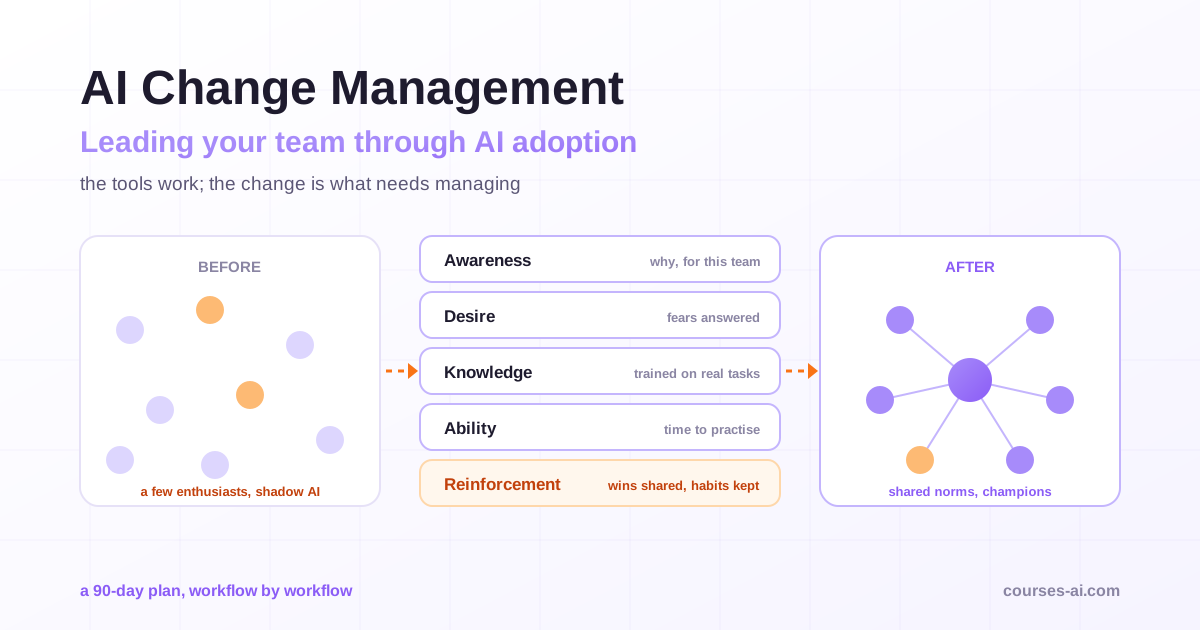
The Prosci ADKAR model describes individual change as five building blocks: Awareness of why the change is needed, Desire to take part, Knowledge of how to change, Ability to perform the new way in practice, and Reinforcement to sustain it. Prosci's own guidance stresses that people get stuck at barrier points, and that working on a later block does not help when an earlier one is missing: sending someone to training (Knowledge) when they see no reason to change (Awareness) or do not want to (Desire) wastes the training.
The model fits AI adoption closely, because most rollouts jump straight to Knowledge (a tool training) and skip the rest.
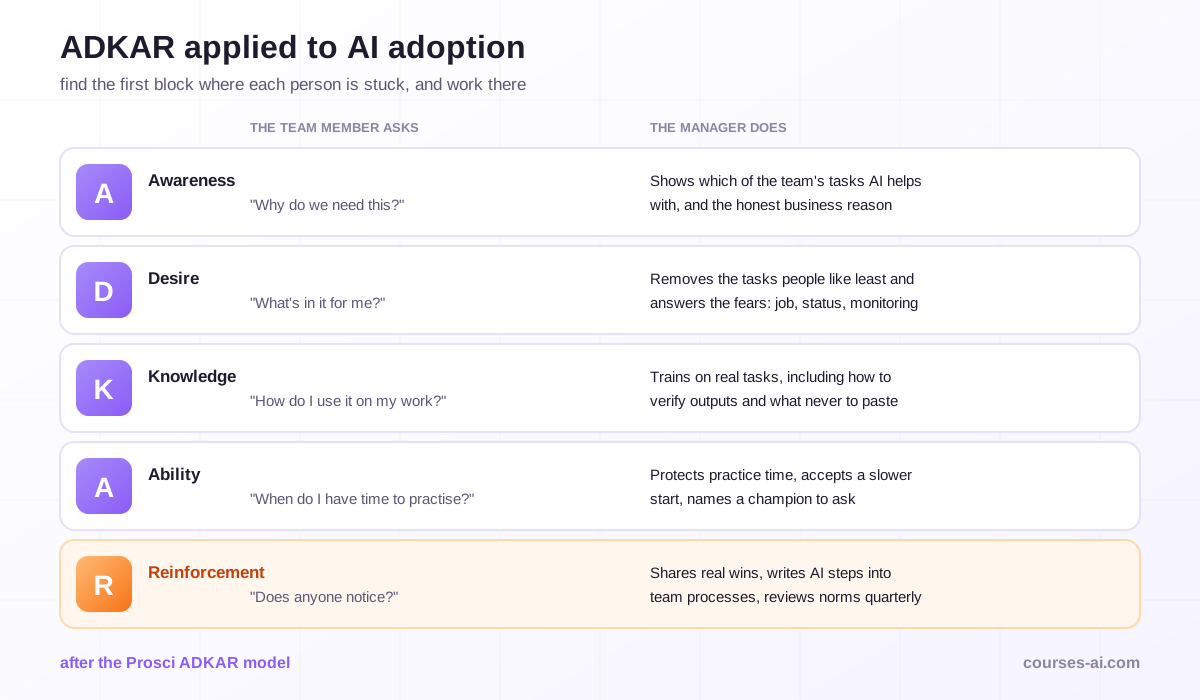
Applying ADKAR to AI in practice, with exercises for diagnosing where each team member is stuck, is the core of our Manager in the AI Era: Leading Your Team Through the AI Transformation course, which also covers resistance conversations, champions and team norms.
Awareness: show the why, for this team
Generic statements ("AI is transforming every industry") do not create awareness. Specifics do: which tasks in this team take the most time, which ones AI handles well today, what changes in your market or your clients' expectations. Explain the business reason honestly, including when it is about cost.
Desire: answer "what's in it for me?"
Desire comes from personal benefit and from removing threats. Show how AI takes away the parts of the job people like least (first drafts, summaries, formatting, searching), and address the four fears directly. Desire cannot be ordered, but it can be killed quickly by a manager who uses AI adoption numbers to judge individuals.
Knowledge: teach on real tasks
Train on the team's own work, not on generic demos. A finance team learns faster from "reconcile this month's report with AI and check it" than from a tour of features. Cover how to verify outputs and what data must never be pasted into a tool, not only how to prompt. A structured, tool-agnostic foundation such as The AI Productivity Masterclass for Knowledge Workers saves each manager from improvising the curriculum.
Ability: make room to practise
Knowing is not doing. People need protected time to use AI on real work, permission to be slower for a few weeks, and someone to ask when they get stuck. This is where most rollouts quietly fail: the training happened, but the workload never made room for practice.
Reinforcement: make the new way stick
Reinforcement means noticing and sharing real uses (for example, a short note in the team channel naming who saved time on which task, with the prompt they used), building AI steps into team templates and processes, and revisiting the rules as tools change. Without it, usage decays back to the enthusiasts within weeks.
Kotter's eight steps at team scale
Where ADKAR describes the individual, Kotter's 8-step process describes the organisation: create urgency, build a guiding coalition, form a vision, communicate it, remove barriers, generate short-term wins, sustain acceleration and anchor the change in culture. A manager can run a scaled-down version for a team of eight:
- Urgency is a concrete problem the team feels, not a trend slide.
- The coalition is two or three respected colleagues, not only the youngest or most technical ones.
- The vision fits in one sentence: what the team's work looks like in six months.
- Barriers are often mundane: no licence, a blocked tool, unclear data rules, no time.
- Short-term wins are real tasks done faster or better, shown by the people who did them.
- Anchoring means AI steps written into how the team works, so they survive the next reorganisation.
Pilots and internal champions
Start small and learn fast. A good AI pilot has:
- One workflow, chosen because it is frequent, time-consuming and low-risk if an output needs correcting.
- A baseline measured before the pilot: how long it takes and how good the result is today.
- A small group of volunteers that includes at least one sceptic, whose objections improve the rules.
- A fixed duration, typically four to six weeks, with a decision at the end: scale, change or stop.
- A written result: time saved, quality observed, problems found and the prompts or steps that worked.
Champions are the multipliers. They are not necessarily the most technical people; they are the ones colleagues already ask for help. Give them time (an hour or two a week is a real commitment, not a favour), early access to tools, a direct line to the manager and recognition. Their job is to answer questions, collect good uses and report what is not working, not to police others.
Team norms: replace shadow AI with clear rules
Shadow AI (unapproved tools used on work data) is a symptom of a gap between what people need and what the organisation provides. Banning it without offering an alternative only drives it further out of sight. A short set of team norms works better than a long policy nobody reads:
- Which tools are approved, for which kinds of data.
- What never goes into a tool: personal data of clients or colleagues, confidential contracts, credentials, anything under a non-disclosure agreement, unless the approved tool is cleared for it.
- How outputs are checked: who verifies, against what, before anything leaves the team.
- When to disclose AI use, to clients or within the team.
- Where to share prompts and lessons, so good practices spread.
Keep the norms to one page and revisit them every quarter. The legal side of data handling, including GDPR and the EU AI Act for professionals, is covered in AI Data Privacy and EU AI Act Compliance.
Honest communication about jobs
Nothing destroys trust faster than a reassurance that turns out to be false. Managers are often pressed to say "no one will lose their job because of AI" without the authority to guarantee it. Better rules for the conversation:
- Say what you know, what you don't know and when you will know more.
- Talk about tasks, not jobs. Most roles change by losing some tasks and gaining others; be specific about which.
- Do not promise what is above your level. Escalate the question instead and come back with an answer.
- Invest visibly in people's skills, which is the most credible signal that you plan to keep them.
Measuring adoption without toxic pressure
What you measure shapes behaviour. Counting prompts per person encourages theatre and punishes careful users. Measure at team and workflow level instead:
- time and quality on the piloted workflows, compared with the baseline
- the share of team members who used AI on a real task in the last two weeks
- the number of documented, reusable uses (prompts, templates, checklists)
- errors caught in review, treated as a sign that verification works, not as failures
- team sentiment in short, anonymous pulse questions
Never use AI usage data to rank or evaluate individuals without a clear legal basis and transparency; in many countries, employee monitoring is restricted by data protection and labour law, and works councils or employee representatives may have a say. Involve HR and legal before you track anything at individual level.
The AI literacy obligation in the EU AI Act
Since 2 February 2025, Article 4 of the EU AI Act has required organisations that provide or deploy AI systems to take measures on AI literacy for their staff. The original text asked them to ensure, to their best extent, a sufficient level of AI literacy. Regulation (EU) 2026/1744, the AI Omnibus, in force since 27 July 2026, amended Article 4 so that providers and deployers must take measures to support the development of AI literacy among their staff and others operating AI systems on their behalf, taking into account their knowledge, experience, education and the context of use.
For a manager, the practical consequence is the same with or without the legal duty: people who use AI at work need to understand what it does well, where it fails and how to use it responsibly, and it helps to keep a simple record of what training and guidance the team received. For the wider compliance picture, see our guide to EU AI Act compliance for businesses. This section is general information, not legal advice.
A 90-day AI adoption plan for managers
Days 1 to 30: diagnose and prepare
- Map the team's recurring tasks and mark where AI could help and where it should not be used.
- Have one-to-one conversations to hear the real fears; note who is already using AI and how.
- Agree the one-page team norms with HR, IT and legal input.
- Choose one pilot workflow, measure the baseline and recruit volunteers, including a sceptic.
Days 31 to 60: pilot and learn
- Train the pilot group on the real workflow, with verification and data rules included.
- Protect practice time and hold a short weekly check-in to collect problems and good prompts.
- Appoint one or two champions and give them time and recognition.
- Share early wins in the team meeting, presented by the people who achieved them.
Days 61 to 90: decide and scale
- Compare the pilot results with the baseline and decide to scale, change or stop.
- Extend to the rest of the team with the prompts, templates and lessons from the pilot.
- Write the AI steps into team processes and onboarding.
- Schedule a quarterly review of norms, tools and results.
If you need to justify the investment to leadership, our article on the ROI of AI upskilling covers how to build the business case, and the AI for business leaders playbook covers strategy at company level.
Common AI change management mistakes
- Launching tools before purpose. "Here is your licence" is not a change plan.
- Training once and calling it done. Knowledge without practice time and reinforcement fades.
- Only recruiting enthusiasts. A pilot without sceptics produces rules that fail on contact with the rest of the team.
- Ranking people by usage. It produces fake usage and destroys trust.
- Banning shadow AI without an alternative. It hides the problem instead of solving it.
- Promising no job changes. Honest uncertainty is better than a reassurance you cannot keep.
Frequently Asked Questions (FAQ)
What is AI change management? AI change management is the structured approach to helping people and teams adopt AI tools in their daily work: explaining why, addressing fears, training on real tasks, making time for practice, setting shared rules and reinforcing new habits until they stick. It focuses on people and processes rather than on the technology itself.
Why do employees resist AI? Most resistance comes from four specific fears: losing their job, losing their status as competent professionals, being monitored, and being held responsible for AI errors. Each needs a different answer, from honest information about roles to clear rules on verification and monitoring.
How do you apply the ADKAR model to AI adoption? Build awareness with specific reasons for this team, create desire by showing personal benefits and addressing fears, teach knowledge on real tasks, give people time to build ability through practice, and reinforce by sharing real uses and building AI steps into team processes. Find the first block where each person is stuck and work there.
What does the EU AI Act require on AI literacy? Article 4 has applied since 2 February 2025. As amended by Regulation (EU) 2026/1744, in force since 27 July 2026, it requires providers and deployers of AI systems to take measures to support the development of AI literacy among their staff, taking into account their background and the context in which the systems are used.
How long does AI adoption take in a team? A focused pilot on one workflow typically runs four to six weeks, and a team-wide rollout with norms, champions and reinforcement can be in place within about 90 days. Habits keep evolving after that, so plan a quarterly review rather than a fixed end date.
Conclusion
AI adoption is a people change with a technology component, not the other way round. Teams adopt AI when they understand why it matters for their own work, when their real fears are addressed honestly, when they learn on real tasks and get time to practise, and when good uses are noticed and built into how the team works. Use ADKAR to find where each person is stuck, run a small pilot with a sceptic in the room, grow champions, replace shadow AI with a one-page set of norms, measure workflows instead of people, and give the change 90 days of deliberate attention before judging it.
Sources
- The Prosci ADKAR Model, Prosci
- The 8-Step Process for Leading Change, Kotter
- 2024 Work Trend Index on the state of AI at work, Microsoft and LinkedIn, May 2024
- Article 4: AI literacy, AI Act Service Desk, European Commission
- Regulation (EU) 2026/1744 (AI Omnibus), EUR-Lex
Verified on 15 November 2026 against the cited sources. General information on management practice and EU law, not legal advice; check monitoring and data questions with your HR and legal teams.

The course that continues this article
Manager in the AI Era: Leading Your Team Through the AI Transformation
You have read the theory. In the course you put it into practice: written lessons structured in modules, with examples and exercises, quizzes, the AI Professor in every lesson and progress saved automatically. Once you complete the lessons and reach the minimum quiz score, you get the Certificate of Completion, a private attestation.
From the course syllabus
- The Manager's New Role in the AI Era: From Control to Orchestration
- The Psychology of Adoption: Why Teams Resist and How You Address Fears
- The ADKAR Framework (Prosci) Applied to AI Adoption
- The Kotter 8-Step Framework: Leading Change at the Team Level
+ 7 more modules in the full syllabus
€99 per month for this course, VAT included · or pick it in a subscription of 3, 5 or 10 courses, from €199 per month, together with other Business courses; you can change them at every renewal (see what you learn across the whole track).
Monthly subscription with automatic renewal · stop the renewal anytime from your account · digital content with immediate access, see the withdrawal conditions. The certificate confirms that you completed the course and is private: it is not a diploma or a state-recognised qualification.