How to start an AI consulting business comes down to three decisions most guides skip: what exactly you sell, where your scope ends, and which duties you take on the moment a client gives you access to their data. The tools are the easy part. This guide is for consultants, freelancers and domain experts adding AI to what they already know: the four services clients pay for, an offer ladder, pricing without guessing, a one-screen scope template you can copy, the EU ground rules, and the mistakes that end new AI consultancies early.
What clients actually buy from an AI consultant
Companies rarely buy "AI". They buy less uncertainty about where to use it, people who can use it safely, one process that works better, or rules everyone can follow. That gives four service lines:
| Service | The client's question | Typical deliverable | Who usually buys |
|---|---|---|---|
| Opportunity audit | "Where would AI actually help us, and where not?" | A ranked list of use cases, each with effort, risk, data involved and a measured baseline | Owner, COO, department head |
| AI literacy and team training | "How do we get our people using AI well and safely?" | Role-based sessions, a short usage guide, a record of what was delivered and to whom | HR, L&D, line managers |
| Workflow implementation | "Can you make this one process faster and keep it reliable?" | A working workflow (prompts, automation, documentation, test cases) handed over to a named owner | Process owner |
| Governance and usage policy | "What are we allowed to do, with which tools and which data?" | An approved-tools list, an acceptable use policy, data rules for AI use, an inventory of AI systems in use | Management, DPO, legal |
Notice what is missing: an abstract "AI strategy" deck, software resale, custom model training. The fastest route into the market is your existing domain: a former finance controller already understands month-end close, a former recruiter knows where screening goes wrong, and neither has to learn each client's business from scratch. Positioning, proposals, pricing and AI-assisted delivery for a one-person practice are covered module by module in AI for Consultants and Freelancers.
AI consulting versus AI freelancing
AI freelancing usually sells output (content, code, an automation) produced faster with AI. AI consulting sells decisions and change: what to do, in which order, with which safeguards. Many solo practices do both; know which one a project is, because it changes the price model, the acceptance criteria and the liability you carry.
How to become an AI consultant: pick a niche you can prove
A niche is not a label on your website; it is the answer to "who exactly do you help, with what?". A simple formula:
domain you know × one recurring workflow × one type of buyer
Illustrative examples, not case studies:
- AI-assisted month-end reporting for finance teams in mid-sized distribution companies.
- Safe AI use in recruitment agencies: drafting and admin support, with screening decisions kept with people.
- Proposal and tender drafting workflows for engineering consultancies.
Run each candidate through five tests:
- You have done the work yourself and can describe it step by step without mentioning AI.
- You can name 30 buyers, and reach some of them through people you know.
- The problem recurs weekly or monthly, so an improvement keeps paying off.
- The buyer has budget and authority, or knows who does.
- You understand the data: which parts of the workflow involve personal or confidential data.
A narrow niche feels limiting at first. Then it starts working: referrals need a sentence people can repeat, and "she fixes tender drafting for engineering firms" is repeatable in a way "AI consultant" is not.
Turn your service into a productized offer
Custom engagements are scoped, priced and designed from scratch every time. A productized service fixes the shape in advance, so the sales conversation becomes "which option?" rather than "what would you do?". Each offer needs a name that says the outcome, a fixed scope with explicit exclusions, a repeatable timeline, named deliverables, acceptance criteria, a price (or two or three tiers of the same offer) and a list of what the client must provide.
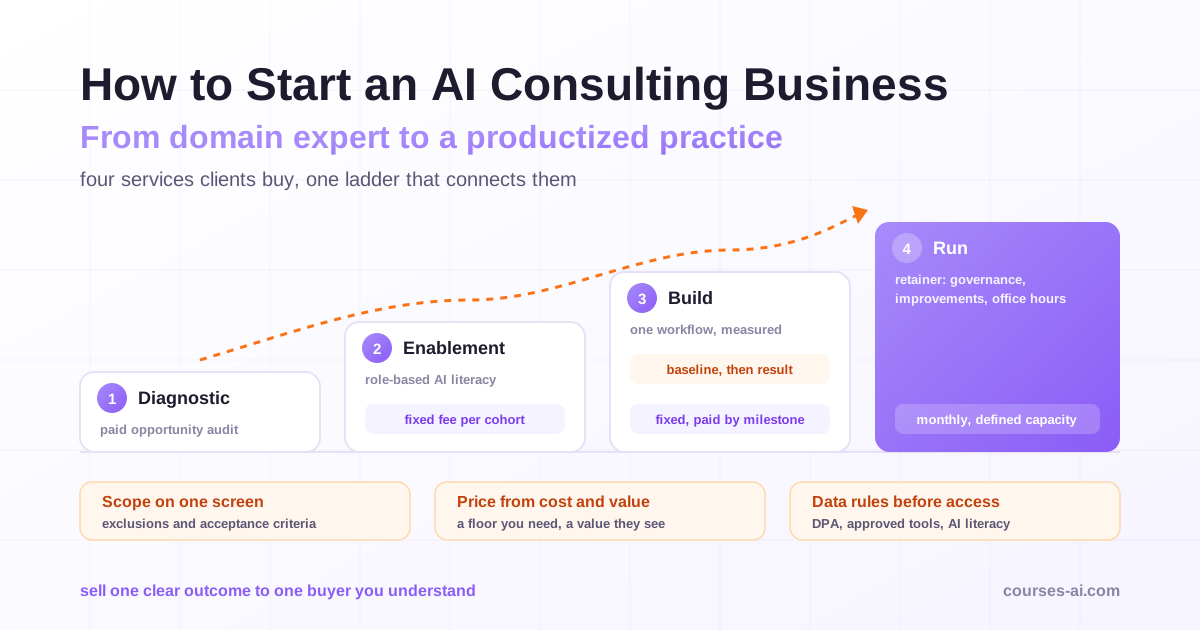
The AI consulting offer ladder
One offer is a start; a small ladder of offers that lead into each other is a business. Each rung should be worth buying on its own, and each should produce something the next rung needs.
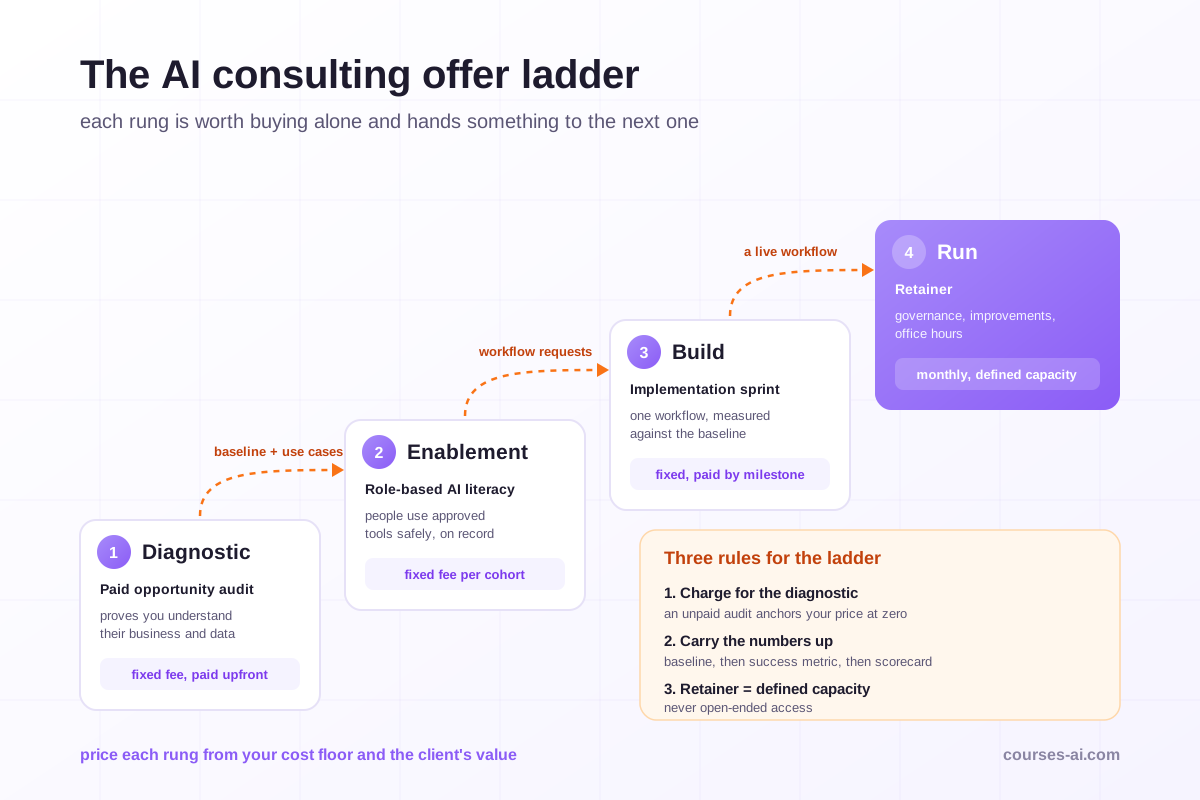
| Rung | Offer | What it proves | Pricing model | What it feeds into |
|---|---|---|---|---|
| 1. Diagnostic | AI opportunity audit, short and fixed | You understand their business and their data | Fixed fee, paid before work starts | The baseline and the one or two use cases for a build |
| 2. Enablement | Role-based AI literacy sessions | People can use the approved tools safely | Fixed fee per cohort or session | Concrete workflow requests from the teams |
| 3. Build | Implementation sprint for one workflow | The process measurably improved against the baseline | Fixed project, paid by milestone | A live workflow that needs an owner and upkeep |
| 4. Run | Retainer: governance, improvements, office hours | Tools, policy and training stay current | Monthly fee for defined capacity | Renewal and the next workflow |
Three rules keep the ladder honest. First, charge for the diagnostic: an unpaid audit attracts people who want ideas, not change, and it trains them to value your thinking at zero. Second, carry numbers up the ladder: the baseline from rung 1 becomes the success metric of rung 3, which becomes the scorecard of rung 4. Third, define the retainer by capacity and deliverables (for example, a monthly review, a set number of change requests, a quarterly policy update), never as open-ended access. If you are building these services inside an existing firm rather than going solo, the leadership side (strategy, change management, governance structures) is covered in AI for Business Leaders.
AI consulting pricing: a method instead of a magic number
Published rate ranges for AI consultants differ widely from one source to the next and rarely explain how they were measured. Your number has to come from two things you can measure: what your practice costs to run, and what the work is worth to this client.
| Model | Works best for | Your risk | The client's risk |
|---|---|---|---|
| Fixed project | Diagnostics, sprints with a tight scope | Overruns when the scope is loose | Paying for a weak result if acceptance criteria are vague |
| Retainer | Ongoing governance and improvement | Scope drift; disputes over unused capacity | Paying in quiet months |
| Day rate | Discovery-heavy work, workshops, unclear problems | AI-assisted speed lowers your revenue; income capped by days | Open-ended cost |
| Value-based | Implementations with a measurable outcome | Needs a baseline and trust; disputes over attribution | Paying more when the value is high |
A day rate is a useful internal floor but the wrong thing to sell for work AI makes faster: every hour you save becomes an hour you cannot bill.
The method, in three steps:
1. FLOOR (your cost)
   day floor = (target annual income + business costs + tools
                + insurance + taxes and contributions)
               / realistic billable days per year
   realistic billable days = working days - selling - admin
                             - learning - holidays
   project floor = estimated days x day floor x risk buffer

2. VALUE (the client's numbers, agreed in discovery)
   value per year = hours saved per period x loaded hourly cost
                    x periods per year
                  + errors avoided x cost per error
                  + revenue the change enables (only if attributable)

3. PRICE
   price >= project floor
   price = a share of the value that the client still finds
           obviously worth paying
   if value < floor: cut the scope or walk away
Write the client's own figures for the value side into the proposal, so the price is anchored to their numbers, and count billable days honestly: selling, admin and learning are part of a solo practitioner's week. Unit economics, offer pricing and positioning are treated as a business discipline in AI for Entrepreneurs and Startups.
Writing the proposal: a scope clients sign and you can deliver
A good AI consulting proposal is short: the situation in the client's words from the discovery call, the outcome and how it will be measured, the approach as steps rather than tools, then the scope itself. Acceptance criteria do most of the work. "A working AI workflow" invites endless polishing; "the workflow produces a first draft for each of the agreed test cases, reviewed and accepted by the named owner within five working days of handover" ends the project on a date.
A one-screen scope template you can copy
SCOPE OF WORK - [Offer name] - [Client] - v1 - [date]

OUTCOME
[One sentence the sponsor will say at the end, e.g. "Our bid team
produces first-draft tender answers with an approved AI tool, and a
named reviewer signs off every answer before it goes out."]

IN SCOPE
1. [Deliverable] - [format] - [client owner]
2. [Deliverable] - [format] - [client owner]
3. [Deliverable] - [format] - [client owner]

OUT OF SCOPE (unless agreed in writing as a change)
- Integration with systems not listed above
- Legal sign-off on policies (the client's counsel approves)
- Training for teams other than [named teams]

ACCEPTANCE CRITERIA
- [Deliverable 1] is accepted when [observable check], confirmed
  by [name] within [n] working days of handover.
- The workflow runs on the [n] agreed test cases with [defined
  result], documented in the handover note.

CLIENT INPUTS
- Access to [systems / data] by [date]
- A named process owner and [n] hours of expert time per week

DATA AND AI USE
- Tools used: [list]. Client personal data processed: [yes / no]
- If yes: data processing agreement signed before access; tools you
  engage under your own accounts are listed as sub-processors and
  approved by the client (tools in the client's own accounts stay
  under the client's contracts)
- No confidential client data in any tool without written approval

TIMELINE AND PAYMENT
- [Milestone] - [date] - [% of fee]

CHANGE CONTROL
- Any request outside IN SCOPE gets a written change note with its
  effect on price and dates, approved before work starts

DECISIONS
- Recommendations are advisory; [client] decides on deployment and
  remains responsible for how the outputs are used
A scope that needs more than one screen is usually two offers.
The delivery stack for a one-person AI practice
Tools change; the layers do not. Choose each one by what it does with client data, not by its feature list.
| Layer | What it is for | Check before using it on client work |
|---|---|---|
| Model access | Drafting, analysis, research | Business terms, whether inputs are used for training, retention period, data location, whether the vendor offers a data processing agreement |
| Workspace and knowledge base | Client folders, notes, standard procedures | Separation per client, access control, deletion at the end of the engagement |
| Automation | Onboarding, reporting, hand-offs between tools | Where data passes, what is logged, who owns the credentials |
| Prompt and procedure library | Repeatable delivery for each offer | Versioned, and no client data inside the templates |
| Test cases | Checking each workflow before and after changes | Real but anonymized examples, rerun after any model or prompt change |
| Handover pack | Documentation, owner, runbook | The client can run and change it without you |
Wherever possible, build in the client's own accounts: they own the credentials and the data, the workflow survives your departure, and you hold less of their data. Verifying AI output before it reaches a client, from sources to calculations, has its own lesson in the quality control module of AI for Consultants and Freelancers.
The responsibilities that come with the job
This section is general information, not legal or tax advice. It was checked on 5 November 2026 against the official sources listed at the end. For decisions about your own contracts, insurance or tax position, talk to a qualified professional in your jurisdiction.
Client data: confidentiality, the GDPR and the data processing agreement
Confidentiality is contractual: an NDA covers business secrets, strategy and financials. The GDPR covers personal data, whatever your contract says.
When you process personal data on a client's behalf (cleaning a customer list, building a workflow on their CRM, analyzing an employee survey), the client is usually the controller and you are the processor. Article 28(3) GDPR then requires a contract between you, often called a data processing agreement (DPA). As Ireland's Data Protection Commission summarizes it, the contract sets out the subject matter, duration, nature and purpose of the processing, the types of personal data and data subjects, and commits the processor to act only on documented instructions, bind its people to confidentiality, apply the Article 32 security measures, help the controller with data subject requests, breaches and impact assessments, delete or return the data at the end, and allow audits.
The clause AI consultants trip over is the one on sub-processors. You may engage them only with the client's prior specific or general written authorization (with a chance to object to each new one in the general case), they must carry the same data protection obligations, and you stay liable to the client for their performance. Every AI tool you put client personal data through can be a sub-processor, so list those tools in the DPA and get approval before you use them. And do not use client data for your own purposes, such as improving a product you sell to others: under Article 28(10) GDPR, a processor that determines the purposes and means of processing is considered a controller for that processing.
The working rules follow: minimize and anonymize before anything goes into a model, keep each client's data separate, and keep consumer accounts away from client work.
The EU AI Act: the AI literacy duty in Article 4
Article 4 of the AI Act (Regulation (EU) 2024/1689) has applied since 2 February 2025. The Act defines AI literacy as the "skills, knowledge and understanding" that allow providers, deployers and affected persons "to make an informed deployment of AI systems" and "to gain awareness about the opportunities and risks of AI and possible harm it can cause" (Article 3(56)).
The duty has since been softened, not removed. The AI Omnibus, Regulation (EU) 2026/1744, in force since 27 July 2026, rewrote it. The original text asked providers and deployers to take measures to ensure, "to their best extent, a sufficient level of AI literacy". The amended Article 4(1) says they "shall take measures to support the development of AI literacy of their staff" and of other persons operating or using AI systems on their behalf, and adds: "This obligation does not require providers or deployers to guarantee any specific level of AI literacy of any individual." A new Article 4(2) asks the Commission and the Member States to support those efforts, in particular for SMEs.
The Commission's AI literacy Q&A, updated on 20 October 2026, adds what a consultant needs to know. No certificate is required, organizations can keep internal records of the measures they provide, and no AI officer or other governance structure is mandated. Asking staff to read the instructions for use "might be ineffective" on its own. Everyday use counts: staff who use a chatbot to write or translate texts should be informed about risks such as hallucination. The "other persons" covered include, in the Commission's examples, a contractor, a service provider and a client. National market surveillance authorities supervise and enforce the rules from 2 August 2026.
What this means for your practice:
- Describe your literacy service accurately. Sell role-based measures that fit the client's tools and risks, with a record of what was delivered. Do not promise an "AI Act certificate" or a guaranteed level of competence; the law asks for neither.
- You are one of the "other persons". When you operate AI systems on a client's behalf, their literacy measures can cover you as a contractor. Keep your own training record and verification routine ready to show.
- What you build brings its own duties. A chatbot that talks to the client's customers falls under the transparency rules, which the Commission says took effect in August 2026; a tool that screens job applicants is an Annex III high-risk use, with those rules applying from 2 December 2027 after the Omnibus. The role-by-role picture is in our EU AI Act compliance guide for businesses, and the business case for training budgets in The ROI of AI Upskilling.
Liability for your recommendations
When AI drafts part of your work, the professional responsibility stays with you. Verify every figure, quote, legal reference and calculation an AI produced, or cut it. Record the assumptions behind your advice and the decisions the client took, since recommendations are advisory and the client decides. Where a question needs a lawyer, a tax adviser or another regulated professional, say so in writing and refer it. Limitation of liability and the boundaries of your advice belong in your contract; have a lawyer in your jurisdiction review the template before the first client signs.
Professional insurance
At a general level, two kinds of cover are worth discussing with a broker: professional indemnity (sometimes called errors and omissions), for claims that your advice or work caused a loss, and cyber cover, for data incidents. Read the exclusions for AI-related work and for data you hold on behalf of clients, and check whether a client's supplier terms require specific cover before you sign.
Mistakes that kill new AI consultancies
- Selling tools instead of outcomes. "I will set up an AI assistant for you" competes with the vendor's own onboarding; "your bid team will draft tender answers in a day instead of a week" competes with nobody.
- Running the diagnostic unpaid. It attracts people who want ideas, not change, and anchors your price at zero.
- Scopes without exclusions or acceptance criteria. The project never ends, and the last month is unpaid.
- Hourly billing for work AI makes faster. Your efficiency becomes the client's discount.
- Client data in consumer tools, or no DPA. One client's customer list in the wrong tool can end the relationship.
- Promising compliance. You can support a client's AI Act and GDPR work; legal sign-off belongs to their counsel.
- Building in your own accounts. The client cannot run the workflow without you, and you hold data you do not need.
- Demo-quality delivery. No test cases, no named owner, no handover pack: it works in the meeting and breaks in month two.
- Being a generalist. "AI expert" is not a niche; your domain is the advantage.
- Inventing proof. Made-up case studies, guaranteed savings and borrowed statistics may win one deal and cost your reputation. Show your method and your documented work instead.
Frequently Asked Questions (FAQ)
Do I need to be technical to become an AI consultant? Not for most of the work clients buy: audits, literacy training and governance depend on domain knowledge, judgment and clear writing. Implementation sprints need hands-on skill with the tools, so scope only the builds you can deliver and maintain.
Do I need a credential to call myself an AI consultant? Clients buy evidence: domain experience, a clear method and documented work. Avoid any title that implies a recognized qualification you do not hold. For the literacy training you deliver, the Commission's Q&A says no certificate is needed under Article 4.
How should I price AI consulting services? Calculate a floor from your costs and realistic billable days, estimate the value with the client's own figures, and price between the two, as a fixed or value-based fee rather than by the hour. If the value is below your floor, cut the scope or decline.
Do I need a data processing agreement with every client? You need one when you process personal data on the client's behalf, because Article 28(3) GDPR requires a contract with set minimum content. If you only handle business information with no personal data, a confidentiality agreement may be enough.
Does the EU AI Act require my clients to train their staff? It requires them to act, not necessarily through formal courses. If your clients provide or deploy AI systems, which includes using AI tools at work, Article 4 has applied to them since 2 February 2025. Since the AI Omnibus entered into force on 27 July 2026, it requires them to "take measures to support the development of AI literacy" of their staff and of others using AI systems on their behalf, taking into account their technical knowledge, experience, education and training and the context in which the systems are used. Training is one such measure, alongside other guidance initiatives, and no specific level has to be guaranteed for any individual.
Conclusion
Starting an AI consulting business is less about mastering every new model than about selling one clear outcome to one kind of buyer you understand. Package it as a ladder from paid diagnostic to retainer, price it from your costs and the client's value, and write a one-screen scope with exclusions and acceptance criteria. Treat client data, the AI Act's literacy duty and your professional liability as part of the service: a consultant who can show what is in scope, how data is handled and who decides is the one clients come back to.
Sources
Checked on 5 November 2026. This article is general information, not legal or tax advice.
- Regulation (EU) 2024/1689 (Artificial Intelligence Act), Official Journal of the European Union, 12 July 2024: Articles 3(56) and 4
- AI Act Service Desk: Article 4, AI literacy, European Commission, consolidated text as amended by the AI Omnibus (version of 27 July 2026)
- AI literacy: questions and answers, European Commission, updated 20 October 2026
- AI Act: regulatory framework and implementation timeline, European Commission, updated 19 October 2026
- Regulation (EU) 2016/679 (General Data Protection Regulation), Official Journal of the European Union: Articles 28 and 32
- A Practical Guide to Controller-Processor Contracts, Data Protection Commission (Ireland), guidance note last updated June 2019
- Also cited: Regulation (EU) 2026/1744 (AI Omnibus), in force since 27 July 2026, as reflected in the consolidated Article 4 above

The course that continues this article
AI for Consultants and Freelancers: Build a Solo AI-Powered Business
You have read the theory. In the course you put it into practice: written lessons structured in modules, with examples and exercises, quizzes, the AI Professor in every lesson and progress saved automatically. Once you complete the lessons and reach the minimum quiz score, you get the Certificate of Completion, a private attestation.
From the course syllabus
- Module 0 — The Solo AI Advantage in 2026
- Module 1 — Positioning and Personal Brand
- Module 2 — Finding and Winning Clients
- Module 3 — Pricing and Packaging Your Services
+ 6 more modules in the full syllabus
€99 per month for this course, VAT included · or pick it in a subscription of 3, 5 or 10 courses, from €199 per month, together with other Business courses; you can change them at every renewal (see what you learn across the whole track).
Monthly subscription with automatic renewal · stop the renewal anytime from your account · digital content with immediate access, see the withdrawal conditions. The certificate confirms that you completed the course and is private: it is not a diploma or a state-recognised qualification.