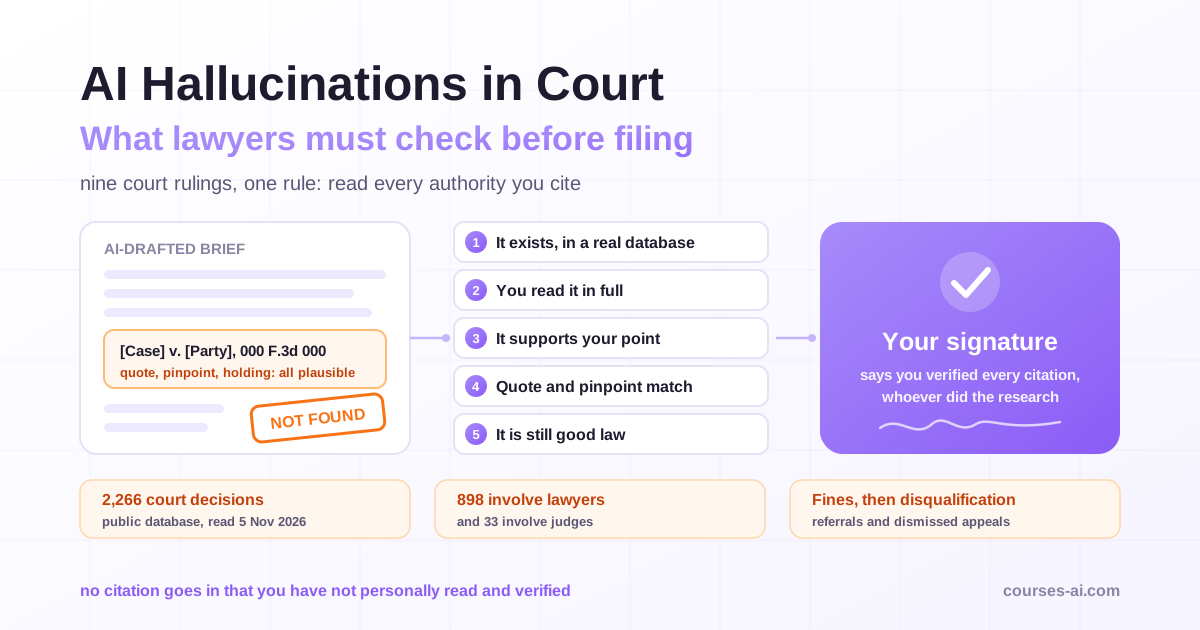
AI hallucinations in court cases have gone from a 2023 curiosity to a weekly occurrence. A public database of court decisions dealing with AI-fabricated material listed 2,266 cases when we read it on 5 November 2026, 898 of them involving lawyers. The sanctions have grown with the numbers: from a $5,000 penalty in Mata v. Avianca to disqualification, five-figure punitive fines, referrals to regulators and appeals dismissed outright. Below are nine rulings, eight checked against the courts' own texts and one (Zhang v. Chen) through press reports, the handful of mistakes behind all of them, and a one-screen checklist for verifying AI legal research before anything is filed.
This article is general information, not legal advice. Court rules, professional conduct rules and disclosure requirements differ by jurisdiction and by court. The facts below come from the decisions and documents listed under Sources, checked on 5 November 2026.
How many AI hallucination court cases are there?
The most complete public count is the AI Hallucination Cases database maintained by Damien Charlotin, which tracks court decisions in which generative AI produced hallucinated content, usually fake citations. The breakdown says more than the headline:
| What the database showed on 5 November 2026 | Count |
|---|---|
| Decisions listed | 2,266 |
| Self-represented litigants | 1,305 |
| Lawyers | 898 |
| Judges | 33 |
| United States / Canada / Australia / United Kingdom | 1,535 / 241 / 112 / 90 |
| Tagged "fabricated" (the authority does not exist) | 1,856 |
| Tagged "misrepresented" (a real authority, described wrongly) | 960 |
| Tagged "false quotes" | 602 |
Three caveats. The database counts court decisions, not every filing with a fake citation: errors caught quietly never produce a decision. It includes some decisions where AI use was alleged but not confirmed. And one case can carry several tags, so the categories add up to more than the total.
The tags carry the practical lesson. "Misrepresented" and "false quotes" mean a real case with the wrong content attached, which a check that only asks "does this case exist?" lets through. Only reading the source catches them.
Nine rulings every litigator should know
Every row below comes from the court's own opinion or order, except the Canadian ruling and the Nebraska follow-up, which rely on the press reports linked under Sources. Case names are enough to find each decision; we do not name the individual lawyers.
| Case | Court and date | What was filed | What the court did | The lesson |
|---|---|---|---|---|
| Mata v. Avianca, Inc., No. 22-cv-1461 | U.S. District Court, S.D.N.Y., 22 June 2023 | An opposition citing six non-existent opinions generated by ChatGPT; counsel kept standing by them after the court questioned their existence | $5,000 penalty under Rule 11, jointly and severally; letters to the client and to each judge falsely named as an author; bad faith found | Asking the chatbot whether its own case is real is not verification |
| Park v. Kim, No. 22-2057 | U.S. Court of Appeals, Second Circuit, 30 January 2024 | A reply brief citing a non-existent state decision that counsel got from ChatGPT and did not read | Referral to the court's Grievance Panel; a copy of the ruling to the client, translated into Korean if necessary | One fake case is enough |
| Zhang v. Chen, 2024 BCSC 285 | Supreme Court of British Columbia, February 2024 | A notice of application in a family case citing two non-existent cases invented by ChatGPT, withdrawn once the problem surfaced | Special costs refused, but the lawyer personally pays the other side's costs of fixing the confusion and must review her other files | Catching it early limits the damage, not the bill |
| Ayinde v Haringey and Al-Haroun v Qatar National Bank, [2025] EWHC 1383 (Admin) | High Court of England and Wales, Divisional Court, 6 June 2025 | Ayinde: five non-existent cases in judicial review grounds. Al-Haroun: 45 citations in a £89.4 million claim, 18 of them non-existent, from research done by the client | Wasted costs of £2,000 each against the barrister and the law centre (ordered earlier in the case); contempt threshold met for the barrister, proceedings not opened; referrals to the regulators | You cannot rely on the client, or anyone else, for citations |
| Johnson v. Dunn, 792 F. Supp. 3d 1241 | U.S. District Court, N.D. Alabama, 23 July 2025 | Two motions with five citations, generated by ChatGPT, that were "completely made up" | Public reprimand, disqualification from the case and referral to the Alabama State Bar; the firm itself was released without sanction | Modest fines, the court said, no longer deter |
| Noland v. Land of the Free, L.P., B331918 | California Court of Appeal, Second District, 12 September 2025 | An opening brief with 23 case quotations, 21 of them fabricated; some cited cases did not exist at all | $10,000 sanction; copy of the opinion to the client and to the State Bar; opinion published "as a warning"; no sanctions payable to the other side, which had not alerted the court | Never file a citation you have not personally read |
| Whiting v. City of Athens, Nos. 24-5918/5919, 25-5424 | U.S. Court of Appeals, Sixth Circuit, 13 March 2026 | Appellate briefs with "over two dozen fake citations and misrepresentations of fact"; the lawyers did not answer the court's question about generative AI | Full appellate attorneys' fees and double costs, jointly and severally; $15,000 punitive sanction each; referral to the chief judge for possible discipline | The court did not need to prove AI was used |
| Prososki v. Regan, No. S-25-295 | Nebraska Supreme Court, 20 March 2026 | An appellant's brief in a divorce appeal with fictitious cases and misquoted real ones; counsel denied using AI | Brief stricken, appeal dismissed, counsel referred to the Counsel for Discipline; local press reported a temporary suspension in April 2026 | The client loses the appeal |
| Withers v. City of Aberdeen, No. 1:24-CV-218-SA-RP | U.S. District Court, N.D. Mississippi, 8 June 2026 | Hallucinated citations in three filings from both sides; the drafting lawyers used AI tools and did not verify; local counsel co-signed | All four lawyers disqualified and referred for discipline; the two out-of-state lawyers barred from the district for two years and fined $2,500 and $3,500; local counsel fined $1,000 each | Your signature says you checked |
The thread through all nine is not the tool. It is a citation that reached the court without anyone opening the source. The protocol that prevents it (confirm the authority exists, read it, check that it supports your point, match the quotation, confirm it is still good law) is the core of the legal research module in AI for Legal Professionals, which works through it citation by citation, including a full verification run.
What went wrong: six patterns behind the sanctions
1. A chatbot was used as a database
In Mata, the lawyer who did the research told the court he had "falsely assumed" ChatGPT was "like a super search engine". In Park v. Kim, counsel relied on ChatGPT "to identify precedent that might support her arguments". A general-purpose model answering from its training does not look anything up: it produces the most plausible continuation of your request, and citations, among the most formulaic text in law, are exactly what it imitates best.
The risk is highest when the law is against you. As the Sixth Circuit put it in Whiting, quoting the California Court of Appeal (which drew in turn on a bankruptcy court): "AI hallucinations are more likely to occur when there are little to no existing authorities available that clearly satisfy the user's request—such as, for example, when a lawyer asks a generative AI tool to supply a citation for an unsupported principle of law." Asking for "cases holding X" when no case holds X is an invitation to invent one.
2. The AI was asked to check its own work
The Mata opinion reproduces screenshots in which the lawyer asked ChatGPT "Is Varghese a real case" and "Are the other cases you provided fake". According to the court, ChatGPT answered that it had supplied "real" authorities that could be found through Westlaw, LexisNexis and the Federal Reporter. They could not. The same process that invents a citation will happily confirm it, so verification has to happen outside the tool that made the claim.
3. The case was real; the content was not
In Noland, 21 of the 23 case quotations in the opening brief were fabrications, and many cited cases "do not discuss the topics for which they are cited". In Prososki, the court's chart of defects mixes fictitious cases with real ones misstated and misquoted. In Withers, invented authorities came with Westlaw-style citations and pinpoints. A real case name with an invented quotation passes an existence check. Format is not evidence; only the text of the decision is.
4. The person who signed did not check
In Withers, the out-of-state lawyers drafted the filings and the local lawyers co-signed them; all four were disqualified and fined. In Al-Haroun, the solicitor relied on research his own client had prepared, and the Divisional Court was blunt: "A lawyer is not entitled to rely on their lay client for the accuracy of citations of authority or quotations." The Second Circuit put the minimum in Park v. Kim: "At the very least, the duties imposed by Rule 11 require that attorneys read, and thereby confirm the existence and validity of, the legal authorities on which they rely."
Whoever did the research (a junior, a client, a tool), the person who signs owns every citation.
5. The response made it worse
Mata became a bad-faith finding because of what followed the first error: "acts of conscious avoidance and false and misleading statements to the Court" after its orders had questioned the cases. In Whiting, the lawyers ignored the show cause directives (including whether they had used generative AI and how they had cite-checked) and called the order "void on its face". In Ayinde, the barrister denied using AI; the court held that either she had deliberately included fake citations or her denial, given under a statement of truth, was untruthful.
In Zhang v. Chen, by contrast, the cases were withdrawn once the problem surfaced and the judge found no intent to deceive; the lawyer paid costs but avoided special costs. Candour does not erase the consequences. Evasion multiplies them.
6. A safeguard existed and was ignored
The City's lead lawyer in Withers told the court her firm had adopted an AI policy in 2025 that specifically required independent verification of the software's output. The court found it "particularly egregious" that she, a partner, "disregarded the AI policy by blindly relying on the AI research tool". A policy nobody follows is not a defence; it is evidence that you knew the risk.
The same goes for specialist tools. A preregistered Stanford study, released in May 2024 and later published in the Journal of Empirical Legal Studies, found that Lexis+ AI and Thomson Reuters' AI research tools hallucinated less than a general-purpose chatbot but still "each hallucinate between 17% and 33% of the time" on its benchmark. The products have changed since; the point has not: retrieval reduces fabrication, it does not remove your duty to read.
How courts are escalating
In date order, the trend is plain. In 2023, Mata ended with a $5,000 penalty and letters. In 2026, the Sixth Circuit imposed the other side's full appellate fees, double costs and $15,000 each in punitive sanctions, and sent the opinion to the chief judge. In Johnson v. Dunn, the court explained why it went beyond money: reprimands and modest fines had proven "insufficient deterrents".
The non-monetary sanctions are the ones that end careers or cases:
- Disqualification and bans. Johnson v. Dunn; all four lawyers in Withers, two of them barred from the district for two years.
- Referral to a regulator or disciplinary body. In seven of the nine rulings above.
- Telling your own client. Mata, Park v. Kim and Noland ordered counsel to send the decision to the client.
- Contempt. The Divisional Court in Ayinde warned that knowingly placing false material before the court (negligence alone is not enough) may amount to contempt, punishable by up to two years' imprisonment, and that in the most serious cases papers may go to the police, though it expected those to be "extremely rare".
The heaviest cost often falls on the client. In Prososki, the brief was struck and the appeal dismissed. In Withers, both parties were left without lawyers and given 60 days to find new counsel.
Europe's bars are saying the same. The Council of Bars and Law Societies of Europe (CCBE), in its guide on the use of generative AI by lawyers of 2 October 2025, warns that "lawyers using AI-generated content without appropriate verification could face sanctions for professional misconduct and/or contempt of court, malpractice lawsuits, damage to their clients' interest and the client's trust in their lawyer, as well as damage to the lawyer's reputation."
How to verify AI legal research before you file
None of these courts objected to AI as such. The Mata opinion opens by saying there is "nothing inherently improper about using a reliable artificial intelligence tool for assistance". What they sanctioned was skipping the lawyer's gatekeeping role.
Let AI work where it is grounded
AI earns its place when it works from sources you can open: research assistants that retrieve from a licensed database and link every authority, summaries of documents you supply, drafts built on authorities you have already verified. Instruct the model to use only the material provided and to say "not found" rather than fill a gap; prompt patterns for that are covered in The Complete Prompt Engineering Masterclass. Anything from a model's memory, with no link to a source, is a lead, never an authority.
Before you paste client material into a tool, check what the provider does with it. The CCBE guide lists confidentiality first among the professional duties engaged by generative AI; the data protection side of choosing tools is covered in AI Data Privacy and EU AI Act Compliance for Professionals.
Run five checks on every authority
- It exists. Find it yourself, by citation, in an official or licensed source, not in the tool that produced it and not by asking a chatbot.
- You have read it. Open the full text and read the relevant passage in context, not a summary.
- It supports your point. Holding or dicta, majority or dissent, comparable facts, the right jurisdiction.
- The quotation and pinpoint match. Word for word, at the page or paragraph you cite.
- It is still good law. Run a citator; for statutes, confirm the version in force at the relevant date.
Add one rule: a near-match is a fail. If the citation is not where it should be and a search turns up a similar name from another year or court, the citation is unverified. You do not round a citation to the nearest real case.
Make the signature mean something
Keep a short verification log for each filing: authority, who checked it, when, against which source. It takes minutes and answers the first question a court will ask. If several lawyers sign, agree who verifies what; in Withers, co-signing without checking cost the local lawyers the case.
Check your court's rules on AI too. In 2024 the Second Circuit noted that several courts had "proposed or enacted local rules or orders specifically addressing the use" of AI tools, and in Zhang v. Chen the judge ordered the lawyer to review her other files and to tell the court and the other side immediately if any of them contained citations or summaries obtained from generative AI.
If you find a fake after filing
Correct it at once: tell the court and the other side, withdraw or correct the authority, explain what happened. Zhang v. Chen shows how much early candour limits the damage; Mata, Whiting and Ayinde show the alternative.
The one-screen checklist
Save it, print it, pin it next to the filing system.
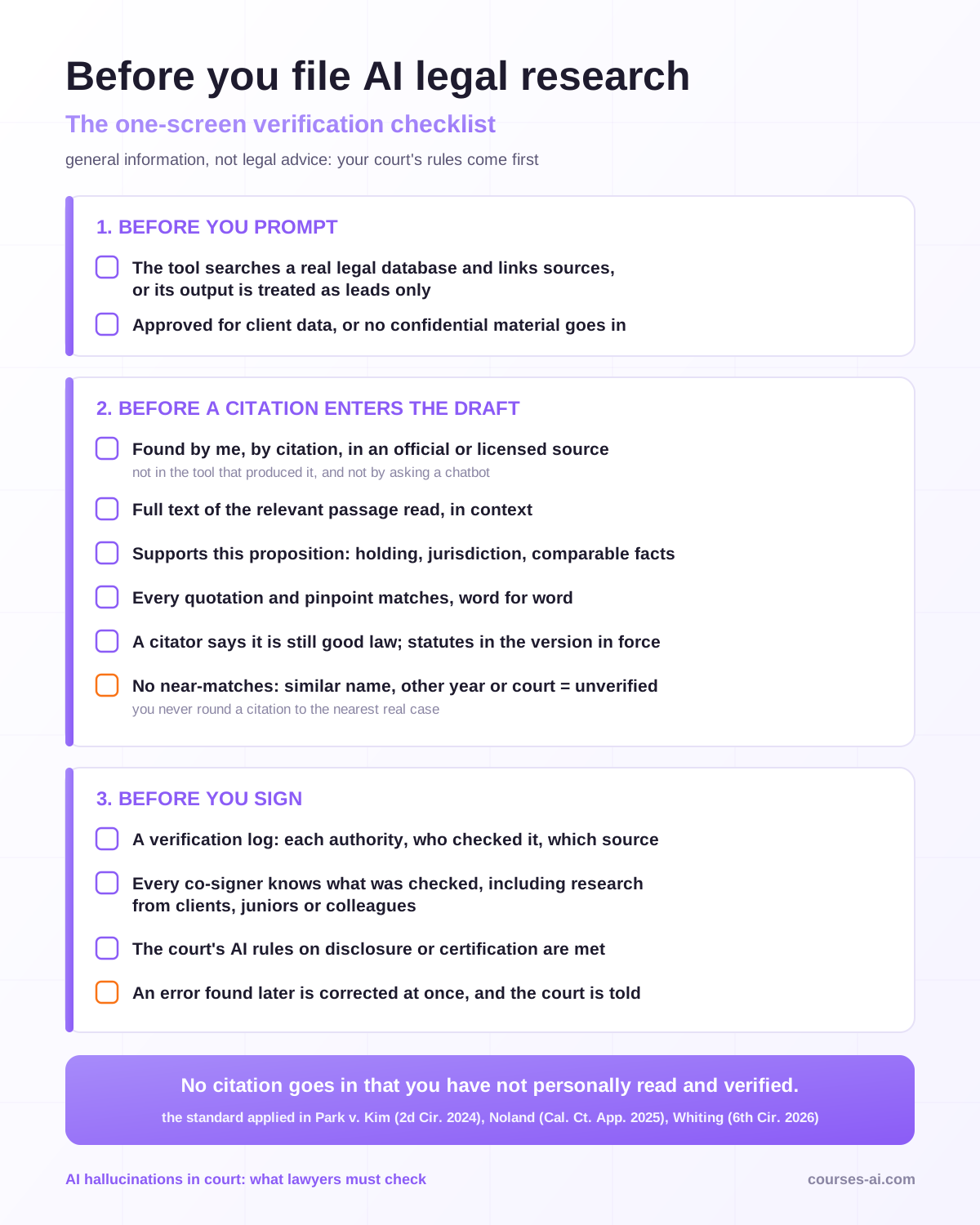
Before you prompt
- The tool retrieves from a real legal database and links its sources, or I treat its output as leads only.
- The tool is approved for client data, or no confidential material goes in.
Before a citation enters the draft
- I found it myself, by citation, in an official or licensed source.
- I read the full text of the relevant passage, in context.
- It supports this proposition: holding, jurisdiction, facts.
- Every quotation and pinpoint matches word for word.
- A citator confirms it is still good law; statutes are in the version in force.
- No near-matches: similar name, different year or court = unverified.
Before you sign
- The verification log names who checked each authority and against which source.
- Every co-signer knows what was checked, including research from clients or colleagues.
- The court's AI rules on disclosure or certification are met.
- If an error turns up later, I correct it at once and tell the court.
If your firm builds or buys legal AI tools
The checklist protects one filing. Before a firm relies on an AI research tool, it needs evidence the tool fits the work: questions with known answers, traps such as a doctrine your jurisdiction does not have, and a measured rate of unsupported citations, as explained in LLM Evaluation: How to Test AI Applications Before They Ship. If you develop or deploy AI systems in the EU, the AI Act adds obligations on top of your professional rules; see EU AI Act Compliance: What Businesses Must Do in 2026.
Frequently Asked Questions (FAQ)
How many court cases involve AI hallucinations? The public AI Hallucination Cases database maintained by Damien Charlotin listed 2,266 court decisions when we read it on 5 November 2026: 1,305 involving self-represented litigants, 898 involving lawyers and 33 involving judges. It counts decisions that deal with hallucinated material, so the number of affected filings is higher, and it includes some decisions where AI use was alleged but not confirmed.
What happened in Mata v. Avianca? In a personal injury case against an airline, the plaintiff's lawyers cited opinions that ChatGPT had invented and stood by them after the court questioned their existence. On 22 June 2023 the Southern District of New York found bad faith, imposed a $5,000 penalty and ordered letters to the client and to each judge falsely named as an author.
Can a lawyer be sanctioned for a fake citation they did not know was fake? Yes. In Park v. Kim the Second Circuit referred counsel for discipline over a single non-existent case she had not read, holding that Rule 11 requires attorneys at least to read the authorities they rely on. In Zhang v. Chen the judge found no intent to deceive and still made the lawyer personally liable for costs. Not knowing is the failure: reading the source would have revealed it.
Do legal AI research tools eliminate hallucinations? No. A preregistered Stanford study of the 2024 versions of Lexis+ AI and Thomson Reuters' AI research tools found fewer hallucinations than a general chatbot, but still between 17% and 33% for each tool on its benchmark. Use their links to reach the source faster, then read it.
Do I have to tell the court I used AI? It depends on the court. Some courts have local rules or standing orders on AI use, and judges increasingly ask, as the Sixth Circuit did in Whiting. Where no rule applies, the duty that never changes is that every authority you cite must be one you have read and verified.
Conclusion
Behind every "lawyers sanctioned for AI" headline is the same story: a model produced plausible citations, and nobody between the model and the court opened the source. Courts in the US, Canada and England now say it in nearly the same words: AI may help, but no citation goes in that the responsible lawyer has not personally read and verified. Sanctions have climbed from small fines to disqualification, regulator referrals and dismissed appeals, and the client often pays most. Five checks per authority, a log and a signature that means something keep your name out of the database.
Sources
Checked on 5 November 2026. This article is general information, not legal advice.
- AI Hallucination Cases database, Damien Charlotin, last updated 5 November 2026 (counts as read on that date)
- Mata v. Avianca, Inc., No. 22-cv-1461 (PKC), Opinion and Order on Sanctions, U.S. District Court for the Southern District of New York, 22 June 2023
- Park v. Kim, No. 22-2057, U.S. Court of Appeals for the Second Circuit, 30 January 2024
- B.C. lawyer reprimanded for citing fake cases invented by ChatGPT, Radio Canada International / CBC, February 2024, reporting Zhang v. Chen, 2024 BCSC 285
- Ayinde v London Borough of Haringey and Al-Haroun v Qatar National Bank QPSC, [2025] EWHC 1383 (Admin), High Court of England and Wales, Divisional Court, 6 June 2025, paragraphs 25-27, 36-38, 49, 66-74 and 81
- Johnson v. Dunn, 792 F. Supp. 3d 1241, U.S. District Court for the Northern District of Alabama, 23 July 2025
- Noland v. Land of the Free, L.P., B331918, California Court of Appeal, Second Appellate District, Division Three, filed 12 September 2025
- Whiting v. City of Athens, Nos. 24-5918/5919 and 25-5424, U.S. Court of Appeals for the Sixth Circuit, 13 March 2026
- Prososki v. Regan, No. S-25-295, Nebraska Supreme Court, 20 March 2026; on the later suspension: Nebraska Supreme Court suspends Omaha attorney over AI use, 10/11 NOW, 15 April 2026
- Withers v. City of Aberdeen, No. 1:24-CV-218-SA-RP, Sanctions Order, U.S. District Court for the Northern District of Mississippi, 8 June 2026
- CCBE guide on the use of generative AI by lawyers, Council of Bars and Law Societies of Europe, 2 October 2025
- Hallucination-Free? Assessing the Reliability of Leading AI Legal Research Tools, Magesh, Surani, Dahl, Suzgun, Manning and Ho, arXiv, May 2024; published in the Journal of Empirical Legal Studies, vol. 22 (2025)

The course that continues this article
AI for Legal Professionals: A Practical Claude for Legal Course
You have read the theory. In the course you put it into practice: written lessons structured in modules, with examples and exercises, quizzes, the AI Professor in every lesson and progress saved automatically. Once you complete the lessons and reach the minimum quiz score, you get the Certificate of Completion, a private attestation.
From the course syllabus
- Module 0 — AI in Legal Practice and Claude for Legal: The 2026 Landscape and the Rules That Govern It
- Module 1 — Legal Research with AI: Speed With Mandatory Verification
- Module 2 — Contract Review and Analysis with AI
- Module 3 — Contract Drafting with AI
+ 7 more modules in the full syllabus
€99 per month for this course, VAT included · or pick it in a subscription of 3, 5 or 10 courses, from €199 per month, together with other Business courses; you can change them at every renewal (see what you learn across the whole track).
Monthly subscription with automatic renewal · stop the renewal anytime from your account · digital content with immediate access, see the withdrawal conditions. The certificate confirms that you completed the course and is private: it is not a diploma or a state-recognised qualification.