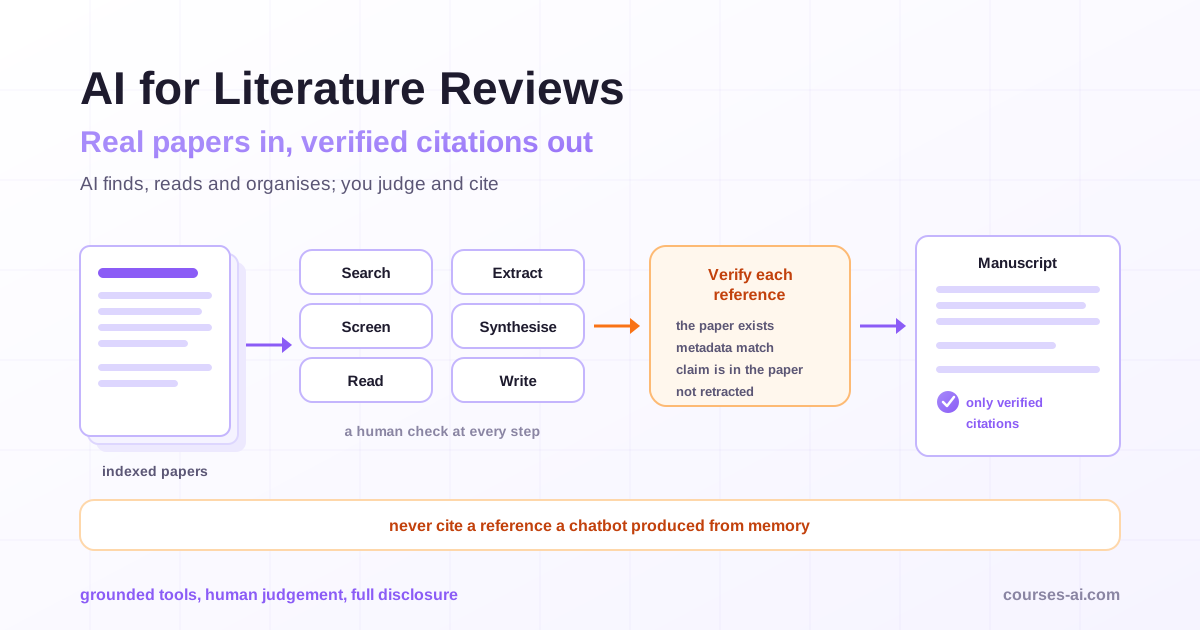
AI can cut weeks from a literature review, and it can also put references into your manuscript to papers that were never written. Both outcomes come from the same tools, used differently. This guide shows how to use AI for a literature review the way careful researchers do: what AI is good at and where it fails, why chatbots invent citations, which kinds of tools work over real papers, an eight-step workflow from research question to synthesis, prompts that keep the model grounded, a checklist for verifying every reference, and the rules on systematic reviews, disclosure and authorship.
What AI can and cannot do in a literature review
The useful question is not "should I use AI?" but "for which step, with which check?" The table shows where AI helps and what stays your job.
| Step | Where AI helps | What you must check |
|---|---|---|
| Framing the question | Suggests angles, narrower questions, key concepts | That the question is answerable and matters in your field |
| Search strategy | Drafts synonyms and Boolean strings | That the strings run correctly in each real database |
| Discovery | Finds related papers through indexes and citation graphs | That you have not missed a key body of work |
| Screening | Prioritises abstracts against your criteria | Every inclusion and exclusion decision |
| Reading | Produces structured summaries of papers you provide | That each claim appears in the paper, with its caveats |
| Extraction | Pulls methods, samples and outcomes into a table | Every extracted value against the source |
| Synthesis | Proposes themes, agreements, contradictions and gaps | That the pattern is real in your evidence matrix |
| Writing and citing | Improves clarity and structure of your draft | Every citation, taken only from your reference manager |
The pattern is consistent: AI is strong at speed, structure and suggestion, and weak at being right without supervision. The researcher's job shifts from doing every step by hand to designing the steps and checking the output.
Why chatbots invent references
A general-purpose chatbot answering from its training data does not look anything up. It generates text that is statistically plausible, and a plausible reference (a real-sounding title, a typical author name, a believable journal and year) is exactly what it produces when it does not have a real one. The result can look perfect and point to nothing.
The problem is measurable. In a study published in the Journal of Medical Internet Research in 2024, Chelli and colleagues asked chatbots of that time to find the references for systematic reviews on rotator cuff pathology and compared the output with the real reference lists. Counting a paper as hallucinated when two of its title, first author or year were wrong, they found hallucination rates of 39.6 percent for GPT-3.5, 28.6 percent for GPT-4 and 91.4 percent for Bard. Models have improved since, and tools that search a real index reduce the problem considerably, but the failure mode has not gone away. Treat every reference produced by a model as unverified until you have opened the paper.
The practical rule follows: use AI to find, read and organise real papers; never use it as the source of a citation. The difference between a chatbot answering from memory and a tool that retrieves from a document index is the same difference our guide to retrieval-augmented generation explains for business applications.
The AI literature review tool landscape, by job
Tools change quickly, so choose them by the job they do and how they ground their answers:
- Scholarly search engines with AI features. Semantic Scholar indexes a very large body of papers and adds AI-assisted features, such as summaries and related-work suggestions, built over real indexed articles. Classic databases (PubMed, Scopus, Web of Science, discipline-specific indexes) remain the backbone of any serious search.
- Citation-graph tools. Connected Papers builds a visual graph from a seed paper, showing clusters, foundational works and gaps. The map is only as good as the seed you choose.
- Question-answering over the literature. Consensus surfaces what papers say in response to a focused question and links to them; Elicit helps find papers and extract structured information, such as sample sizes or outcomes, into a table. Both work best on focused empirical questions, and every extracted value still needs checking.
- Answer engines with citations. General answer engines that cite their sources are useful for quick orientation in an unfamiliar area, provided you open and read the sources rather than citing the answer.
- General chatbots. Strong for brainstorming, explaining methods, restructuring your notes and summarising papers you paste in, and weak as a search engine.
- Reference managers. Zotero, Mendeley and similar tools are where verified references live. Your manuscript's citations should come only from here.
How to choose and combine these tools, with exercises on real search strategies, is the subject of the first modules of our AI for Research and Academia course, which then covers summarising papers, reference management, academic writing and disclosure.
An eight-step AI literature review workflow
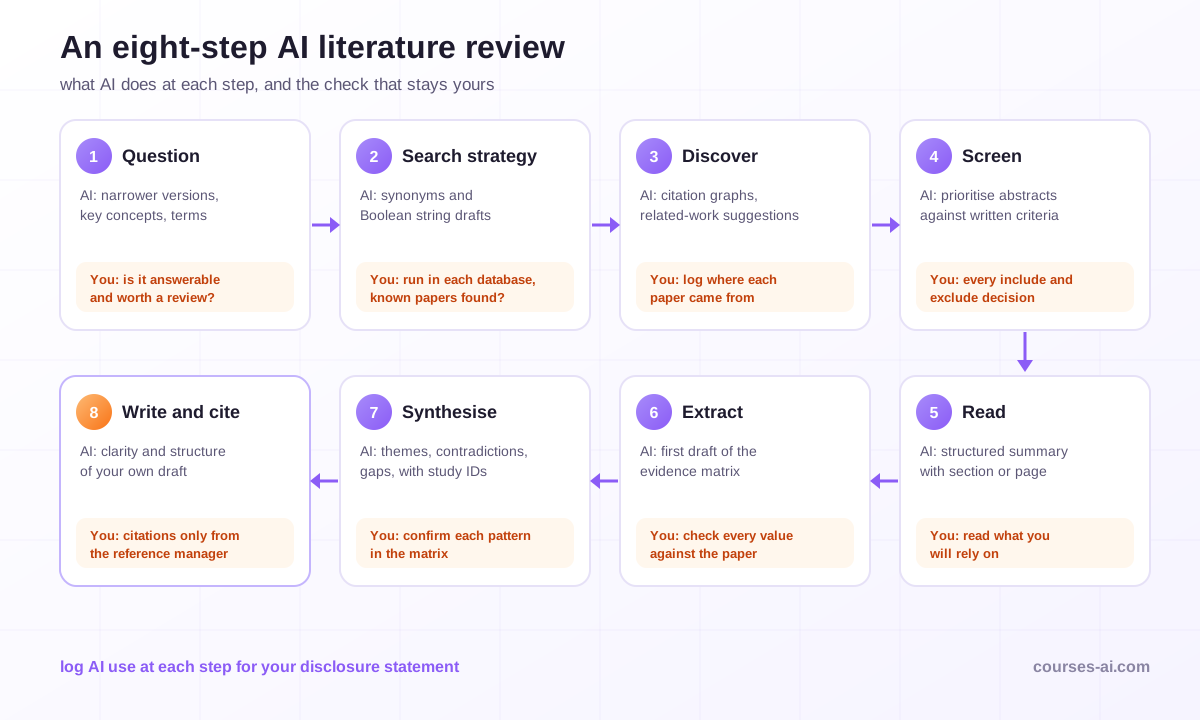
1. Define the question
Start with a question narrow enough to answer. Frameworks such as PICO (population, intervention, comparison, outcome) for clinical questions, or a simple scope statement for other fields, keep it precise. AI is a good sparring partner here: ask it to propose narrower versions of your question, list key concepts and alternative terms, and point out ambiguities. You decide which version is worth a review.
2. Build the search strategy
Ask a model to draft synonyms, related terms and Boolean strings for each concept, then adapt and run them yourself in each database, because syntax differs between them. Check the results: do known key papers appear? If not, the strategy has a gap. For formal reviews, an information specialist or librarian remains the best check on a search strategy, and the final strings must be reported exactly.
3. Discover beyond keywords
Keyword searches miss papers that use different vocabulary. Use citation chasing (references of key papers, and newer papers citing them) and citation-graph tools to find work your strings did not catch. Add every candidate to your reference manager with its source noted, so you can report how you found it.
4. Screen titles and abstracts
AI can help prioritise a large set of abstracts against your written inclusion criteria, putting the most likely matches first. It should not make final decisions on its own. Record each decision and its reason; for a systematic review, follow your protocol on how many reviewers screen each record and how disagreements are resolved.
5. Read and summarise
Give the model the paper itself (the full text or the sections you need) and ask for a structured summary: research question, design, sample, main findings, limitations, and where in the paper each point appears. Asking for the section or page makes checking fast. Summaries are reading aids, not substitutes for reading the papers you will rely on.
6. Extract into an evidence matrix
Build a table with one row per study and columns for what matters to your question (design, population, measures, effect, limitations). Extraction tools and chatbots can fill a first draft quickly, but they can misread a table or miss a caveat, so check every value against the paper. Vague column definitions produce vague tables; define each column precisely.
7. Synthesise
With a verified matrix, ask the model to propose themes, points of agreement, contradictions and gaps, citing study IDs from your matrix for each claim. Then check every proposed pattern against the matrix. The synthesis is your intellectual contribution; AI is a fast way to see candidate structures, not the judge of which one is true.
8. Write and cite
Write the review in your own words, using AI for clarity, structure and language editing where your institution and target journal allow it. Insert citations only from your reference manager, never from a model's output. If English is not your first language, AI editing can help considerably, as long as the ideas, the argument and the responsibility remain yours.
Prompts that keep the model grounded
The common thread in good research prompts is to restrict the model to material you supply and to demand traceability.
Summarise one paper with locations:
Using only the paper text below, summarise: research question, design,
sample, main findings, limitations. After each point, give the section
heading or page where it appears. If something is not in the text,
write "not reported". Do not add information from outside the text.

[paper text]
Compare several papers you provide:
Below are structured summaries of 12 studies, each with an ID.
Identify (1) findings most studies agree on, (2) contradictions,
(3) methodological differences that could explain them, (4) gaps.
Cite study IDs for every claim. Use only the summaries provided.
Stress-test your synthesis:
Here is my draft synthesis and the evidence matrix it is based on.
List every claim in the draft that is not supported by the matrix,
and every important pattern in the matrix the draft ignores.
These patterns rely on general prompting principles (role, context, constraints, output format) covered in our prompt engineering guide; the Complete Prompt Engineering Masterclass goes further for researchers who want to build reusable prompt templates.
How to verify every reference
Run this check on every citation before it enters your manuscript, whatever produced it:
- The paper exists: search the exact title in a scholarly database; resolve the DOI and confirm it lands on that paper.
- The metadata match: authors, year, journal, volume and pages agree with the publisher's record.
- The claim is in the paper: open it and find the passage that supports the sentence you are citing it for, not just a similar topic.
- The context fits: the finding applies to the population and conditions you describe, and you have not dropped a key limitation.
- It has not been retracted: check the publisher page and databases that flag retractions and corrections.
- It lives in your reference manager, with the PDF or a note of where you read it.
If a reference fails step 1 or 3, delete it. Do not try to "fix" a fabricated citation by finding something similar; rebuild the sentence from a paper you have read.
Systematic reviews: where AI fits and what you must report
Systematic reviews have stricter rules because their value comes from a transparent, reproducible method. The PRISMA 2020 statement sets out what a systematic review should report, through a 27-item checklist and flow diagrams, including how records were identified, screened and selected and whether automation tools were used in the process.
In November 2025, Cochrane, the Campbell Collaboration, JBI and the Collaboration for Environmental Evidence published a joint position statement on AI use in evidence synthesis, supporting the RAISE recommendations (Responsible use of AI in evidence SynthEsis). Its core positions: review authors remain accountable for their work; AI may be used when it does not compromise the rigour of the synthesis, with human oversight; and AI that makes or suggests judgements should be reported fully. The statement is tied to a specific version of RAISE, so check the current version before you rely on it.
In practice: write AI use into your protocol before you start, keep humans responsible for every eligibility and quality judgement, record what each tool did and how you checked it, and report it in your methods.
Academic integrity, disclosure and authorship
Publishing bodies agree on the essentials. The ICMJE Recommendations state that AI tools should not be listed as authors because they cannot take responsibility for the accuracy, integrity and originality of the work, and that authors who use AI-assisted technologies should disclose how they used them. COPE, the Committee on Publication Ethics, takes the same position: AI tools cannot meet authorship requirements, and human authors remain fully responsible for everything in the manuscript, including any part produced with AI.
Beyond these principles, rules differ by institution, funder and journal, and they change. Before you start, check:
- your university's policy on AI use in coursework, theses and research
- your target journal's policy on AI use and how to disclose it
- your funder's rules for proposals and reports
- confidentiality rules for peer review: many journals do not allow manuscripts under review to be uploaded to AI tools
Keep a short log of how you used AI at each stage. It makes the disclosure statement easy to write and protects you if questions arise later.
Common mistakes
- Asking a chatbot for "the key papers on X" and citing the list. This is how fabricated references end up in theses and manuscripts.
- Citing a summary instead of the paper. Summaries drop caveats; the caveat is often what a reviewer asks about.
- Letting AI screen without written criteria. Without explicit criteria, decisions are unreproducible.
- Trusting extracted numbers. A misread table can reverse a conclusion; check every value.
- Skipping disclosure. Undisclosed AI use is an integrity problem even when the content is correct.
- Uploading confidential material. Unpublished data, manuscripts under review and participant data need a tool cleared for them, or should not be uploaded at all.
For the quantitative side of a review, such as exploring extracted data or checking a simple analysis, No-Code Data Analysis with AI covers how to analyse data with AI and verify the results.
Frequently Asked Questions (FAQ)
Can I use ChatGPT to write a literature review? You can use a general chatbot to brainstorm questions, draft search terms, summarise papers you provide and improve the clarity of your own writing, if your institution and journal allow it. Do not use it to find or cite sources from memory, because it can invent references, and disclose how you used it.
Which AI tools are best for a literature review? Use tools that work over real indexed papers: scholarly search engines such as Semantic Scholar alongside databases like PubMed or Scopus, citation-graph tools such as Connected Papers, and literature tools such as Elicit or Consensus. Keep verified references in a reference manager such as Zotero or Mendeley.
How do I stop AI from inventing citations? Do not ask a model to supply references from memory. Find papers in real databases, give the model the text you want summarised, ask it to cite only the material you provide, and verify every reference by opening the paper and checking that it supports your sentence.
Can AI be used in a systematic review? Yes, within rules. Write the AI use into your protocol, keep humans responsible for eligibility and quality judgements, record what each tool did, and report it. PRISMA 2020 covers reporting, and the 2025 joint position statement by Cochrane, Campbell, JBI and CEE sets out responsible use.
Do I have to disclose AI use in my paper? Usually yes. ICMJE asks authors to describe how they used AI-assisted technologies, and many journals have their own disclosure rules. AI tools cannot be listed as authors, and you remain responsible for the entire content.
Conclusion
AI makes literature reviews faster when it works on real papers and slower, and riskier, when it is treated as a source. Use it to sharpen the question, draft search strings, find related work, prioritise abstracts, summarise and extract from papers you supply, and propose a structure for your synthesis. Keep every judgement, every extracted value and every citation under your control, verify references by opening the papers, follow PRISMA and the evidence-synthesis guidance for systematic reviews, and disclose your AI use the way your institution and journal require.
Sources
- Hallucination Rates and Reference Accuracy of ChatGPT and Bard for Systematic Reviews: Comparative Analysis, Chelli et al., Journal of Medical Internet Research, 2024
- PRISMA 2020 statement, PRISMA
- Position statement on AI use in evidence synthesis across Cochrane, the Campbell Collaboration, JBI and the Collaboration for Environmental Evidence 2025
- Recommendations for the Conduct, Reporting, Editing and Publication of Scholarly Work in Medical Journals, ICMJE
- Also cited: COPE, Authorship and AI tools, position statement; Page et al., The PRISMA 2020 statement, BMJ 2021;372:n71
Verified on 15 November 2026 against the cited sources. Tool features and institutional policies change often; check your university's, funder's and journal's current rules before relying on this guide.

The course that continues this article
AI for Research and Academia
You have read the theory. In the course you put it into practice: written lessons structured in modules, with examples and exercises, quizzes, the AI Professor in every lesson and progress saved automatically. Once you complete the lessons and reach the minimum quiz score, you get the Certificate of Completion, a private attestation.
From the course syllabus
- Module 0 — AI in the Research Lifecycle: Mindset and Integrity
- Module 1 — Literature Discovery and Search
- Module 2 — Reading, Summarizing, and Synthesizing
- Module 3 — Citations, References, and the Hallucination Problem
+ 6 more modules in the full syllabus
€99 per month for this course, VAT included · or pick it in a subscription of 3, 5 or 10 courses, from €199 per month, together with other Business courses; you can change them at every renewal (see what you learn across the whole track).
Monthly subscription with automatic renewal · stop the renewal anytime from your account · digital content with immediate access, see the withdrawal conditions. The certificate confirms that you completed the course and is private: it is not a diploma or a state-recognised qualification.