Generative engine optimization (GEO) is the work of making your pages the ones that AI search experiences quote, summarize and link to when they answer a question. It is also full of myths, because the platforms publish little about how they pick sources and many people fill the gap with confident guesses. This guide separates what Google, OpenAI, Perplexity, Anthropic and Microsoft actually document, what peer-reviewed research shows, and which practices are reasonable bets that you should label as bets.
What generative engine optimization actually means
The term comes from a research paper, "GEO: Generative Engine Optimization" by Aggarwal and colleagues, accepted to KDD 2024 and published on arXiv (2311.09735). The authors describe generative engines as systems that search for information and use large neural models "to generate a response grounded on the sources", and present GEO as a way "to aid content creators in improving their content visibility in generative engine responses."
In practice, marketers use three overlapping labels:
- SEO: earning visibility in classic ranked results.
- AEO (answer engine optimization): being the direct answer, whether in a featured snippet, a voice assistant or an AI summary.
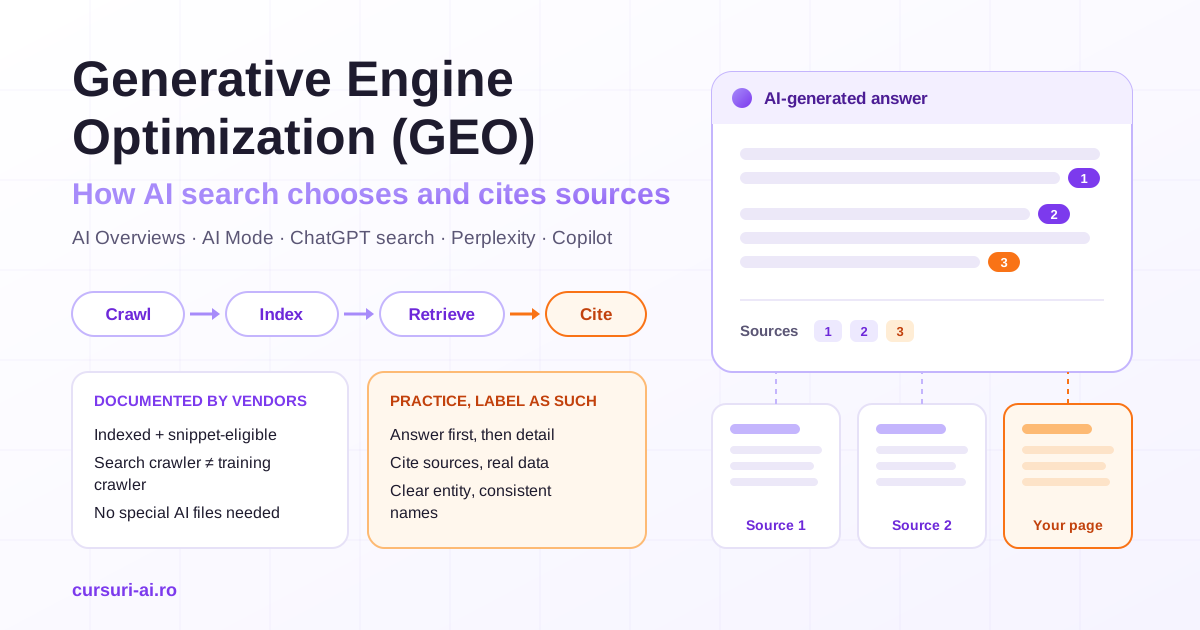
- GEO: being one of the sources an AI-generated answer draws on and cites, in Google AI Overviews and AI Mode, ChatGPT search, Perplexity, Copilot, Claude and similar tools.
The shift is the unit of success. In classic search you win a position on a list; in an AI answer you win a citation, a mention or nothing, and the user may never see a list. That changes how you structure and measure content, but, as the vendor documentation below shows, not the foundations. The full system, from technical SEO to AI citation monitoring, is covered in depth in SEO and AEO/GEO in the AI Era.
What the platforms actually document
Start with primary sources. Everything in this section is quoted or closely paraphrased from the vendors' own pages, checked on 31 October 2026.
Google AI Overviews and AI Mode
Google's Search Central page AI features and your website is the closest thing to an official GEO manual, and it is blunt:
- Eligibility. To be shown as a supporting link, "a page must be indexed and eligible to be shown in Google Search with a snippet."
- No special optimization. "There are no additional requirements to appear in AI Overviews or AI Mode, nor other special optimizations necessary." And: "You don't need to create new machine readable files, AI text files, or markup to appear in these features. There's also no special schema.org structured data that you need to add."
- How answers are assembled. Both features "may use a 'query fan-out' technique", issuing multiple related searches across subtopics and data sources to build a response. Google also notes that AI Mode and AI Overviews "may use different models and techniques, so the set of responses and links they show will vary."
- Controls. The same preview controls as classic search apply:
nosnippet,data-nosnippet,max-snippetandnoindex. Google's May 2025 post on succeeding in AI search, written by John Mueller, adds: "More restrictive permissions will limit how your content is featured in our AI experiences." - Google-Extended is not a Search switch. Google's crawler documentation describes Google-Extended as a robots.txt product token for training and grounding in Gemini Apps and Vertex AI, and states that it "does not impact a site's inclusion in Google Search" and is not "used as a ranking signal in Google Search." Blocking it does not take you out of AI Overviews; blocking Googlebot would take you out of Search.
- Measurement. Sites appearing in AI features "are included in the overall search traffic" in Search Console, "reported on in the Performance report, within the 'Web' search type."
The practical reading: for Google, GEO is SEO. Query fan-out means a page can be pulled in for one sub-question of a longer query, which favors pages that answer specific sub-questions clearly, but the gate is the same index and snippet eligibility as always.
ChatGPT search
OpenAI's crawler documentation separates three user agents, and the distinction is the most useful GEO fact OpenAI publishes:
- OAI-SearchBot is "for search." The key sentence: "Sites that are opted out of OAI-SearchBot will not be shown in ChatGPT search answers", though they "can still appear as navigational links."
- GPTBot crawls content that may be used to train OpenAI's foundation models. "Disallowing GPTBot indicates a site's content should not be used in training generative AI foundation models."
- ChatGPT-User handles user-initiated actions, such as visiting a page a user asked about. It "is not used for crawling the web in an automatic fashion", and "because these actions are initiated by a user, robots.txt rules may not apply."
OpenAI states that "each setting is independent of the others", so you can allow search while refusing training, and that after a robots.txt change "it can take ~24 hours" for its search systems to adjust. OpenAI publishes IP ranges for each agent, which lets you verify that a request claiming to be OAI-SearchBot really is.
Perplexity
Perplexity's bot documentation describes two agents. PerplexityBot "is designed to surface and link websites in search results on Perplexity" and "is not used to crawl content for AI foundation models"; Perplexity recommends allowing it in robots.txt so your site can appear in its results. Perplexity-User fetches pages when a user asks a question and may "include a link to the page in its response"; because the user requested the fetch, it "generally ignores robots.txt rules."
Claude and Microsoft Copilot
Anthropic's support article on its crawlers uses the same split. Restricting ClaudeBot signals that a site's future materials should be excluded from training datasets. Disabling Claude-SearchBot "may reduce your site's visibility and accuracy in user search results", and disabling Claude-User, which fetches pages for user questions, "may reduce your site's visibility for user-directed web search." Anthropic states its bots honor robots.txt.
Microsoft went furthest on measurement. On 10 February 2026 Bing announced an AI Performance report in Bing Webmaster Tools, in public preview, covering citations across Microsoft Copilot, AI-generated summaries in Bing and select partner integrations: total citations, average cited pages, grounding queries, page-level citation activity and trends over time. The announcement also gives Microsoft's own advice for pages that are indexed but rarely cited, quoted in the playbook below, and notes that Bing respects content owner preferences expressed through robots.txt.
The pattern across platforms
| Platform | What governs citation eligibility | Training opt-out | Measurement the vendor offers |
|---|---|---|---|
| Google AI Overviews / AI Mode | Googlebot access, indexing, snippet eligibility | Google-Extended (does not affect Search) | Search Console, inside "Web" |
| ChatGPT search | OAI-SearchBot | GPTBot | None in the crawler docs |
| Perplexity | PerplexityBot | Not applicable (PerplexityBot is not used for training) | None in the crawler docs |
| Claude | Claude-SearchBot | ClaudeBot | None in the crawler docs |
| Copilot / Bing | Bing index, robots.txt preferences respected | Not covered here | Bing AI Performance report (preview) |
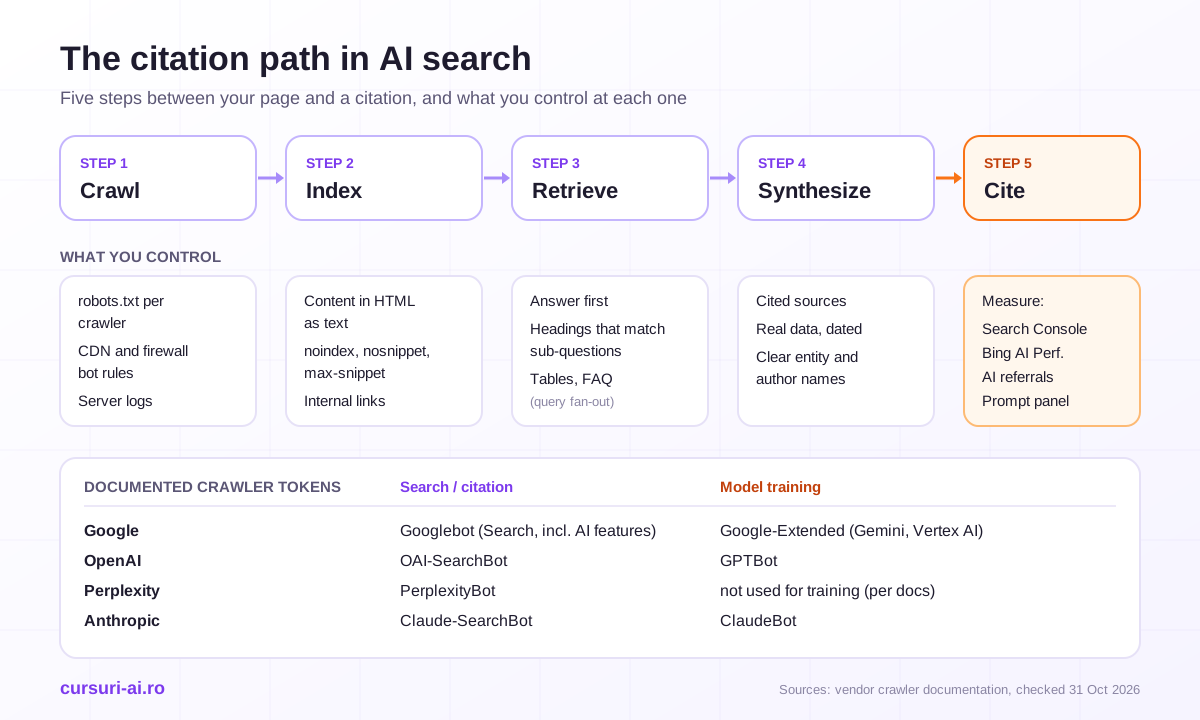
Two conclusions follow. First, the citation crawler and the training crawler are separate controls wherever they are documented, so "block AI" is not one decision but several. Second, every platform above ties citations to its own search crawling or index. If that crawler cannot reach and index you, nothing else in this article matters.
What is not documented, and how to treat claims about it
None of the vendor pages cited here lists citation ranking factors. Google says plainly that "indexing and serving isn't guaranteed." OpenAI, Perplexity and Anthropic document access, not selection. So when someone presents a precise list of "GEO ranking factors" or a percentage lift from a particular markup, ask for the primary source and its date.
A few recurring claims, measured against the documentation:
- "You need an llms.txt file." Google's AI features page says you do not need "AI text files" to appear in its AI features. None of the other vendor pages cited here mentions such a file as a requirement. Publishing one is harmless; selling it as a requirement is not supported by any source above.
- "There is special schema for AI Overviews." Google: "no special schema.org structured data." Structured data still matters for rich results and for describing entities, as long as it matches the visible content.
- "You must chunk your content for LLMs." Google says no special optimizations are necessary. Clear sections help readers, but rewriting pages into fragments is not a documented requirement.
- "GEO replaces SEO." Every platform above ties citations to search crawling and indexing. GEO extends SEO to new surfaces; it does not replace it.
A useful team habit: keep an evidence log for every GEO tactic you adopt (claim, source, date checked). Tactics with an empty source column are experiments, and should be measured as experiments.
What the research shows, with its limits
The original GEO paper is the strongest public evidence on which content changes affect citation. The authors built GEO-bench, "a benchmark consisting of 10000 queries from diverse domains and sources", and tested nine content interventions on a simulated engine (a GPT-3.5-based answer generator over the top Google results) and on Perplexity.
The findings worth knowing:
- The abstract reports that GEO "can boost visibility by up to 40% in generative engine responses". The "top-performing methods, Cite Sources, Quotation Addition, and Statistics Addition, achieved a relative improvement of 30-40%" on the paper's position-adjusted word count metric.
- "Simple methods like Keyword Stuffing traditionally used in SEO don't perform well."
- "Lower-ranked websites, which typically struggle for visibility, benefit significantly more from GEO." In one experiment, Cite Sources produced a 115.1% visibility increase for the site ranked fifth, while the top-ranked site's visibility fell by 30.3% on average.
Read these numbers carefully. They come from the authors' own benchmark and metrics, on the engines of the time, and the authors note they tested two engines and that methods may need to adapt as engines evolve. The direction is useful (well-sourced, quotable content tended to be used more); the magnitudes are not a forecast for your site today.
A practical GEO playbook
Everything below is practice, not vendor fact; where a step is backed by documentation, the source is named.
1. Audit access before content
Google's AI features page lists "ensuring that crawling is allowed in robots.txt, and by any CDN or hosting infrastructure" as a best practice. The second half matters: network-level bot rules can refuse a crawler your robots.txt allows. Cloudflare, for example, announced on 1 July 2025 that it blocks AI crawlers accessing content without permission or compensation by default, with every new domain starting from that "default of control." Check server logs or CDN bot analytics, not just robots.txt.
A robots.txt that allows citation crawlers while opting out of training looks like this:
# Search and citation crawlers: allowed
User-agent: OAI-SearchBot
Allow: /

User-agent: PerplexityBot
Allow: /

User-agent: Claude-SearchBot
Allow: /

# Model training: opted out
User-agent: GPTBot
Disallow: /

User-agent: ClaudeBot
Disallow: /

# Gemini training and grounding (does not affect Google Search or AI Overviews)
User-agent: Google-Extended
Disallow: /
Opting out of training is a business decision, not a GEO one: per the documentation above, it is separate from search eligibility. And the user-initiated fetchers (ChatGPT-User, Perplexity-User) may not follow robots.txt at all, per their own vendors.
2. Put the answer where a retriever can find it
Practice: open each important page with a direct, self-contained answer to the question in its title, then the detail. Use descriptive H2 and H3 headings that read like the sub-questions a user would ask, tables for comparisons and numbered steps for procedures. Microsoft's guidance says "clear headings, tables, and FAQ sections help surface key information", and Google's query fan-out description suggests why sub-question coverage matters.
Keep the answer in the HTML. Google's best practices include "making sure that important content is available in textual form." Text that only appears after client-side scripts run, or lives inside images, is harder for crawlers to use.
3. Make claims checkable
The GEO paper's best interventions were citing sources, adding quotations and adding statistics. Microsoft's guidance says the same thing in plain language: "Examples, data, and cited sources help build trust when content is reused in AI-generated answers." The practical rule for content teams:
- Every number has a named source and a date, linked in the sentence.
- Quotes are attributed to a person or document a reader can find.
- Original material (your own data, test results, case notes) is labeled as such.
And never invent a statistic to look more citable: a fabricated figure quoted by an AI answer is a credibility problem you cannot recall. Writing workflows that keep AI-assisted drafts factual are covered in AI for Content Creation and Copywriting.
4. Make your entity unambiguous
Practice, partly documented. AI answers name brands and people, not just pages, so help every system resolve who you are:
- Use consistent organization, product and author names across your site, profiles and press mentions.
- Add Organization structured data to your home page. Google says it "can help Google better understand your organization's administrative" details and "disambiguate your organization in search results." Its
sameAsproperty points to other pages about you, such as official profiles. - Give authors real bio pages with verifiable credentials, and link bylines to them.
{
  "@context": "https://schema.org",
  "@type": "Organization",
  "name": "Example Analytics Ltd (illustrative)",
  "url": "https://www.example.com",
  "logo": "https://www.example.com/logo.png",
  "sameAs": [
    "https://www.linkedin.com/company/example-analytics",
    "https://github.com/example-analytics"
  ]
}
Keep markup honest. Google's guidance is to make sure "all the content in your markup is also visible on your web page."
5. Keep pages current
Microsoft says regular updates "help ensure AI systems reference the most current version of your content", and recommends IndexNow to notify participating search engines when content is added, updated or removed. A practical cadence: review your most-cited pages quarterly and update facts and dates when something material changed.
6. Earn presence beyond your own site
Practice, not documented fact: answer engines cite pages they can retrieve, and many queries retrieve third-party pages such as reviews, comparisons and industry publications. Being accurately described there, through real reviews, talks, contributed research or partner documentation, gives the engines more places to find you. This is classic digital PR: earn mentions, do not buy link schemes.
7. Do not mass-produce pages for AI
Google's spam policies define scaled content abuse as "when many pages are generated for the primary purpose of manipulating search rankings", "no matter how it's created", and list "using generative AI tools or other similar tools to generate many pages without adding value for users" as an example. Thin pages written to catch AI answers fit that definition. For where AI belongs in a marketing team without crossing that line, see our AI for digital marketing guide.
Measuring GEO without fooling yourself
GEO measurement is immature, and an honest report says so. Combine four sources and state what each cannot show.
1. Vendor consoles. Google documents AI Overviews and AI Mode traffic as part of the "Web" search type in Search Console, not as a separate report. Bing's AI Performance report counts citations, grounding queries and cited pages; its announcement does not describe click data, so pair it with analytics.
2. Referral analytics. Practice: create a channel group or segment for referrals from AI assistants' domains, for example a pattern such as chatgpt\.com|perplexity\.ai|copilot\.microsoft\.com|gemini\.google\.com|claude\.ai. Treat the result as a floor: some clicks arrive without a referrer, and an answer read without a click leaves no trace in analytics.
3. A fixed prompt panel. Practice: write a fixed list of real questions your buyers ask, run them on a schedule in each assistant you care about, and log the date, the mode (with or without web search), the sources cited and how your brand was described. Google itself says AI Mode and AI Overviews may show different responses and links, so single screenshots prove nothing; trends across repeated runs do. Citation-tracking tools automate this, but ask how they sample prompts and locations before trusting their share-of-voice numbers. The prompt-writing discipline that makes a panel consistent is the same one covered in our prompt engineering guide.
4. Business outcomes. Google's May 2025 guidance says that clicks from results pages with AI Overviews "are higher quality" and recommends looking at "various indicators of conversion on your site" rather than only at clicks. Report signups, leads and sales next to traffic.
A simple monthly GEO report then has four lines: crawler access status per platform, citation trend from the prompt panel and Bing, AI referral sessions and conversions, and the list of pages updated. Building that report into a wider marketing analytics routine is part of AI for Digital Marketing.
Frequently Asked Questions (FAQ)
Is generative engine optimization different from SEO? Mostly in where success shows up, not in what earns it. Google says AI Overviews and AI Mode need nothing beyond being indexed and snippet-eligible, and the other platforms tie citations to their own search crawlers. GEO adds new surfaces, crawlers and measurement on top of solid SEO.
Do I need an llms.txt file to appear in AI answers? Not for Google: its AI features documentation says you do not need machine-readable files, AI text files or special markup. None of the OpenAI, Perplexity or Anthropic crawler pages cited here lists such a file as a requirement either.
If I block GPTBot, will my site disappear from ChatGPT search? No, according to OpenAI. GPTBot governs training use; OAI-SearchBot governs whether your pages can appear in ChatGPT search answers, and each setting is independent. Blocking OAI-SearchBot is what keeps you out of search answers, except as navigational links.
Does blocking Google-Extended remove my site from AI Overviews? No. Google states that Google-Extended does not affect inclusion in Google Search and is not a ranking signal; it covers training and grounding in Gemini Apps and Vertex AI. AI Overviews and AI Mode follow Googlebot access and the usual preview controls.
How can I tell if AI search engines are citing my site? Combine Search Console (AI features sit inside the "Web" search type), Bing's AI Performance report, an analytics segment for AI assistant referrals and a fixed set of test questions run on a schedule. No single source is complete, so report them together with their limits.
Conclusion
Generative engine optimization rewards teams that read the documentation before buying the hype. The vendors agree on what they publish: citations depend on each platform's search crawling and index, citation and training crawlers are separate controls, and Google requires nothing beyond being indexed and snippet-eligible. What none of them publishes is a ranking formula for citations. So work from the documented basics: keep the right crawlers able to reach you, answer specific questions early, back every claim with a source, make your organization unambiguous, avoid mass-produced pages, and measure citations, referrals and conversions together, with dates and caveats attached.

The course that continues this article
SEO and AEO/GEO in the AI Era: Optimizing for Google, AI Overviews and Generative Engines
You have read the theory. In the course you put it into practice: written lessons structured in modules, with examples and exercises, quizzes, the AI Professor in every lesson and progress saved automatically. Once you complete the lessons and reach the minimum quiz score, you get the Certificate of Completion, a private attestation.
From the course syllabus
- The 2026 SEO Landscape: From Classic SEO to AEO/GEO
- Durable Fundamentals That Do Not Age
- AI-Assisted Technical SEO
- Keyword and Intent Research at Scale with AI
+ 6 more modules in the full syllabus
€99 per month for this course, VAT included · or pick it in a subscription of 3, 5 or 10 courses, from €199 per month, together with other Business courses; you can change them at every renewal (see what you learn across the whole track).
Monthly subscription with automatic renewal · stop the renewal anytime from your account · digital content with immediate access, see the withdrawal conditions. The certificate confirms that you completed the course and is private: it is not a diploma or a state-recognised qualification.