AI courses for developers, in the language you work in
Coding agents take over more and more of the routine code, and applications get AI components:
retrieval over your own data, agents with tools, MCP servers. The courses here teach you to build,
evaluate and secure them, and each language guide says what carries over to your stack.
A subscription by number of courses: you pick them and can change them at every renewal. Prices include VAT and are billed monthly. From €99/month for one course.
Choose your language
Each guide: the tools available in the ecosystem, what changes in your work and the courses, in order.
What changes for developers in the age of AI agents
Three changes you can already see in teams that ship software, and the skill that answers each of them.
01
Agents write the routine code
Claude Code, Cursor and terminal agents generate, refactor and test code. The difference is made by whoever gives them the right context, limits their permissions and verifies their output in CI.
What you learnYou learn to give context, limit permissions and verify generated code in CI, not just accept suggestions.
Retrieval over your own data, agents with tools, MCP servers. Someone has to design them into the application that already exists, not into a notebook.
What you learnYou design retrieval, agents and MCP tools for the application you maintain, with predictable cost and behaviour.
The same IT catalog, ordered for your ecosystem: the tools available, what changes in your work and a track of courses, with the reason each one matters. Where no course is written in your language, the guide says so.
The guides go from foundations to systems in production. If you already have experience, you do not have to start with the first course: choose the profile that describes you.
1
I have not used AI in my code yet
You have been writing software for years, but language models are still a black box. You start with the mental model, then prompting, then a production integration.
You have shipped a chat or a RAG prototype and the production problems are showing up: quality, cost, security, agents that "forget". You move on to systems.
What you get here that you do not get from a tutorial
Courses of about 25 hours, structured in modules
Code examples, architectures and case studies, and in some courses a capstone project at the end. Not summaries of documentation, but structured material that you go through in order, at your own pace.
AI Professor in every lesson
You ask in the context of the lesson, by typing or by voice, and get an explanation of the concept you are on. Every lesson has its quiz: about 355 questions per course on average. The professor is an AI system, not a human teacher, included in every plan with a fair-use limit.
Up to date with what the industry asks for
Agentic coding, MCP, RAG, agents, evals, LLM security, fine-tuning, AIOps, computer vision and Edge AI are whole courses in the catalog, not closing chapters.
See the material before you pay
A preview of the first lesson of every course can be read without an account. Then you choose a subscription by number of courses, from €99 a month for one course to €319 a month for 10 courses, VAT included; you pick the courses and can change them at every renewal. You can stop the renewal anytime from your account; access stays until the end of the period already paid for.
The proof, at the end
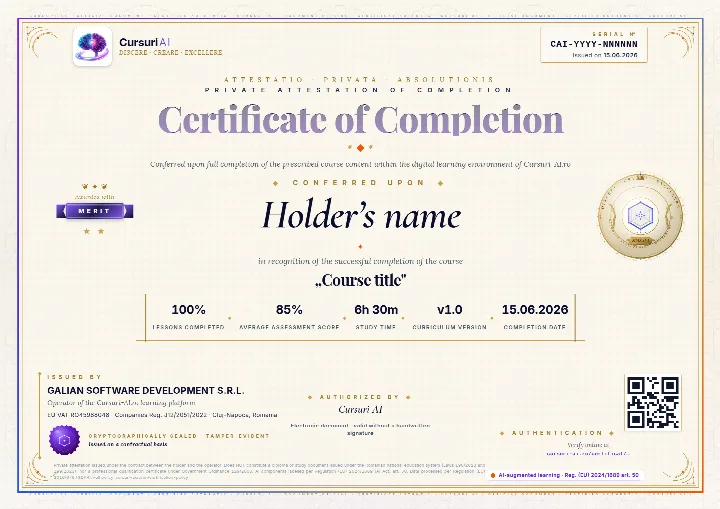
A Certificate of Completion for every course
When you have gone through all the lessons of a course and have an average of at least 70% on its quizzes, you issue from your account, after confirming the conditions, a
Certificate of Completion with a unique number and a public verification link.
It is not issued automatically and it comes at no extra cost, with a plan or with single-course access.
Verifiable by anyone. Every certificate has a QR code and a public verification page, with its unique code. A recruiter checks it without an account.
With figures, not just a name. The percentage of lessons completed, the average quiz score and the study time are written on the document.
Three tiers, by quiz average: Pass (70–79%), Merit (80–89%) and Distinction (90% and above), shown on the document.
Your name, your choice. You decide whether your name appears on the public verification page, and you can change that choice at any time.
A private attestation of course completion. It is NOT a diploma or a state-recognised qualification under Romanian
Laws 198/2023, 199/2023 or Government Ordinance 129/2000; employers may take it into account at their own discretion.
The real document, an A4 PDF, shown here with sample data: the name, the course and the serial number are placeholders, and the QR code in the image is decorative.
The IT catalog
The 25 IT courses you pick your subscription from
The language guides choose and order from this catalog; there are no separate courses per language. The list is generated from the catalog, with the real number of lessons: from agentic coding and MCP to evals, LLM security, fine-tuning, AIOps, computer vision and Edge AI.
Pick the courses for your language and stack in a subscription of 3, 5 or 10 courses, with the AI Professor included, and change them at every renewal. With the full catalog (€499 a month, VAT included) you have every course.
How many courses a month?
Pay for the tier, then pick the courses in your account. You can change them at every renewal.
Total prices, VAT included. Move up anytime and pay only the difference for the days left; move down at renewal. Renews automatically, you stop it anytime from your account; your progress and certificates stay. Digital content with immediate access: see the withdrawal terms.
Are developers really at risk of becoming irrelevant because of AI?
It is not the language that becomes irrelevant, it is the way of working. Coding agents take over more and more of the routine code, and applications get AI components, retrieval, agents, tools, that someone has to design, evaluate and secure. The courses here are chosen for exactly those skills. They do not promise a job or a promotion: they give you the knowledge, and the result depends on how you apply it.
Which programming languages does the section cover?
Python, JavaScript and TypeScript, Java, C# and .NET, PHP, Go, Rust, C and C++, and SQL with databases. Each has its own page, with the position of the language in the AI ecosystem, the SDKs and tools available, and a track of courses in stages. The courses themselves are the IT courses in the catalog; there are no separate courses per language. Each guide says which courses have material in your language and which are on the page because what they teach does not depend on the language.
Are the courses in English?
Yes. Every course on this page belongs to the English catalog: the lessons, the quizzes and the certificate are in English, and the AI Professor answers in English, whether you type your question or ask it by voice.
Do I need to learn Python to take the courses?
You need to be able to read it. Most code examples are in Python. The MCP course has one module on servers in Python and one on servers in TypeScript, the LLM integration course implements streaming with FastAPI, Express and Symfony, and the Edge AI course adds C, Kotlin and Swift for its targets. The language pages say, course by course, what is in your language and what you carry over from the Python examples.
Are the courses theoretical or practical?
Practical. Lessons work through code, architectures and case studies, and each lesson has its own quiz. Several courses close with a project: the Claude Code course with an end-to-end agentic pipeline on a realistic repository, the MCP course with end-to-end practical projects, the context engineering course with an agent that has persistent memory. A few courses, such as MLOps, AI security and the AI SaaS course, teach architecture and practice in prose rather than through code listings. The AI Professor built into every lesson answers in the context of the lesson you are reading.
How long does a language track take?
It depends on your pace and on what you already know. Each language page shows the number of courses and lessons and the total estimated duration. The stages are meant to be taken in order, but you do not have to take all of them: if you have already worked with model APIs, skip the foundations. You mark the lessons you finish in your account, where you see your progress in each course.
Which subscription do I need?
A subscription by number of courses: 1, 3, 5, 10, 15 or 25 courses a month, or the full catalog. You pick them and can change them at every renewal. For your language and stack, the fitting ones are usually 3, 5 or 10 courses a month (10 is the one we recommend); at the two ends are a single course and the full catalog, with the technical and business courses. Every price includes VAT and is shown, from the code that bills it, on the pricing page. The subscription renews automatically; you can stop the renewal anytime from your account, and access stays until the end of the period already paid for. See every tier on the pricing page.
Do you have courses on Claude Code, Cursor and MCP?
Yes, each has a full course: Claude Code Mastery (agentic coding from the terminal, across multiple files, with git and CI), Cursor as a Pro (the AI-native IDE, Composer and working with several agents) and MCP (Model Context Protocol), about building servers in Python and TypeScript. You can pick all three in the same subscription by number of courses, from 3 courses up, or individually, as a single course.
Can my company pay for the courses?
Yes. For teams there is the team library: the company picks a number of courses a month for all its members, priced per member, plus VAT, with the invoice issued to the company, described on the For companies page. On an individual subscription, the Stripe payment page lets you add your company’s VAT ID.
Do I get a certificate?
Yes. When you have gone through all the lessons of a course and reached the minimum average on its quizzes, you issue a Certificate of Completion from your account. It has a unique number, a QR code and a public verification page, and it comes at no extra cost, with any subscription. It is a private attestation of completion, not a diploma and not a state-recognised qualification: it shows that you went through the course and reached the quiz threshold. Details in the Certification policy.
A free preview of the first lesson, without an account
Choose your language and start today
Pick 10 courses a month for your stack: €319 per month, VAT included.
You can change them at every renewal; the AI Professor is built into every lesson.
Immediate access after paymentSecure payment through StripeStop the renewal anytime
The courses are for educational purposes only: they are not professional advice, they do not promise a job, and
completing them is not a diploma or a state-recognised qualification. The names of languages, tools and products
belong to their owners and are mentioned for identification only; Cursuri AI is not affiliated with them.
Details in the Terms & Conditions.
ChatGPT, OpenAI, Claude, Anthropic, Gemini, Google, Microsoft 365 Copilot, Cursor, Midjourney and the other product and company names mentioned are trademarks or trade names of their respective owners. Cursuri-AI.ro is an independent training provider and is not affiliated with, sponsored by or endorsed by any of them.
10 courses · €319/monthYou pick them · VAT included