AI for C# and .NET developers: your stack already has the tools
.NET has lined up behind AI: an official OpenAI library for .NET, an official Anthropic SDK for C#, Microsoft.Extensions.AI as a common abstraction, Semantic Kernel for orchestration and an official C# SDK for the Model Context Protocol. For a C# developer the tools are not the problem. None of the courses here is written in C#: their examples are mostly Python. They are on this page because they teach how a language model behaves in production, which is the part the NuGet packages do not give you.
The .NET applications inside companies, ERPs, portals and internal services, are where assistants over documents, agent automations and tools exposed to copilots are being asked for. A C# developer who understands RAG, tool use, evaluation and security is the person who can deliver them in the ecosystem the company already lives in.
but
Where the risk is
The difference from "we added a chat" is measurable: retrieval with document-level permissions, agents with guardrails and a human in the loop, evals in the release pipeline, cost per client under control. The courses below are chosen for these skills; you apply them with Semantic Kernel or directly with the SDKs, in C#.
In practice
What changes in your work with C# and .NET
01
AI abstractions move into the framework
Microsoft.Extensions.AI makes the chat client and the embedding generator injectable dependencies, like any other service. The model becomes part of the application architecture, with everything that implies: testing, telemetry, resilience.
02
Agent orchestration becomes C# code
Semantic Kernel lets you compose tools, memory and plans in C#. What decides success is the production design patterns, the guardrails and the evaluation, not the framework.
03
Internal tools are exposed to copilots through MCP
Your services become tools for assistants and agents, with authentication and least-privilege permissions, through the official C# SDK for MCP.
04
Editors become agents
Coding agents work on large .NET solutions as well. Whoever gives them the right context and verifies them in CI ships faster without losing control.
Each of these changes has at least one course in the track below. See the track
The proof, at the end
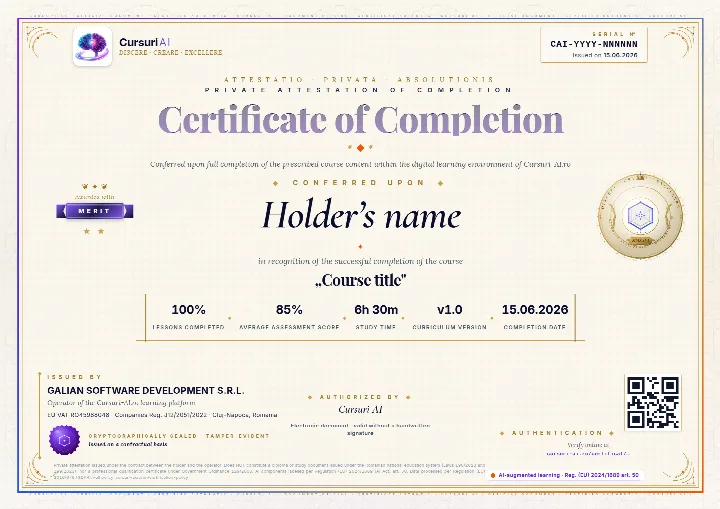
A Certificate of Completion for every course in the C# and .NET track
When you have gone through all the lessons of a course and have an average of at least 70% on its quizzes, you issue from your account, after confirming the conditions, a
Certificate of Completion with a unique number and a public verification link.
It is not issued automatically and it comes at no extra cost, with a plan or with single-course access.
Verifiable by anyone. Every certificate has a QR code and a public verification page, with its unique code. A recruiter checks it without an account.
With figures, not just a name. The percentage of lessons completed, the average quiz score and the study time are written on the document.
Three tiers, by quiz average: Pass (70–79%), Merit (80–89%) and Distinction (90% and above), shown on the document.
Your name, your choice. You decide whether your name appears on the public verification page, and you can change that choice at any time.
A private attestation of course completion. It is NOT a diploma or a state-recognised qualification under Romanian
Laws 198/2023, 199/2023 or Government Ordinance 129/2000; employers may take it into account at their own discretion.
The real document, an A4 PDF, shown here with sample data: the name, the course and the serial number are placeholders, and the QR code in the image is decorative.
The recommended track
AI courses for C# and .NET: 2 stages, 9 courses
In the order in which they matter. If you already have experience with model APIs, skip the foundations. For each course, the reason it matters to someone who works with C# and .NET.
1
Stage 1: Foundations: the mental model and the integration layer
What a model can and cannot do, how you talk to it and how a production integration is built. Language-independent, with the examples mostly in Python.
The complete frame: LLMs, APIs, RAG, agents, evaluation and security, so you make informed decisions before installing the first package.
Key modules: Machine Learning Essentials · Large Language Models and Modern Architectures · Working with LLM APIs and Integrations · AI Tools for Developers
Streaming, error handling, function calling, multi-model orchestration and productionization: the layer that abstractions such as Microsoft.Extensions.AI sit on top of, and that you have to understand in order to operate it. It also shows authentication to Azure OpenAI with managed identity, in a Python example.
Key modules: Streaming and Error Handling · Function Calling and Tool Use · Model Context Protocol (MCP) · Multi-Model Orchestration and Optimization
Stage 2: Systems and operations: RAG, agents, MCP, evaluation and security
The components you will build with Semantic Kernel or with the SDKs, and the practices that keep them in production. What transfers is the design; the examples stay in Python.
RAG end to end, from chunking to advanced architectures and evaluation. The module on tools and frameworks has a section on Semantic Kernel as the Microsoft approach, with its example in Python.
Key modules: Implementing the RAG Pipeline · Embedding Models and Document Processing · Advanced RAG · Advanced RAG Architectures
Memory, state, tools, design patterns, guardrails and observability for agents. The frameworks module presents Semantic Kernel, with a Python example, and says when a .NET-centric organisation should choose it.
Key modules: Memory, State and Advanced Reasoning · Frameworks and SDKs for AI Agents · Model Context Protocol (MCP) and Interoperability · Workflow Automation with AI
Protocol architecture, transports, authentication, enterprise patterns and security. The example servers are in Python and TypeScript; the protocol is language-agnostic, so the design carries to the C# SDK.
Key modules: Building MCP Servers with Python · Building MCP Servers with TypeScript · Transport, Authentication and Configuration · Enterprise Patterns and Production Architectures
Golden datasets, LLM-as-a-judge and regression tests in CI/CD: answer quality becomes a release criterion in whatever pipeline you already run.
Key modules: Classic Metrics and Why They Fail on Open-Ended Text · LLM-as-a-Judge: Design, Bias and Calibration · Building Evaluation Datasets · The Evaluation Tooling Landscape
Attacks, layered defences, guardrails, data protection and compliance with GDPR and the EU AI Act: the requirements you will get from security and compliance.
Key modules: Prompt Injection: The Defining Threat · Insecure Output Handling and Downstream Exploits · Guardrails: Input and Output Filtering · Securing RAG and Agents: Excessive Agency
Agentic coding on large codebases, the git workflow, deterministic hooks and CI. None of it is tied to a language, so it applies to .NET solutions as to any other repository.
Key modules: Multi-File and Large Codebases: Plan, Edit, Review and Context Management · The Full Git Workflow: Branches, Commits, Conflicts, Code Review and PRs · Headless Mode (claude -p) and Non-Interactive Automation · Subagents and Agent Teams: Orchestration, Delegation and Controlled Parallelization
All 9 courses in this track fit in a subscription of 10 courses.€319 per month, VAT included; you pick the courses and can change them at every renewal. Or only the course you are interested in, €99 per month, from the “This course only” link on each row.
What already exists, so that you do not start from zero. The courses in the track teach you what to build with it.
The official OpenAI library for .NETAn officially supported API client for C#.
The official Anthropic SDK for C#A client for the Claude API on .NET.
Microsoft.Extensions.AICommon abstractions for chat clients and embedding generators in .NET, with dependency injection and middleware for telemetry and caching.
Semantic KernelMicrosoft’s SDK for orchestrating tools, memory and agents; the agents course presents it as the natural choice for .NET-centric organisations.
The C# SDK for MCPAn official SDK of the protocol, for MCP servers and clients in .NET.
OpenAI-compatible endpointsSelf-hosted models served with vLLM or Ollama are called from .NET the same way as cloud APIs.
At the end
What you will be able to do at the end of the C# and .NET track
1Integrate an LLM into an existing .NET application through standard abstractions, with resilience, telemetry and cost under control
2Specify a RAG assistant over company documents, with document-level permissions and evaluation
3Design agents with tools, memory and guardrails, with a human in the loop where needed
4Put quality evaluation and security checks into the release pipeline
These are the skills you practise in the courses of the track; results depend on the time you invest and on your previous experience.
What you get here that you do not get from a tutorial
Courses of about 25 hours, structured in modules
Code examples, architectures and case studies, and in some courses a capstone project at the end. Not summaries of documentation, but structured material that you go through in order, at your own pace.
AI Professor in every lesson
You ask in the context of the lesson, by typing or by voice, and get an explanation of the concept you are on. Every lesson has its quiz: about 355 questions per course on average. The professor is an AI system, not a human teacher, included in every plan with a fair-use limit.
Up to date with what the industry asks for
Agentic coding, MCP, RAG, agents, evals, LLM security, fine-tuning, AIOps, computer vision and Edge AI are whole courses in the catalog, not closing chapters.
See the material before you pay
A preview of the first lesson of every course can be read without an account. Then you choose a subscription by number of courses, from €99 a month for one course to €319 a month for 10 courses, VAT included; you pick the courses and can change them at every renewal. You can stop the renewal anytime from your account; access stays until the end of the period already paid for.
Access
Pick the courses for C# and .NET in a subscription of 3, 5 or 10 courses
You pick them, with the AI Professor included, and can change them at every renewal. The whole track fits in a subscription of 10 courses (€319 a month, VAT included); with the full catalog (€499) you have every course.
How many courses a month?
Pay for the tier, then pick the courses in your account. You can change them at every renewal.
Total prices, VAT included. Move up anytime and pay only the difference for the days left; move down at renewal. Renews automatically, you stop it anytime from your account; your progress and certificates stay. Digital content with immediate access: see the withdrawal terms.
No. The examples are mostly in Python, and the MCP course also has a module in TypeScript. The courses are chosen for architecture, production practices and evaluation, which you then apply in C# with Microsoft.Extensions.AI, Semantic Kernel or the official SDKs. That is also why this track has two stages instead of three: it lists only the courses whose substance does not depend on the language.
I use Azure OpenAI. Do the courses apply?
Yes. The integration, RAG, agents and evaluation courses are not tied to one provider, and the LLM integration course shows authentication to Azure OpenAI with managed identity.
What is the difference between using a coding assistant and building with AI?
A coding assistant helps you write code faster. The courses here teach you to build products with AI components: retrieval, agents, MCP tools, evaluation, security. The first is personal productivity; the second is a design skill.
Which subscription opens these courses?
All the courses recommended here are IT courses. You pick them in a subscription by number of courses: usually 3, 5 or 10 courses a month for one language and stack; there are also 15 and 25 courses, a single course and the full catalog. You pick the courses and can change them at every renewal. The subscription renews automatically, and you can stop the renewal anytime from your account. Every price, VAT included, is shown below and on the pricing page. Every course has a free preview of its first lesson, readable without an account.
A free preview of the first lesson, without an account
Start the C# and .NET track today
9 courses, ~227 hours, all in a subscription of 10 courses: €319 per month, VAT included.
You can change them at every renewal; the AI Professor is built into every lesson.
Secure payment through StripeImmediate access after paymentStop the renewal anytime
The courses are for educational purposes only: they are not professional advice, and completing them is not a
diploma or a state-recognised qualification. The names of languages, tools and products belong to their owners
and are mentioned for identification only.
Details in the Terms & Conditions.
ChatGPT, OpenAI, Claude, Anthropic, Gemini, Google, Microsoft 365 Copilot, Cursor, Midjourney and the other product and company names mentioned are trademarks or trade names of their respective owners. Cursuri-AI.ro is an independent training provider and is not affiliated with, sponsored by or endorsed by any of them.
10 courses: €319/monththe whole C# and .NET track · VAT included