AI for SQL developers and data engineers: your data is the context models work with
If you work with SQL, databases or data pipelines, you are already at the centre of AI systems, even if you have never written a prompt. RAG means retrieval over your data, vector search has entered PostgreSQL through pgvector, agents query databases through MCP tools, and evaluating a model starts with a clean golden dataset. Your relevance does not depend on learning machine learning, but on understanding how models consume data and what makes them give wrong answers.
AI projects that fail in production very often fail on data: badly indexed documents, permissions ignored at retrieval, schemas the model does not understand, evaluation sets that do not reflect reality. Someone who knows data modelling, data quality and controlled access solves exactly these problems, provided they also understand the other half: embeddings, chunking, hybrid search, structured outputs, evals.
but
Where the risk is
At the same time, models now generate queries, which changes who writes SQL. The need for SQL does not disappear; the monopoly on it does. Value moves towards designing schemas that models can use, validating what they generate and governing access: skills the courses below build on your foundation.
In practice
What changes in your work with SQL and databases
01
Retrieval becomes a data problem
Chunking, embeddings, vector indexing, hybrid filtering and permissions at row or document level. A RAG pipeline is, in essence, a data pipeline with a model stage at the end.
02
Models write SQL, and someone has to validate it
Generated queries reach products. The AI security course treats model output sent to a database as untrusted input, so clear schemas, parameterization, least-privilege access and validation before execution become the data team’s job.
03
Databases are exposed to agents through MCP
MCP servers for databases give agents access to schemas and queries. Least-privilege permissions, read-only resources, limits and audit are new requirements for whoever administers the data.
04
Model quality is measured with datasets
Golden datasets, human annotation, retrieval metrics and privacy rules for evaluation data. Evaluating AI systems is, to a large extent, data work done rigorously.
Each of these changes has at least one course in the track below. See the track
The proof, at the end
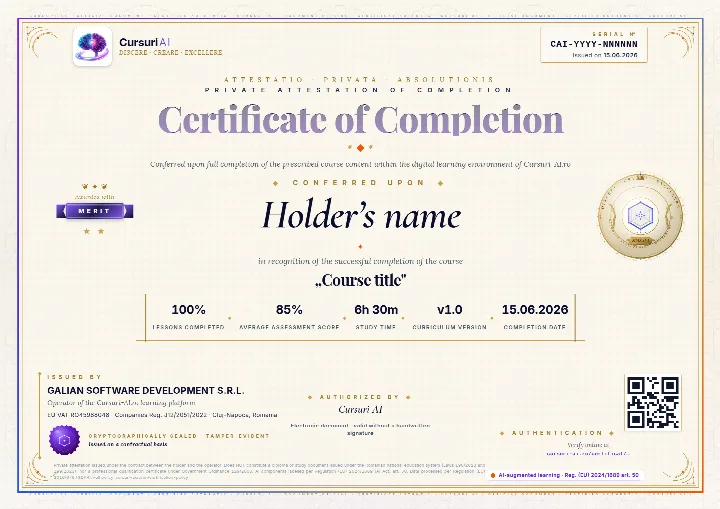
A Certificate of Completion for every course in the SQL and databases track
When you have gone through all the lessons of a course and have an average of at least 70% on its quizzes, you issue from your account, after confirming the conditions, a
Certificate of Completion with a unique number and a public verification link.
It is not issued automatically and it comes at no extra cost, with a plan or with single-course access.
Verifiable by anyone. Every certificate has a QR code and a public verification page, with its unique code. A recruiter checks it without an account.
With figures, not just a name. The percentage of lessons completed, the average quiz score and the study time are written on the document.
Three tiers, by quiz average: Pass (70–79%), Merit (80–89%) and Distinction (90% and above), shown on the document.
Your name, your choice. You decide whether your name appears on the public verification page, and you can change that choice at any time.
A private attestation of course completion. It is NOT a diploma or a state-recognised qualification under Romanian
Laws 198/2023, 199/2023 or Government Ordinance 129/2000; employers may take it into account at their own discretion.
The real document, an A4 PDF, shown here with sample data: the name, the course and the serial number are placeholders, and the QR code in the image is decorative.
The recommended track
AI courses for SQL and databases: 3 stages, 10 courses
In the order in which they matter. If you already have experience with model APIs, skip the foundations. For each course, the reason it matters to someone who works with SQL and databases.
1
Stage 1: Foundations: how models consume data
What an LLM is, how you talk to it, and the data engineering underneath every serious AI system.
LLMs, APIs, agents and evaluation: the complete frame, with a module on RAG, embeddings and vector databases that sets pgvector next to the dedicated engines.
Key modules: Machine Learning Essentials · Large Language Models and Modern Architectures · Working with LLM APIs and Integrations · AI Tools for Developers
Prompt engineering for code, including a case study on optimising a slow SQL query, and prompt security: instructions that produce verifiable output and resist injection.
Key modules: Advanced Prompting Techniques · Multi-Modal Prompt Engineering · Prompt Engineering for AI Agents · Prompt Engineering for Code
The course written for you: ingestion with change data capture, ETL and ELT with Airflow, Dagster and dbt, Parquet and Iceberg, data quality and contracts, embedding pipelines and vector databases in depth, with Python and SQL throughout.
Key modules: Storage and Table Formats: Parquet and Iceberg · Ingestion from Diverse Sources · ETL/ELT and Orchestration · Data Quality, Validation, and Contracts
Chunking, embedding models, hybrid search, re-ranking, advanced architectures and systematic evaluation: the pipeline of any AI system that answers from your data, with pgvector among the vector stores it covers.
Key modules: Implementing the RAG Pipeline · Embedding Models and Document Processing · Advanced RAG · Advanced RAG Architectures
Retrieval strategies for context, vector, graph, relational and hybrid, plus persistent memory and compaction: where data modelling decides the quality of an agent.
Key modules: The Anatomy of Context: The Components of the Inference Window · Memory Types for AI Agents · Memory Managers and Persistence: Extraction, Consolidation, Store · Retrieval Strategies for Context: Vector, Graph, Relational, Hybrid
How data is exposed to agents: the schema as a read-only resource, the query as a parameterized tool, with validation against SQL injection, authentication and least-privilege permissions. The practical projects include a PostgreSQL server.
Key modules: Building MCP Servers with Python · Building MCP Servers with TypeScript · Transport, Authentication and Configuration · Enterprise Patterns and Production Architectures
Postgres with pgvector as the product database, and multi-tenant isolation built on one rule: every row that belongs to a tenant carries a tenant id, and every query filters on it.
Key modules: Choosing Your Stack: Frontend, Backend, and LLM APIs · Integrating the LLM: Streaming, Tools, and Cost Control · Vector Search and RAG for Your Product · Authentication and Multi-Tenancy
Golden datasets with edge cases and slices, human annotation, RAG metrics with Ragas and regression tests in CI/CD, with attention to privacy for evaluation data: evaluation as a data discipline.
Key modules: Classic Metrics and Why They Fail on Open-Ended Text · LLM-as-a-Judge: Design, Bias and Calibration · Building Evaluation Datasets · The Evaluation Tooling Landscape
Data and feature management with feature stores, training pipelines, data lineage and drift monitoring: the pipeline in which your data feeds and monitors models.
Key modules: Experiment Tracking and Reproducibility · Data and Feature Management · Training Pipelines and Orchestration · Model Registry, Versioning, and CI/CD for ML
PII, leakage and poisoning, the insecure handling of model output such as generated SQL, and the security of RAG pipelines: the requirements the data team will be asked to meet.
Key modules: Prompt Injection: The Defining Threat · Insecure Output Handling and Downstream Exploits · Guardrails: Input and Output Filtering · Securing RAG and Agents: Excessive Agency
All 10 courses in this track fit in a subscription of 10 courses.€319 per month, VAT included; you pick the courses and can change them at every renewal. Or only the course you are interested in, €99 per month, from the “This course only” link on each row.
What already exists, so that you do not start from zero. The courses in the track teach you what to build with it.
pgvector and vector search in SQLEmbeddings stored and queried directly in PostgreSQL, next to relational data; the data engineering course has a full lesson on it.
Dedicated vector databasesPinecone, Qdrant and Weaviate for retrieval at scale, with approximate indexes and metadata filtering.
dbt, Airflow and DagsterTransformation and orchestration for the pipelines that feed models.
Parquet and Apache IcebergColumnar storage and the table format behind a lakehouse.
MCP servers for databasesTools through which agents explore schemas and run queries, with the permissions and limits you configure.
Evaluation frameworksDeepEval, Ragas and promptfoo consume the test datasets you build and maintain like any other data asset.
At the end
What you will be able to do at the end of the SQL and databases track
1Design and evaluate a RAG pipeline over relational data and documents, with permissions at row or document level
2Add vector search in PostgreSQL or in a dedicated database, with hybrid filtering
3Build the ingestion, quality and embedding pipelines that feed models
4Expose databases to agents through MCP, with least-privilege permissions, limits and audit
5Build and maintain the evaluation datasets that decide the quality of the AI system
These are the skills you practise in the courses of the track; results depend on the time you invest and on your previous experience.
What you get here that you do not get from a tutorial
Courses of about 25 hours, structured in modules
Code examples, architectures and case studies, and in some courses a capstone project at the end. Not summaries of documentation, but structured material that you go through in order, at your own pace.
AI Professor in every lesson
You ask in the context of the lesson, by typing or by voice, and get an explanation of the concept you are on. Every lesson has its quiz: about 355 questions per course on average. The professor is an AI system, not a human teacher, included in every plan with a fair-use limit.
Up to date with what the industry asks for
Agentic coding, MCP, RAG, agents, evals, LLM security, fine-tuning, AIOps, computer vision and Edge AI are whole courses in the catalog, not closing chapters.
See the material before you pay
A preview of the first lesson of every course can be read without an account. Then you choose a subscription by number of courses, from €99 a month for one course to €319 a month for 10 courses, VAT included; you pick the courses and can change them at every renewal. You can stop the renewal anytime from your account; access stays until the end of the period already paid for.
Access
Pick the courses for SQL and databases in a subscription of 3, 5 or 10 courses
You pick them, with the AI Professor included, and can change them at every renewal. The whole track fits in a subscription of 10 courses (€319 a month, VAT included); with the full catalog (€499) you have every course.
How many courses a month?
Pay for the tier, then pick the courses in your account. You can change them at every renewal.
Total prices, VAT included. Move up anytime and pay only the difference for the days left; move down at renewal. Renews automatically, you stop it anytime from your account; your progress and certificates stay. Digital content with immediate access: see the withdrawal terms.
I am not an application developer but an analyst or a DBA. Does it make sense?
Yes. The courses are chosen for the data side of AI systems: pipelines, retrieval, schemas, evaluation, controlled access. You need Python at reading level for the examples; the introduction to AI engineering gives you the frame for the rest.
Is there SQL in the courses?
The data engineering course uses Python and SQL throughout, including in its lesson on pgvector. The MCP course builds a PostgreSQL server and treats the query as a parameterized tool. The other courses use Python, with SQL appearing where a database is involved.
Do models that generate SQL make my work pointless?
They change it. Models generate queries; someone has to design schemas they understand, validate what they produce, limit access and evaluate the results on known sets. Those are the skills the data engineering, MCP, security and evaluation courses build on your SQL foundation.
Which subscription opens these courses?
All the courses recommended here are IT courses. You pick them in a subscription by number of courses: usually 3, 5 or 10 courses a month for one language and stack; there are also 15 and 25 courses, a single course and the full catalog. You pick the courses and can change them at every renewal. The subscription renews automatically, and you can stop the renewal anytime from your account. Every price, VAT included, is shown below and on the pricing page. Every course has a free preview of its first lesson, readable without an account.
A free preview of the first lesson, without an account
Start the SQL and databases track today
10 courses, ~251 hours, all in a subscription of 10 courses: €319 per month, VAT included.
You can change them at every renewal; the AI Professor is built into every lesson.
Secure payment through StripeImmediate access after paymentStop the renewal anytime
The courses are for educational purposes only: they are not professional advice, and completing them is not a
diploma or a state-recognised qualification. The names of languages, tools and products belong to their owners
and are mentioned for identification only.
Details in the Terms & Conditions.
ChatGPT, OpenAI, Claude, Anthropic, Gemini, Google, Microsoft 365 Copilot, Cursor, Midjourney and the other product and company names mentioned are trademarks or trade names of their respective owners. Cursuri-AI.ro is an independent training provider and is not affiliated with, sponsored by or endorsed by any of them.
10 courses: €319/monththe whole SQL and databases track · VAT included