Knowing how to use AI in your job search is now a basic skill, but the useful version is not "paste the job ad, send what comes back." That produces generic applications, and sometimes applications that claim things you never did. This guide shows the other way: AI as researcher, editor and interview partner working only with your real experience, plus what applicant tracking systems verifiably do, what employers' rules say, and what never to paste into a chat window.
What AI is good at in a job search, and what it is not
A general-purpose assistant such as ChatGPT, Claude, Gemini or Microsoft Copilot is good at the language work around an application: pulling the essentials out of a long job description, suggesting clearer wording, spotting where your resume (CV) is vague, and playing an interviewer who asks follow-up questions.
It is bad at three things that matter in hiring:
- Facts about you. The model does not know what you did. Ask it to "make my resume stronger" without evidence and it fills the gaps with plausible achievements, metrics and tools. Those are fabrications, even when they sound like you.
- Facts about the employer. Company details, recent news and pay ranges from model memory can be outdated or invented. Anything you will mention to an employer needs a primary source.
- Judgment about fit. It will argue that you suit any role. Whether the role suits you is your call.
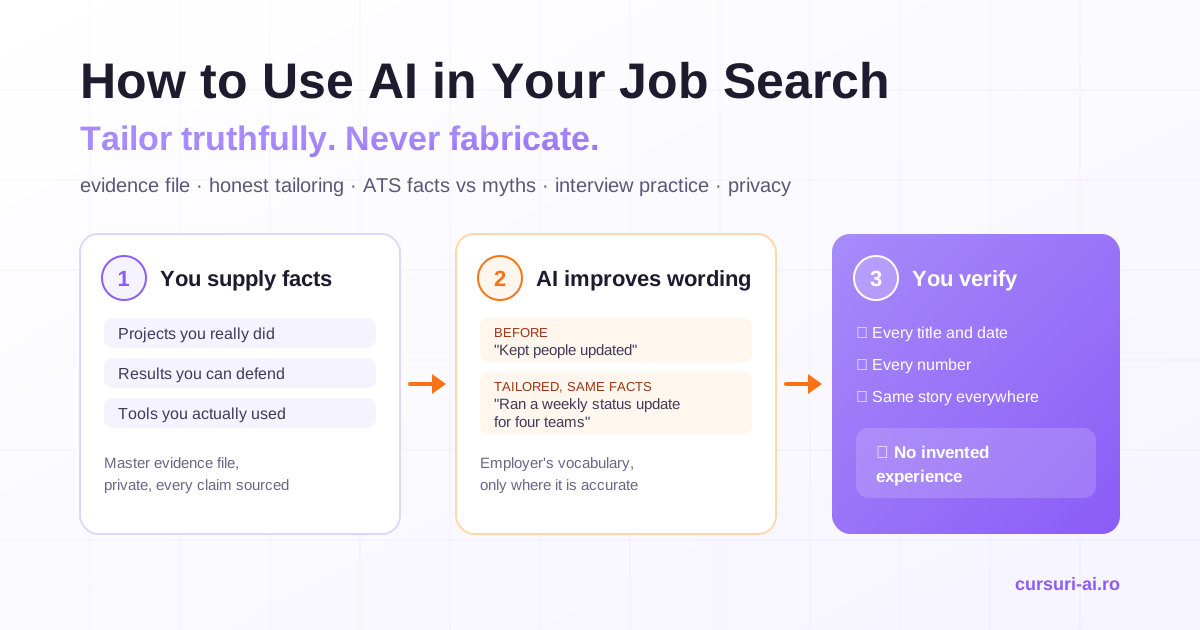
The working rule: you supply the facts, AI improves the expression, and you verify every line before it leaves your hands.
The integrity rule: tailor, never fabricate
Tailoring means selecting, ordering and wording true experience so its relevance to a specific role is obvious. Fabrication means adding anything untrue: a tool you have not used, a metric you cannot defend, a title you did not hold, a responsibility that belonged to your manager.
This is a practical line as well as an ethical one. People can compare your resume, profiles and interview answers, and employers can verify titles, dates and education before an offer. A claim that got you through a keyword search becomes a liability at the first follow-up question.
Employers that publish candidate AI policies draw the same line. Anthropic's published guidance for candidates encourages applicants to use Claude to research the company, practice answers and refine their own drafts, but lists "Generic content with experiences you haven't actually had" as not allowed. Policies differ, so read the one that applies to each application.
The hard part is not the prompting. It is building an honest evidence base and keeping one consistent story across every document and conversation, which is the backbone of AI for Your Job Search and Career Growth.
Step 1: Build a master evidence file
Weak AI-assisted resumes are usually weak because the input was weak. Before tailoring anything, write a private document with everything you can prove for each role: projects, what you personally did, tools you really used, outcomes, numbers you can defend and where they come from.
Then let AI interview you about it. This surfaces achievements you forgot without letting the model invent them:
I am preparing a job search. Below are my notes about my role as
[title] at [company type], [dates]. Ask me up to 10 questions, one at
a time, to uncover concrete achievements: what I changed, for whom,
with what result, and how I know the result is real. Do not suggest
achievements yourself. If I cannot answer with evidence, move on.

[paste your notes]
Answer in your own words, then ask for draft bullets, each tagged with the evidence behind it. Bullets without evidence stay in your notes. If a number is an estimate, record it as one ("about 20%, from the team dashboard in Q2") so you can explain it in an interview.
Step 2: Decode the job description
Job ads mix hard requirements, nice-to-haves and boilerplate. AI separates them quickly if you keep it inside the text:
Here is a job description. Using only this text, list:
1. The 5 to 8 most important requirements, each with the exact
   phrase from the ad.
2. Requirements that look like knockout criteria (location, work
   authorization, licenses, languages, years of experience).
3. The employer's vocabulary for key skills, including abbreviations.
Do not add anything that is not in the text. Quote, do not paraphrase.

[paste the job description]
Requiring quotes lets you check every line against the ad. The knockout list matters because, as shown below, some automated screening runs on your answers to application questions rather than on your resume.
Step 3: Tailor your resume with truthful evidence
Now combine the two, so the most relevant true material is easy to find and uses the employer's vocabulary where that vocabulary is accurate:
Below are (A) my master evidence file and (B) the key requirements
from a job description. For each requirement, find the strongest
matching evidence in (A) and suggest a resume bullet that uses the
employer's wording only where it accurately describes what I did.
Rules:
- Use only facts present in (A). Never add tools, metrics, titles or
  responsibilities.
- If a requirement has no supporting evidence, write "NO EVIDENCE".
- Flag any wording that overstates my role ("led" when I
  "contributed").

(A) [paste evidence file]
(B) [paste requirements]
The "NO EVIDENCE" rows show where you are honestly weaker: address them in a cover letter or take them as a sign the role is not a fit.
An illustrative example (not a real candidate):
- Original: "Responsible for keeping stakeholders updated on project status."
- Tailored, same facts: "Ran a weekly status update for four internal teams during a CRM migration, flagging schedule risks before each release."
- Fabricated, do not do this: "Led stakeholder management for a company-wide transformation, cutting delivery time by 40%."
The tailored version is more specific because it draws on the evidence file. The fabricated one is more impressive and collapses at the first follow-up question.
Two wording habits help both software and people: write the standard name of a skill with its abbreviation once ("Search Engine Optimization (SEO)"), and put each skill where it is proven, inside an experience bullet, not only in a skills list.
ATS: what is documented and what is myth
An applicant tracking system (ATS) is the software employers use to receive, store and search applications. Advice about ATS is full of confident claims with no source, so here is what one widely used vendor, Greenhouse, actually documents.
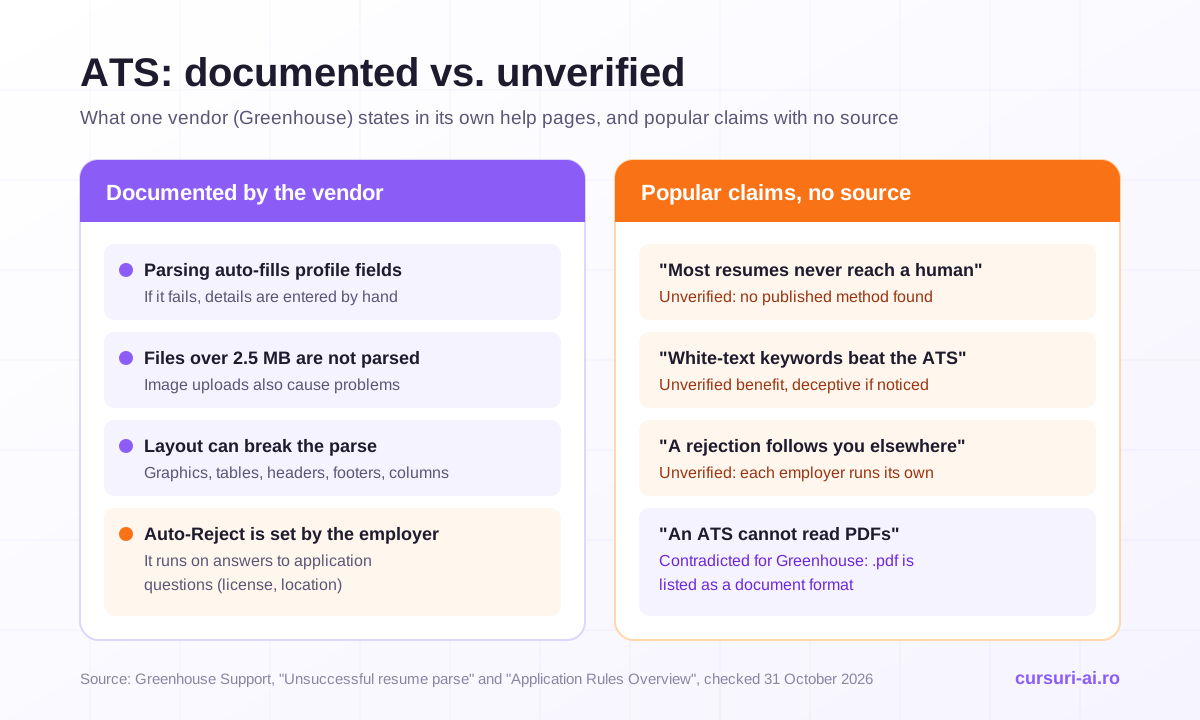
Parsing
Greenhouse's help article on unsuccessful resume parses says parsing scans an imported resume and auto-fills the appropriate profile fields. When a parse fails, the resume is still attached to the candidate, but someone has to enter the details by hand. The listed causes:
- files larger than 2.5 MB;
- a resume uploaded as an image rather than a document such as a .docx or .pdf;
- graphics, photos or word art;
- complex layouts with tables, headers and footers, or columns;
- letters separated by spaces;
- placeholder or disguised data, such as "Company 1".
It does not say a badly parsed resume is rejected; it says the structured data may be incomplete, which matters when a recruiter searches those fields. Other products parse differently.
A sixty-second self-test: open your PDF, select all the text, paste it into a plain-text editor. If your name, titles, dates and bullets come out in a sensible order, a parser has a fair chance too. If they come out scrambled, simplify the layout.
Automatic rejection exists, configured by the employer
Greenhouse's application rules documentation describes Auto-Reject, which "uses custom application questions to screen and reject candidates based on their responses", intended for essential criteria such as license or location requirements. The documented automatic rejection in this product runs on your answers to questions the employer chose, not on a secret reading of your resume.
So answer knockout questions (work authorization, location, licenses, availability) accurately and carefully. One click there can end an application, and a false answer there is easy to discover later.
Claims to treat as unverified
| Claim you will see | Status | What to do instead |
|---|---|---|
| "Most resumes are rejected by software before a human sees them" | Unverified: we found no published methodology behind it | Write for the human skim; keep the file parseable |
| "Hidden white-text keywords beat the ATS" | Unverified as a benefit, and deceptive if noticed | Use accurate keywords where they are true |
| "PDFs cannot be read by an ATS" | Contradicted for Greenhouse, which names .pdf as a document format | Submit a text-based PDF or .docx, as the employer asks |
| "A rejection at one company follows you to others" | Unverified; each employer runs its own ATS for its own hiring | Treat each application on its own merits |
Clean structure, accurate vocabulary and real evidence work under any configuration; gaming tricks are not worth the risk.
Cover letters that do not sound generated
A bare prompt like "write a cover letter for this job" produces text that could come from anyone. Give AI your raw material and ask for structure instead:
Help me structure a cover letter. Inputs:
- Why this role and company (my notes, from their site): [paste]
- My two most relevant achievements, from my evidence file: [paste]
- One honest gap and how I would close it: [paste]
Produce an outline of 3 short paragraphs with suggested opening
sentences. Use only my inputs. Under 250 words. Avoid clichés such as
"I am excited to apply" and "passionate".
Write the letter from that outline, or edit the draft heavily, and read it aloud. Any sentence that could appear in anyone's letter gets cut or replaced with a specific detail. Before sending, ask AI to list (not fix) every inconsistency in titles, dates, numbers and tools between your resume, letter and profile.
Interview practice: rehearse with AI, perform without it
Interview preparation is where AI is most useful and least risky, because nothing it produces goes to the employer:
Act as a hiring manager for the role below. Ask me one interview
question at a time, based only on the job description. After each
answer, ask one probing follow-up, then give feedback on clarity,
evidence and length. Do not invent facts about me or the company.
After 6 questions, summarize my two weakest answers.

[paste the job description]
For behavioral questions, paste a rough STAR answer (Situation, Task, Action, Result) and ask which part is missing or too long, not for a better story.
In the real interview, the employer's rules apply. Anthropic's candidate guidance, for example, says live interviews are "all you" with "no AI assistance unless we indicate otherwise", and asks for take-home assessments to be completed without Claude unless stated. If a policy is unclear, ask the recruiter beforehand. Hidden real-time assistance where it is not allowed is a fast way to end a process.
How employers use AI in hiring, and the rules around it
Employers use AI too: drafting job ads, matching and ranking applications, summarizing interviews. Regulators treat this as sensitive.
This section is general information, not legal advice. Dates and article numbers were checked against the official texts on 31 October 2026.
EU AI Act. Annex III of Regulation (EU) 2024/1689 lists as high-risk "AI systems intended to be used for the recruitment or selection of natural persons, in particular to place targeted job advertisements, to analyse and filter job applications, and to evaluate candidates." Those high-risk obligations were due on 2 August 2026; Regulation (EU) 2026/1744, the Digital Omnibus on AI, moved them to 2 December 2027. From then, deployers of such systems that make or assist decisions about people must inform those people (Article 26(11)). The Act's prohibitions have applied since 2 February 2025, including the ban on AI that infers people's emotions in the workplace, except for medical or safety reasons.
GDPR. Article 22 of Regulation (EU) 2016/679 gives you the right not to be subject to a decision based solely on automated processing with legal or similarly significant effects, subject to narrow exceptions with safeguards such as human intervention; Recital 71 names "e-recruiting practices without any human intervention" as an example. Article 15 lets you access the personal data an employer holds about you and, where such automated decision-making exists, "meaningful information about the logic involved." These rights apply now.
New York City. Local Law 144 of 2021 bars employers and employment agencies from using an automated employment decision tool unless it has had a bias audit within one year of use, information about the audit is public, and candidates have received the required notices. The Department of Consumer and Worker Protection has enforced it since 5 July 2023, says notice must come 10 business days before the tool is used, and accepts complaints. Other US jurisdictions and the UK have their own rules; check your regulator.
As a candidate, you can reasonably ask a recruiter whether there is human review at each decision stage and how long they keep application data.
Privacy: what not to paste into a chatbot
A job search produces sensitive material: contact details, salary history, references, sometimes health details behind a gap, and your employer's confidential information.
- Strip identifiers. A bullet point does not need your phone number, address, date of birth or ID numbers. Use placeholders.
- Leave other people out. References and former colleagues did not agree to have their details processed by your tools.
- Respect confidentiality. Client names, unreleased products and internal figures under an NDA stay at the level you would say aloud in an interview.
- Check the training setting. In Claude's consumer apps it is "Model Improvement" under Privacy Settings; ChatGPT has its own model-improvement switch in its data settings. Decide deliberately, and do not run your job search on an employer's account.
- Watch for early document requests. An application does not need copies of identity documents or bank details. A recruiter asking for fees or banking information is a red flag.
A weekly routine
| When | Task | Where AI helps | What you verify |
|---|---|---|---|
| Once, then monthly | Master evidence file | Interviewing you to surface achievements | Every number and claim |
| Per application | Decode the job ad | Extracting requirements with quotes | Quotes match the ad |
| Per application | Tailor resume and letter | Mapping evidence, wording | No new facts, no inflated verbs |
| Weekly | Interview practice | Mock interviews with follow-ups | Answers are true and specific |
| Weekly | Tracking and follow-up | Summarizing status, drafting messages | Names, dates, tone |
The habits behind this (templates, a prompt library, a tracking sheet, time-boxing) are general productivity skills, covered for everyday knowledge work in the AI Productivity Masterclass for Knowledge Workers. If your prompts keep producing generic output, the techniques in Prompt Engineering in 2026: From Beginner to Pro transfer directly, and if your search points toward technical AI roles, What Is an AI Engineer? explains what that work involves.
Keep a human route open as well: referrals and conversations with hiring managers reward what AI cannot supply, your track record and your relationships.
Frequently Asked Questions (FAQ)
Is it acceptable to use AI to write my resume? Using AI to structure, edit and tailor a resume built from your own verified experience is generally accepted, and some employers explicitly encourage it. Using AI to add experience, skills or results you do not have is fabrication. Check each employer's policy, since some restrict AI in assessments and live interviews.
Do applicant tracking systems automatically reject resumes? Automatic rejection exists as an employer-configured rule. In Greenhouse, Auto-Reject screens candidates based on their answers to custom application questions, such as license or location requirements. The popular claim that software rejects most resumes before a human reads them has no published methodology we could find.
Can I use AI during a live interview? Only if the employer allows it. Some publish explicit rules; Anthropic's candidate guidance says live interviews are "all you" unless the company indicates otherwise. When in doubt, ask the recruiter before the interview.
What rights do I have if an employer uses AI to screen me? In the EU, the GDPR already gives you access to your data and protection against decisions based solely on automated processing with significant effects, and the AI Act's high-risk rules for recruitment AI apply from 2 December 2027. In New York City, Local Law 144 requires bias audits and advance notice. Other jurisdictions differ; this is general information, not legal advice.
Conclusion
Using AI in your job search well is a division of labor: you own the facts, AI helps with research, structure, wording and practice, and you check everything before it goes out. Build an evidence file, tailor with evidence, keep files parseable, answer knockout questions carefully, rehearse with AI but answer real interviews on your own, and keep private data out of prompts. None of this guarantees an interview or an offer. It makes every application accurate, specific and defensible, which is the part you control.
This article is general information, not legal advice. Legal references were checked against the official texts on 31 October 2026; rules and employer policies change, so check current versions before relying on them.
Sources
- Regulation (EU) 2024/1689 (Artificial Intelligence Act), Annex III point 4(a), Articles 5, 26(11) and 113
- Regulation (EU) 2026/1744 (Digital Omnibus on AI), Official Journal of the European Union, 24 July 2026
- Regulation (EU) 2016/679 (General Data Protection Regulation), Articles 15 and 22, Recital 71
- Unsuccessful resume parse, Greenhouse Support

The course that continues this article
AI for Your Job Search and Career Growth
You have read the theory. In the course you put it into practice: written lessons structured in modules, with examples and exercises, quizzes, the AI Professor in every lesson and progress saved automatically. Once you complete the lessons and reach the minimum quiz score, you get the Certificate of Completion, a private attestation.
From the course syllabus
- Module 0 — AI for Your Career in 2026: Mindset and Integrity
- Module 1 — Career Clarity and Honest Self-Assessment
- Module 2 — Your Resume, Optimized with AI and ATS-Friendly
- Module 3 — Cover Letters and Written Applications
+ 6 more modules in the full syllabus
€99 per month for this course, VAT included · or pick it in a subscription of 3, 5 or 10 courses, from €199 per month, together with other Business courses; you can change them at every renewal (see what you learn across the whole track).
Monthly subscription with automatic renewal · stop the renewal anytime from your account · digital content with immediate access, see the withdrawal conditions. The certificate confirms that you completed the course and is private: it is not a diploma or a state-recognised qualification.