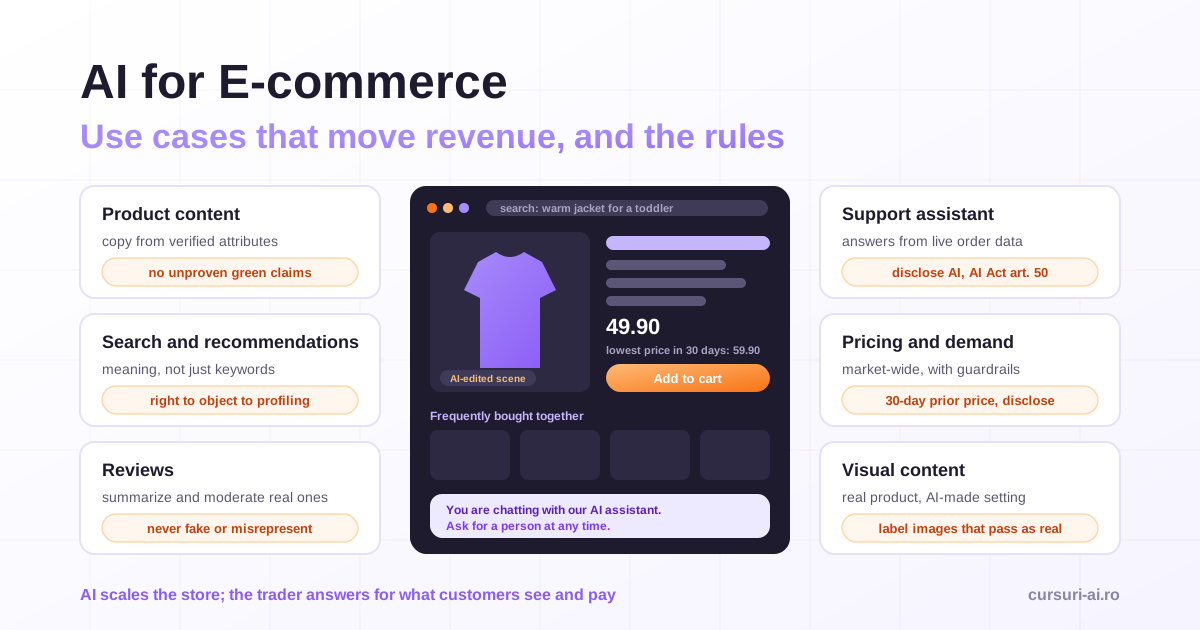
AI for e-commerce is no longer a single feature such as a chatbot in the corner of the page. It now touches every step between a product feed and a delivered order: the copy on the product page, the results of the search box, the "you may also like" row, the answer a customer gets at 11 p.m., the price, and the images. Each of those can move revenue, and each sits under rules that apply whether a person or a model produced the output. This guide walks through the use cases one by one, with what works, what goes wrong, and the EU rules that apply to each.
Where AI for e-commerce actually pays off
Most stores do not need more AI. They need it in the few places where it changes a number they already track. A useful way to map those places is the order journey:
| Stage | AI use case | The number it moves |
|---|---|---|
| Catalog | Product titles, descriptions, attributes, translations | Organic traffic, conversion, returns |
| Discovery | Semantic site search, recommendations, merchandising | Search conversion, average order value |
| Decision | Review summaries, sizing help, shopping assistants | Conversion, returns |
| Service | Order-status and returns assistants, agent copilots | Contact rate, resolution time, satisfaction |
| Operations | Demand forecasting, markdowns, dynamic pricing | Stock-outs, overstock, margin |
| Creative | Product photo editing, lifestyle scenes, ad variants | Production cost, speed to market |
Two rules hold across all of them. First, AI scales whatever you feed it: clean product data produces good copy, good search and good recommendations; messy data produces confident errors at catalog scale. Second, the trader stays responsible for what the customer sees and pays, whoever wrote it. The full map, from catalog to fraud and analytics, with the legal guardrails attached to each module, is covered in AI for E-commerce and Retail.
Product content at scale
Product content is where most stores start, because the gain is immediate: thousands of thin or supplier-copied descriptions can be rewritten, translated and structured in days instead of months.
What works is attribute-grounded generation. The model receives the product's verified attributes (materials, dimensions, compatibility, care instructions) and writes only from them. It does not "know" the product; it formats facts you give it. A prompt that enforces this looks like:
Write a product description for the product below.
Use ONLY the attributes provided. If an attribute is missing, do not guess it.
Do not make health, safety, medical or environmental claims unless they
appear verbatim in the attributes. Do not use absolute terms ("waterproof",
"unbreakable") unless the exact rating is provided.
Do not invent discounts, scarcity, comparisons or "best-seller" status.
After the description, list every sentence that would need documented proof.

Attributes:
{attributes_json}
The last instruction turns the model into a first-pass reviewer: it points a human at the sentences most likely to carry legal risk.
What goes wrong is predictable:
- Invented attributes. A model asked to "make it compelling" adds a feature the product does not have. On a large catalog, a small error rate becomes hundreds of wrong pages, and wrong pages become returns.
- Marketing claims that are now illegal. Models love phrases like "eco-friendly" and "sustainable." Since 27 September 2026, EU member states must apply Directive (EU) 2024/825, which adds to the blacklist of unfair practices "making a generic environmental claim for which the trader is not able to demonstrate recognised excellent environmental performance relevant to the claim," environmental claims about the entire product when they concern only one aspect, and climate-neutral claims based on carbon offsetting. A generated "eco-friendly" on a thousand product pages is a thousand problems.
- Thin, interchangeable pages. Google's guidance on generative AI content warns that using these tools "to generate many pages without adding value for users may violate" its spam policy on scaled content abuse. Descriptions that differ from the supplier's only in wording add nothing.
Marketplaces and shopping feeds have their own labeling rules. Google Merchant Center's policy on AI-generated content requires that "all images created using generative AI must contain meta data indicating that the image was AI-generated" (the IPTC DigitalSourceType property, for example TrainedAlgorithmicMedia), and that AI-generated titles and descriptions go in the separate structured_title and structured_description attributes, with the digital_source_type sub-attribute set to trained_algorithmic_media. If your pipeline writes product data with a model, the feed needs to say so.
Product content also feeds the AI assistants that increasingly answer shopping questions before anyone visits a store. Clean attributes, consistent naming and accurate structured data are what those systems can quote; how to be cited by them is covered in Generative Engine Optimization (GEO).
Site search and recommendations
Search and recommendations are where shoppers with intent either find the product or leave.
Semantic and hybrid search. Keyword search fails on the queries real people type: "warm jacket for a toddler," "charger for a 2019 laptop," a misspelled brand. Embedding-based retrieval matches meaning, and combining it with keyword matching keeps exact matches (SKUs, model numbers, brand names) working. The practical starting point is not a new engine but your own logs: the queries that return zero results or get no clicks are your backlog.
Recommendations. The classic families still apply: "frequently bought together" from co-purchase data, "similar items" from product attributes and embeddings, and personalized ranking from a shopper's behavior. Three failure modes deserve attention:
- Popularity bias. The engine keeps recommending best-sellers, which would have sold anyway. Measure incremental revenue against a holdout group, not total revenue through the widget.
- Cold start. New products and new visitors have no history. Attribute-based similarity covers both until behavioral data exists.
- Recommending the unavailable or the inappropriate. Out-of-stock items, products a customer just returned, or accessories that do not fit what they bought. Business rules on top of the model are not optional.
Personalization runs on personal data. Behavioral recommendations and personalized emails are profiling, so the GDPR applies. In particular, Article 21(2) gives customers "the right to object at any time" to processing for direct marketing, "which includes profiling to the extent that it is related to such direct marketing," and once they object, the data can no longer be used for that purpose. Build the opt-out into the recommendation pipeline, not just the email footer. Testing, consent and measurement for personalization are treated in depth in AI for Digital Marketing, and the channel side in our practical guide to AI for digital marketing.
Reviews: summarize the real ones, never write fake ones
AI is useful with reviews: summarizing hundreds of them into an honest overview, moderating spam and abuse, surfacing the most helpful ones, and mining recurring complaints ("runs small," "arrived damaged") for the product and operations teams. That last use often reduces returns more than any on-site feature.
The line not to cross is fabrication, and EU law draws it explicitly. The Omnibus Directive (EU) 2019/2161 added two practices to the Unfair Commercial Practices Directive's list of practices that are always unfair:
- Point 23b: "stating that reviews of a product are submitted by consumers who have actually used or purchased the product without taking reasonable and proportionate steps to check that they originate from such consumers."
- Point 23c: "submitting or commissioning another legal or natural person to submit false consumer reviews or endorsements, or misrepresenting consumer reviews or social endorsements, in order to promote products."
The same directive made it material information, under Article 7(6), "whether and how the trader ensures that the published reviews originate from consumers who have actually used or purchased the product." In practice: say on the review page how reviews are collected and verified, moderate under a neutral policy that removes spam and abuse whether positive or negative, and never publish AI-generated "customer" reviews or testimonials. A review summary must reflect the real balance of opinion; one that drops the criticism is a quieter form of misrepresentation.
Enforcement is real. In a coordinated screening of 223 major websites published in January 2022, consumer authorities from 26 member states, Iceland and Norway could not confirm, for 144 of them, that the trader was doing enough to ensure reviews were authentic, and 118 gave no information on how fake reviews are prevented.
Customer support and shopping assistants
Retail support volume is dominated by a short list of questions: where is my order, how do I return this, does this fit, when will it be back in stock. These are well suited to an AI assistant, provided it answers from your systems and not from its general knowledge.
What a production-grade retail assistant needs:
- Grounding in live data. Order status, delivery tracking, stock and the current returns policy come from your systems through tool calls, not from the model's memory. A confidently wrong returns window is a consumer-law problem, not just a bad answer.
- Clear limits. Refunds above a threshold, damaged-goods claims, complaints and anything involving a payment dispute go to a person.
- A real handoff. The customer reaches a human with the conversation history attached, without repeating everything.
- Measurement beyond deflection. Track resolution, repeat contacts and satisfaction. A bot that "deflects" a customer who then calls has added a contact, not removed one.
Disclosure is now a legal requirement. Article 50(1) of the AI Act requires that AI systems "intended to interact directly with natural persons" be designed so that people "are informed that they are interacting with an AI system," unless that is obvious to a reasonably well-informed person in context, and Article 50(5) requires that information "at the latest at the time of the first interaction." These transparency obligations apply from 2 August 2026, and the AI Omnibus, Regulation (EU) 2026/1744, did not postpone them. A line such as "You are chatting with our AI assistant. You can ask for a person at any time" at the start of the conversation covers the disclosure and sets expectations. Building, measuring and escalating AI support, from deflection to agent copilots, is the subject of AI for Customer Support and Service.
Pricing and demand signals
Pricing is where AI can add margin quickly and where mistakes are most expensive, legally and in customer trust.
Demand forecasting is the lower-risk entry point. Models that combine sales history, seasonality, promotions and external signals help decide what to reorder, when to mark down and where to place stock. Keep a person in the loop for what the history cannot see: a new product, a supplier problem, a competitor's clearance sale.
Dynamic pricing means changing the price shown to the whole market over time, based on demand, stock, competitor prices or season. It is a long-established practice and generally lawful, but it needs guardrails in any engine:
- price floors and ceilings per category, so a feed error cannot sell below cost or at an absurd price;
- limits on how fast a price can move;
- an audit log of every change and the reason for it;
- a human who reviews the strategy and can stop the engine.
Three EU rules apply directly to AI pricing:
- Reference prices. Under Article 6a of the Price Indication Directive, inserted by the Omnibus Directive, an announced price reduction must show the prior price, which is "the lowest price applied by the trader during a period of time not shorter than 30 days prior to the application of the price reduction" (member states may set different rules for perishable goods and products on sale for less than 30 days). Never let a model generate a "was" price or a discount percentage; pull them from your pricing history.
- Personalized prices must be disclosed. The Consumer Rights Directive, as amended by the Omnibus Directive, requires traders to tell consumers, before a distance contract, "where applicable, that the price was personalised on the basis of automated decision-making." If you would not be comfortable showing that notice, do not personalize the price.
- No coordination. Monitoring public competitor prices and responding independently is normal competition; using a shared pricing tool or data pool in a way that aligns rivals' prices is a competition-law risk. Treat any vendor pitch built on "everyone on the platform prices together" as a red flag.
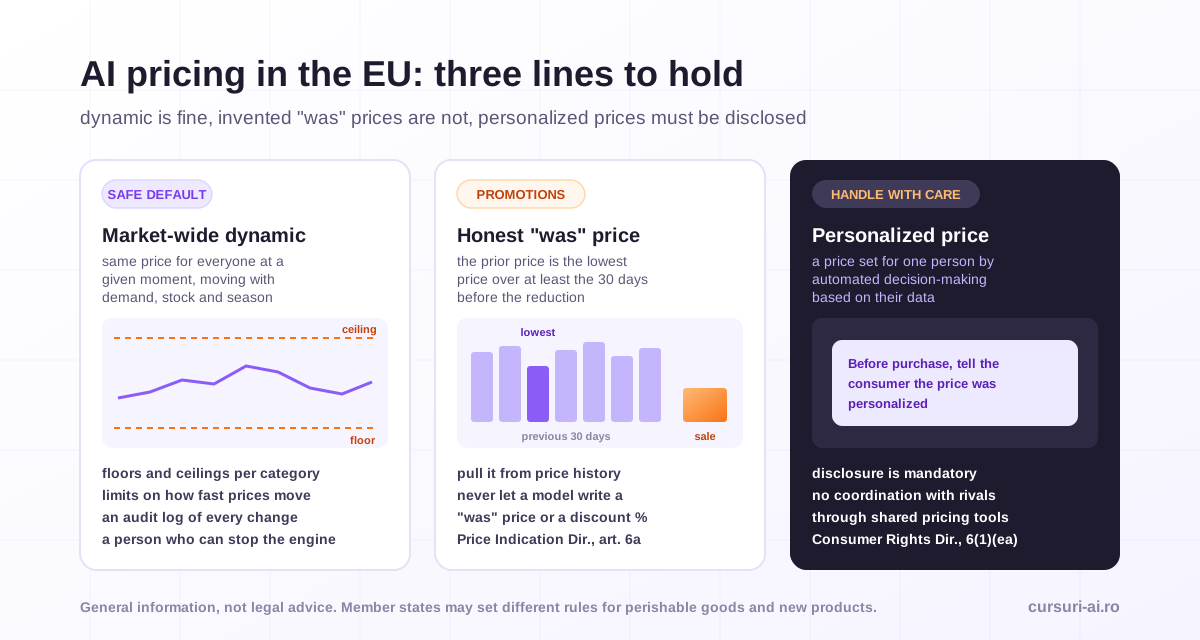
The safe default for most stores is simple: dynamic, market-wide pricing with honest reference prices, and no individual-level price discrimination.
Visual content
Generative image tools have changed product photography economics. Background removal, consistent lighting, resizing for each channel and lifestyle scenes built around a real packshot are now routine, and they cut the cost of launching a new product.
The risk is misrepresentation. An image that makes the product look larger, a different color or better finished than it is will mislead shoppers and come back as returns and complaints, whoever made it. Practical rules:
- Start from a real photograph of the actual product and let AI change the setting, not the product.
- Keep color, proportions, texture and included accessories exactly as delivered.
- Do not present generated people as real customers, and do not use generated "customer photos" next to reviews.
- Preserve the AI metadata that your tools embed; Merchant Center requires it for generated images, and many editing tools strip it on export.
The AI Act adds two layers. Providers of generative tools must mark outputs "in a machine-readable format and detectable as artificially generated or manipulated" under Article 50(2); for tools already on the market before 2 August 2026, the AI Omnibus allows until 2 December 2026. And under Article 50(4), a deployer of an AI system that generates or manipulates image content "constituting a deep fake" must disclose that it is artificially generated. The AI Act defines a deep fake as generated or manipulated content, such as an image, that "resembles existing persons, objects, places, entities or events and would falsely appear to a person to be authentic or truthful." A photorealistic generated model wearing your jacket in a real city can fall within that definition. A visible "AI-generated image" note costs little and removes the doubt.
Governance that scales with the catalog
The common thread in every section above is that AI multiplies both good and bad outcomes. A short operating model keeps the multiplier pointed the right way:
- A product-data owner. Attributes are verified at the source, because every downstream AI use depends on them.
- A claim register. Every health, safety, performance or environmental claim maps to a document that proves it.
- Human gates on high-risk categories. Cosmetics, food supplements, toys, electrical goods and anything medical get specialist review before publication.
- Disclosure by default. The chatbot says it is an AI from the first message; generated images that could pass as real are labeled.
- Honest pricing data. Reference prices come only from real history; no individual-level pricing without disclosure.
- Reviews policy published. How reviews are collected and verified is stated on the review page; moderation rules apply equally to positive and negative reviews.
- Measurement against a holdout. Every AI feature is judged on incremental impact, not on activity through the widget.
- A log for every automated decision that affects what a customer sees or pays.
Turning that list into a working governance framework and a roadmap, with owners, review gates and a sequence of use cases that starts on low-risk ground, is where AI for E-commerce and Retail ends.
This article is general information, not legal advice. Consumer-protection rules are transposed into national law, and details can differ between member states.
Frequently Asked Questions (FAQ)
What are the best AI use cases for e-commerce? The ones tied to a number you already track: product content at scale (traffic, conversion, returns), semantic site search and recommendations (search conversion, order value), support assistants grounded in order data (contact rate, resolution time), demand forecasting and market-wide dynamic pricing (stock-outs, margin), and product image editing (production cost and speed). Start where your product data is cleanest.
Can I use AI to write product descriptions? Yes, if the model writes only from verified attributes and a person reviews claims before publication. Ban unsupported health, safety and absolute performance claims in the prompt, avoid generic environmental claims, which Directive (EU) 2024/825 restricts from 27 September 2026, and label AI-generated titles and descriptions where a channel such as Google Merchant Center requires it.
Do I have to tell customers they are talking to an AI chatbot? Yes. Under Article 50 of the EU AI Act, applicable from 2 August 2026, people must be informed that they are interacting with an AI system, at the latest at the first interaction, unless it is obvious from the context. A short line at the start of the chat is the simplest way to comply.
Is it legal to use AI to generate customer reviews? No. Since the Omnibus Directive, submitting or commissioning false consumer reviews, or misrepresenting reviews, is on the EU list of commercial practices that are always unfair. AI can summarize, moderate and analyze genuine reviews, but it must never write reviews presented as customer opinion.
Is AI dynamic pricing legal in the EU? Market-wide dynamic pricing is generally lawful, provided reference prices in promotions follow the 30-day lowest-price rule and the engine does not coordinate prices with competitors. Prices personalized to an individual through automated decision-making must be disclosed to the consumer before the purchase.
Conclusion
AI for e-commerce pays off where it touches a number the business already tracks: product content, search, recommendations, support, pricing and visuals. In each case the quality of the output depends on the quality of the product data, and the responsibility stays with the store. The EU rules are specific rather than vague: tell people when they are talking to an AI, label generated images that could pass as real, never fabricate or misrepresent reviews, show honest reference prices, disclose personalized prices, and do not make environmental claims you cannot prove. Build those rules into prompts, pipelines and review gates from the start, and AI scales the store without scaling the risk.
Sources
- Regulation (EU) 2024/1689 (AI Act), EUR-Lex: Article 3(60) definition of deep fake, Article 50 transparency obligations, Article 113 dates of application.
- Regulation (EU) 2026/1744 (Digital Omnibus on AI), EUR-Lex: transitional period to 2 December 2026 for Article 50(2) marking by generative systems placed on the market before 2 August 2026.
- Directive (EU) 2019/2161 (Omnibus Directive), EUR-Lex: fake reviews (Annex I points 23b and 23c of Directive 2005/29/EC), review information (Article 7(6)), personalized pricing information (Article 6(1)(ea) of Directive 2011/83/EU), prior price in price reductions (Article 6a of Directive 98/6/EC).
- Directive (EU) 2024/825 (empowering consumers for the green transition), EUR-Lex: generic environmental claims and offset-based claims, applicable from 27 September 2026.

The course that continues this article
AI for E-commerce and Retail
You have read the theory. In the course you put it into practice: written lessons structured in modules, with examples and exercises, quizzes, the AI Professor in every lesson and progress saved automatically. Once you complete the lessons and reach the minimum quiz score, you get the Certificate of Completion, a private attestation.
From the course syllabus
- Module 0 — The AI E-commerce and Retail Landscape in 2026
- Module 1 — Product Content and Listings at Scale
- Module 2 — Product Photography and Visual Content with AI
- Module 3 — Personalization and Recommendations
+ 6 more modules in the full syllabus
€99 per month for this course, VAT included · or pick it in a subscription of 3, 5 or 10 courses, from €199 per month, together with other Business courses; you can change them at every renewal (see what you learn across the whole track).
Monthly subscription with automatic renewal · stop the renewal anytime from your account · digital content with immediate access, see the withdrawal conditions. The certificate confirms that you completed the course and is private: it is not a diploma or a state-recognised qualification.