Introduction to AI Engineering
Why it matters if you work with Java: AI and LLM fundamentals, working with APIs, RAG and agents at concept level: the frame you need before any architecture decision.
Java is not going anywhere: the banking, insurance, telecom and logistics systems you maintain will get AI components, they will not be rewritten. The ecosystem has lined up, with Spring AI, LangChain4j, official OpenAI and Anthropic SDKs for Java and an official Java SDK for the Model Context Protocol. None of the courses here is written in Java: their examples are mostly Python. They are on this page because what they teach, how a model behaves in production and how you design around it, does not depend on the language.
In the order in which they matter, each with the reason it matters if you work with Java. Untick what you already know: the subscription and the price update.
Language-independent on purpose: the mental model of LLMs, prompting for code and for systems, and the integration patterns of a production service. The code examples are mostly in Python.
Why it matters if you work with Java: AI and LLM fundamentals, working with APIs, RAG and agents at concept level: the frame you need before any architecture decision.
Why it matters if you work with Java: Prompt engineering for code and for agents, plus prompt security and guardrails: instructions that are verifiable and resist injection, whatever language calls the model.
Why it matters if you work with Java: Gateway, queue-based and sidecar integration patterns, exponential backoff, circuit breakers, graceful degradation, multi-provider fallback and tracing with OpenTelemetry: vocabulary a Java backend developer already owns, applied to a model. You implement it afterwards with Spring AI or the Java SDKs.
The AI components you will design into existing applications, and the practices that keep them in production. What transfers is the architecture; the examples stay in Python.
Why it matters if you work with Java: Complete RAG pipelines, advanced architectures, production scaling and systematic evaluation: what an assistant over enterprise documents needs, independent of the language of the service around it.
Why it matters if you work with Java: Agent architecture, design patterns for production, guardrails, observability and deployment strategies. The frameworks module also presents Semantic Kernel, which it describes as an SDK for .NET, Python and Java.
Why it matters if you work with Java: Protocol fundamentals, transports, OAuth 2.1 authentication, enterprise patterns and security. The example servers are in Python and TypeScript; the protocol is language-agnostic, and the same design carries to the Java SDK.
Why it matters if you work with Java: Golden datasets, LLM-as-a-judge, RAG and agent evals and regression tests in CI/CD: answer quality becomes a release criterion, like any other test suite.
Why it matters if you work with Java: The OWASP Top 10 for LLM Applications, prompt injection, guardrails, excessive agency and data leakage: the requirements you will get from security and compliance.
Why it matters if you work with Java: Agentic coding on large codebases, with the git workflow, hooks, CI and least-privilege permissions. None of it is tied to a language, so it applies to the Java repositories you maintain.
Not sure what you can skip? Take the free level assessment
The course in the track that ends with a capstone project, from their real modules.
It opens next to the lesson and starts from it. You type or talk to it, and you can listen to the answer.
Included in every plan and in single-course access, within a fair-use limit. It is an artificial intelligence system, not a human teacher; its answers may contain errors. Details in the Terms.
The professor opens next to the lesson, on the section you have reached, with four ways to start: a summary, applying it to your job, mistakes to avoid, or a test.
You select a passage and ask for an explanation. The answer starts from the lesson, and you can listen to it, copy it or save it to your notes.
The ideas of the lesson, point by point, when you ask for them. You can listen to the summary or send it to your notes.
3, 5 or 10 new questions from the lesson you are reading, with an explanation for every answer.
Flashcards made from the lesson: you flip the card and mark what you already knew.
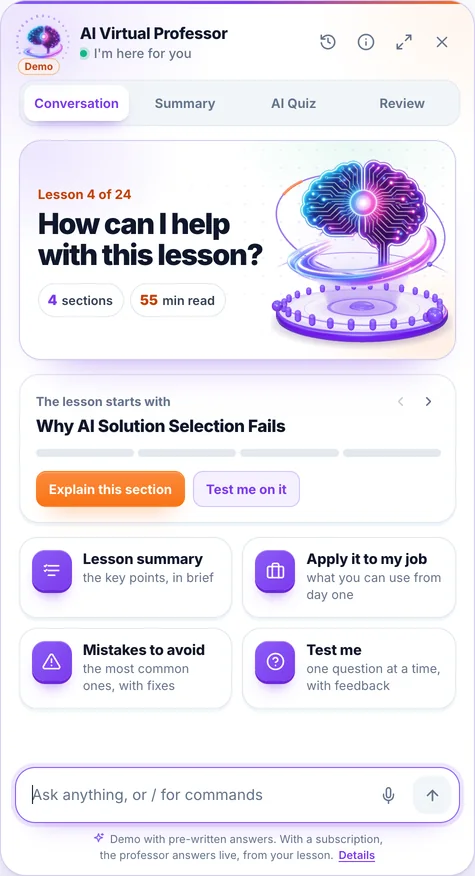
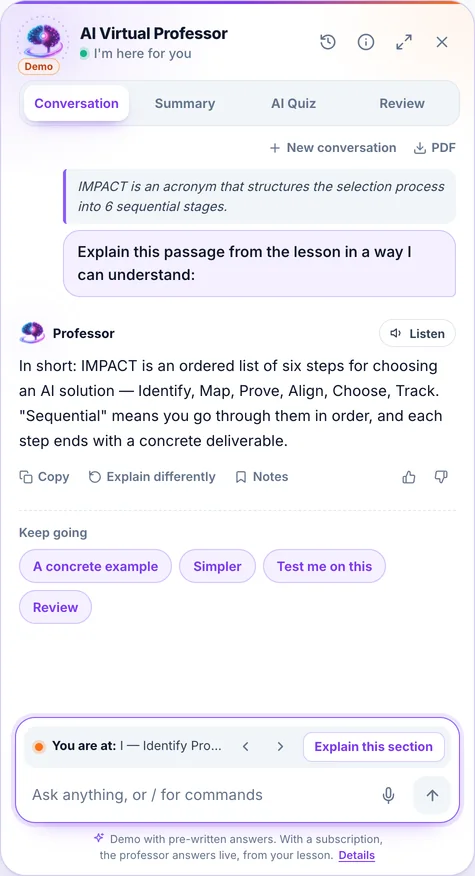
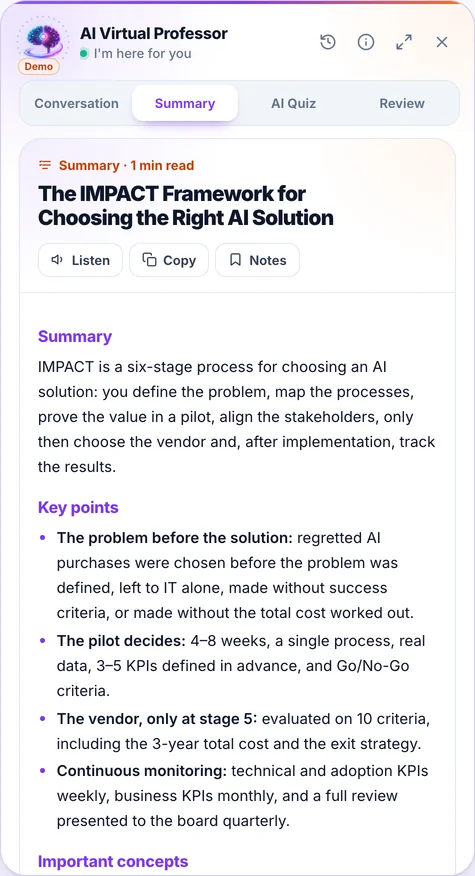
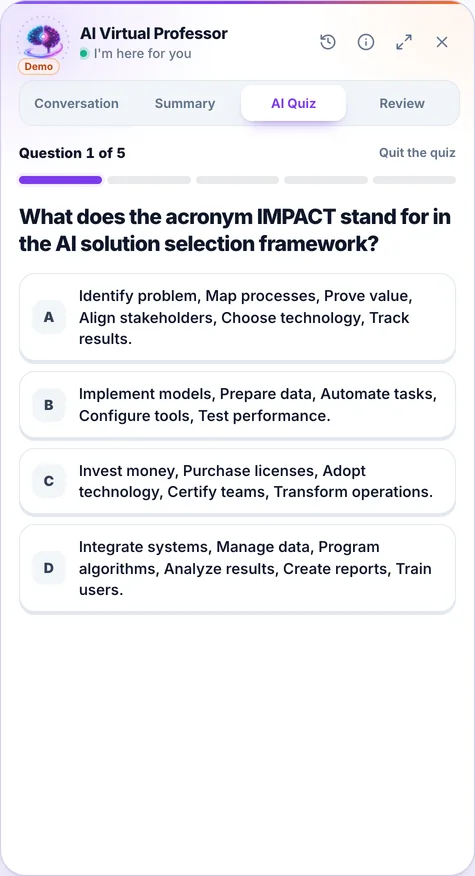
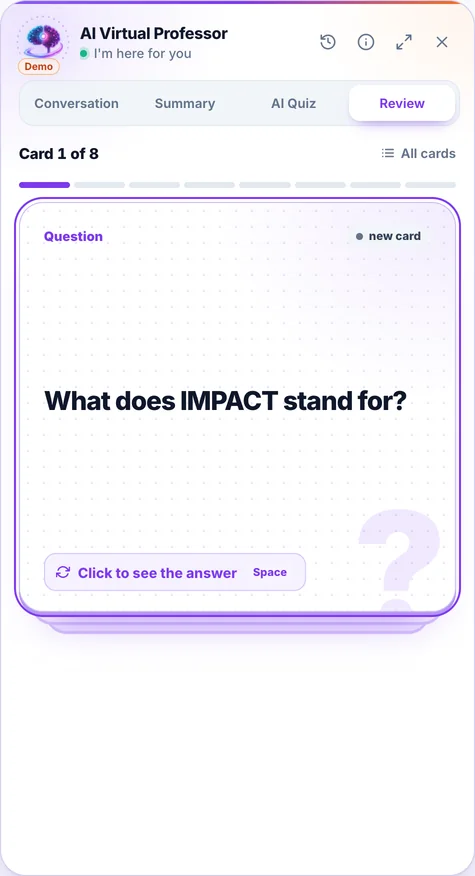
Screenshots from the app, taken in the demo lesson, with prepared answers.
The position of the language, what changes in your work, the tools and what you will be able to do at the end.
A Java developer has an advantage that AI prototypes usually lack: the discipline of large systems. Transactions, observability, resilience, security and governance are what decides whether a project gets past the pilot. Add an understanding of language models, RAG and agents, and you are the person who can take AI into the systems that matter.
The risk is treating the model as one more REST service. It is not: the answer is non-deterministic, cost is per token, latency is measured in seconds and quality has to be measured with new metrics. The courses below are chosen to give you that mental model and the operating practices, not to turn you into a Python developer.
Where the model sits in your architecture, how you handle timeouts and retries, how you isolate cost per client, how you log prompts without exposing personal data: decisions you make, not the framework.
Documents, tickets, contracts and relational databases become context for models. Chunking, embeddings, document-level permissions and retrieval evaluation are new requirements for backend teams.
Your services, order lookup, invoicing, stock queries, become tools for agents and assistants, with authentication and least-privilege permissions. The protocol has an official Java SDK.
Coding agents work on large Java codebases too. The difference is made by the context you give them, deterministic hooks and verification wired into CI.
These are the skills you practise in the courses of the track; results depend on the time you invest and on your previous experience.
Start the Java trackThe whole Java track fits in a subscription of 10 courses: €319 a month, VAT included. You pick the courses and can change them at every renewal.
Pay for the tier, then pick the courses in your account. You can change them at every renewal.
€99 a course
€99a month €990a year, 12 months of access
under €67 a course
€199a month €1,990a year, 12 months of access
under €52 a course
€259a month €2,590a year, 12 months of access
under €32 a course
€319a month €3,190a year, 12 months of access
under €24 a course
€359a month €3,590a year, 12 months of access
under €16 a course
€399a month €3,990a year, 12 months of access
under €10 a course, across all 50
€499a month €4,990a year, 12 months of access
Total prices, VAT included. Move up anytime and pay only the difference for the days left; move down at renewal. Renews automatically, you stop it anytime from your account; your progress and certificates stay.
Payments are processed by Stripe, a PCI DSS Level 1 certified provider, with 3-D Secure for payer authentication. The connection to this site is TLS-encrypted.
Compare all the subscriptions · The team library, priced per member · Give a month of access as a gift
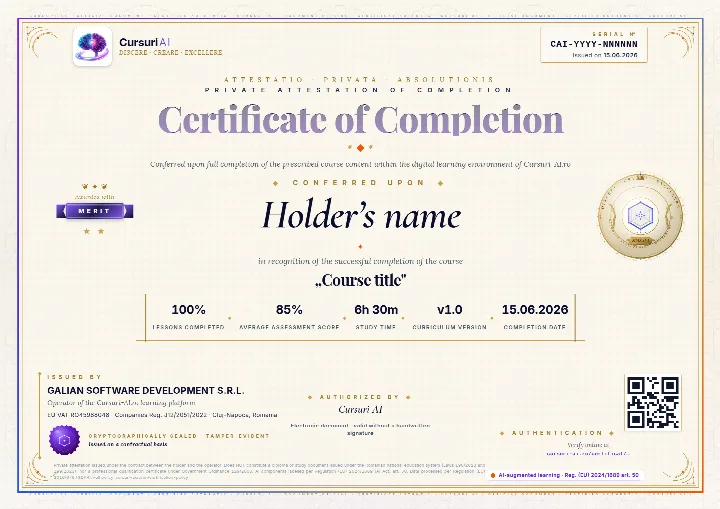
When you finish the lessons of a course with an average of at least 70% on its quizzes, you issue the PDF certificate from your account, at no extra cost.
A private attestation of course completion. It is NOT a diploma or a state-recognised qualification under Romanian Laws 198/2023, 199/2023 or Government Ordinance 129/2000; employers may take it into account at their own discretion.
 Blog
What Is an AI Engineer? Role, Skills, and How to Become One in 2026
 Blog
Prompt Engineering in 2026: From Beginner to Pro
The same skills, seen from each ecosystem. The languages close to Java are highlighted.
No. The code examples are mostly in Python, and the MCP course also has a module in TypeScript. The courses are chosen here for the concepts, architecture and production practices that you then apply with Spring AI, LangChain4j or the official Java SDKs. That is also why this track has two stages instead of three: it lists only the courses whose substance does not depend on the language.
Not in order to change languages. It is worth being able to read Python, so you can follow the examples, the documentation and the evaluation tools, but enterprise Java systems will get their AI components in Java. Your value is in architecture, integration and operations, not in rewriting applications.
Yes, although it is not on this track: the course on fine-tuning open-source LLMs covers open-model licenses, quantization and self-hosting with Ollama, vLLM and TGI, and you can pick it in the same subscription. The AI security course covers data protection, PII and leakage.
All the courses recommended here are IT courses. You pick them in a subscription by number of courses: usually 3, 5 or 10 courses a month for one language and stack; there are also 15 and 25 courses, a single course and the full catalog. You pick the courses and can change them at every renewal. The subscription renews automatically, and you can stop the renewal anytime from your account. Every price, VAT included, is shown below and on the pricing page. Every course has a free preview of its first lesson, readable without an account.
9 courses, ~227 hours, in a subscription of 10 courses: €319 per month, VAT included. You can change them at every renewal.
The courses are for educational purposes only: they are not professional advice, and completing them is not a diploma or a state-recognised qualification. The names of languages, tools and products belong to their owners and are mentioned for identification only. Details in the Terms & Conditions.
ChatGPT, OpenAI, Claude, Anthropic, Gemini, Google, Microsoft 365 Copilot, Cursor, Midjourney and the other product and company names mentioned are trademarks or trade names of their respective owners. Cursuri AI is an independent training provider and is not sponsored or endorsed by any of them; our membership in Anthropic's Claude for Startups program does not mean that Anthropic endorses our courses.