1. Home
  2. For developers
  3. JavaScript and TypeScript
For developers · JavaScript and TypeScript

AI for JavaScript and TypeScript developers: from interfaces to agents

JavaScript and TypeScript are the languages in which the interfaces of AI products and many MCP servers are built. OpenAI and Anthropic publish official TypeScript SDKs, and prompt-to-app tools generate React and Next.js interfaces. The question for a JavaScript developer is not whether AI affects the work, but whether you meet it as a user or as a builder.

AI courses for JavaScript and TypeScript: 3 stages, 12 courses

In the order in which they matter, each with the reason it matters if you work with JavaScript and TypeScript.

Stage 1: Foundations: the mental model and the first integrations

You understand what an LLM is, how to call it properly and what an AI product looks like beyond a chat box.

  1. Introduction to AI Engineering

    Beginner 28 lessons ~25 h

    Why it matters if you work with JavaScript and TypeScript: The map of the field, including the module on AI tools for developers and the one on LLM APIs, so you know what you are building and with what. The examples are mostly in Python, with some TypeScript.

  2. The Complete Prompt Engineering Masterclass

    Intermediate 32 lessons ~27 h

    Why it matters if you work with JavaScript and TypeScript: Prompt engineering for code and for agents: instructions that produce correct components and verifiable decisions.

  3. Vibe Coding: From Prompt to Application with Lovable, v0, Bolt and Replit Agent

    Beginner 22 lessons ~24 h

    Why it matters if you work with JavaScript and TypeScript: A comparative tour of Lovable, v0, Bolt and Replit Agent; v0, for one, generates React and Next.js components. You see what these tools do well, where they fall short on security and production, and where your expertise fits next to them.

Stage 2: Systems: integration, MCP, agents and a full product

You build the components that turn an interface into a product: tool orchestration, MCP servers, realtime sessions and the architecture of an AI SaaS.

  1. Advanced LLM Integration in Production Applications

    Advanced 24 lessons ~26 h

    Why it matters if you work with JavaScript and TypeScript: The streaming lesson implements the server side with Express in TypeScript and the client with fetch and ReadableStream. The rest, function calling, routing, error handling and productionization, is mostly in Python and is the logic you write in Node whatever the framework.

  2. MCP (Model Context Protocol) — Building Servers and Integrations (Enterprise Edition)

    Advanced 22 lessons ~25 h

    Why it matters if you work with JavaScript and TypeScript: A whole module on building MCP servers with TypeScript, plus transport, authentication, testing and containerization. Your tools become available in any MCP client.

  3. AI Agents: Architecting and Automating Autonomous Systems

    Advanced 30 lessons ~26 h

    Why it matters if you work with JavaScript and TypeScript: Agent architecture: memory, state, tools, design patterns for production and guardrails. The MCP module builds the same server in Python and in TypeScript; the other examples are in Python and the concepts carry over.

  4. Build and Ship a Production AI SaaS: From Idea to Paying Users

    Advanced 30 lessons ~25 h

    Why it matters if you work with JavaScript and TypeScript: The default stack of the course is yours: Next.js, React and TypeScript with Postgres and pgvector. It takes you through streaming, multi-tenancy, Stripe billing, rate limiting and observability as architecture and decisions, not as code listings.

  5. Voice AI and Realtime Multimodal Agents

    Advanced 30 lessons ~25 h

    Why it matters if you work with JavaScript and TypeScript: Realtime voice agents: speech-to-text, text-to-speech, the Realtime API and bidirectional streaming over WebSockets and WebRTC, transports a web developer already knows.

Stage 3: Tools and quality: agentic coding, evals, security

You ship faster with coding agents and you stand behind quality with evaluation and security.

  1. Claude Code Mastery: Agentic Coding from the Terminal (multi-file, git, CI, MCP)

    Advanced 28 lessons ~25 h

    Why it matters if you work with JavaScript and TypeScript: Claude Code on large codebases, the full git workflow, subagents, hooks and GitHub Actions integration. It installs with npm and runs in the terminal next to your existing toolchain.

  2. Cursor as a Pro: AI-Native IDE, Composer and Multi-Agent 2026 (Enterprise Edition)

    Expert 30 lessons ~25 h

    Why it matters if you work with JavaScript and TypeScript: Composer, background agents, MCP in Cursor and team productivity, with rules and profiles shown for a project that has a React frontend in TypeScript.

  3. LLM Evaluation and Testing: Shipping Reliable AI

    Advanced 30 lessons ~25 h

    Why it matters if you work with JavaScript and TypeScript: promptfoo for comparing prompts and models from a YAML file, run with npx, next to DeepEval, Ragas and pytest. Quality tests go into the same pipeline as your unit tests.

  4. AI Security: Defending LLM Applications (OWASP LLM Top 10, Guardrails, Red-Teaming)

    Advanced 30 lessons ~25 h

    Why it matters if you work with JavaScript and TypeScript: Prompt injection, insecure output handling (model output rendered as raw HTML becomes cross-site scripting), guardrails and excessive agency: the risks specific to AI applications exposed in a browser.

All 12 courses fit in a subscription of 15 courses. €359 per month, VAT included. The courses you chose come already selected in your account after payment.

Not sure what you can skip? Take the free level assessment

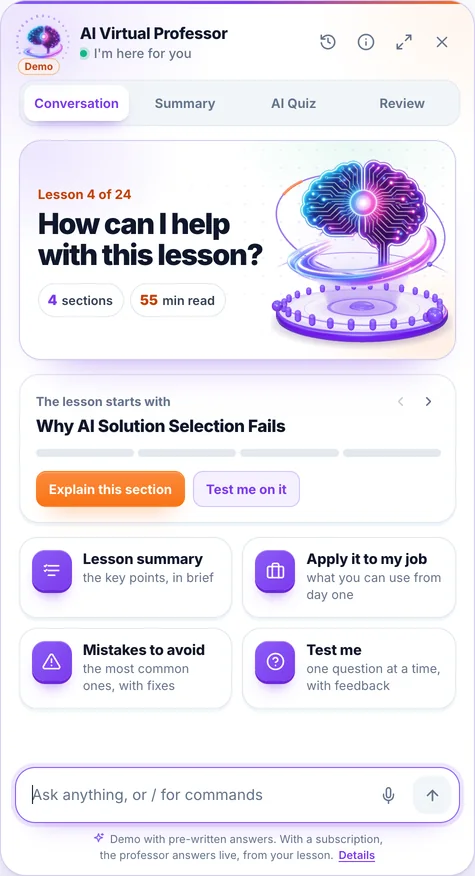
An AI Professor in every lesson

It opens next to the lesson and starts from it. You type or talk to it, and you can listen to the answer.

  • Explanations on any passage. “Explain this to me”, “Give me an example”, “Why does it matter?”.
  • A summary when you ask for it. The ideas of the lesson, point by point.
  • AI Quiz. 3, 5 or 10 new questions, with explanations.
  • Review. Flashcards made from the lesson.

Included in every plan and in single-course access, within a fair-use limit. It is an artificial intelligence system, not a human teacher; its answers may contain errors. Details in the Terms.

The professor opens next to the lesson, on the section you have reached, with four ways to start: a summary, applying it to your job, mistakes to avoid, or a test.

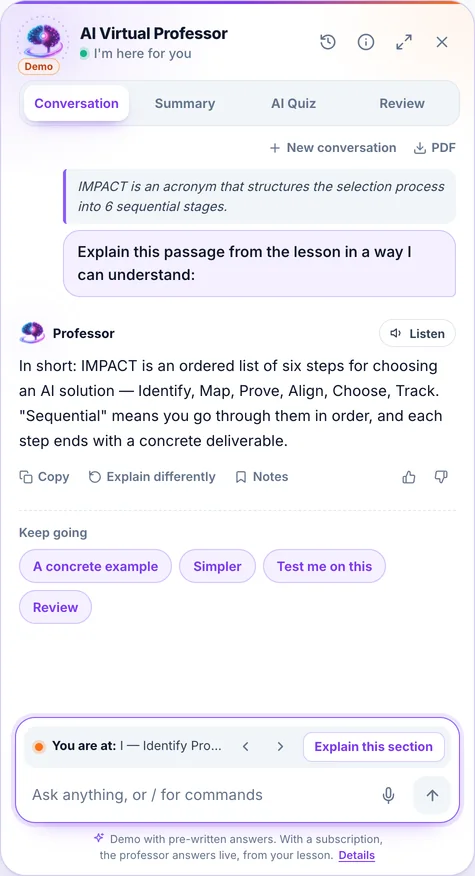
You select a passage and ask for an explanation. The answer starts from the lesson, and you can listen to it, copy it or save it to your notes.

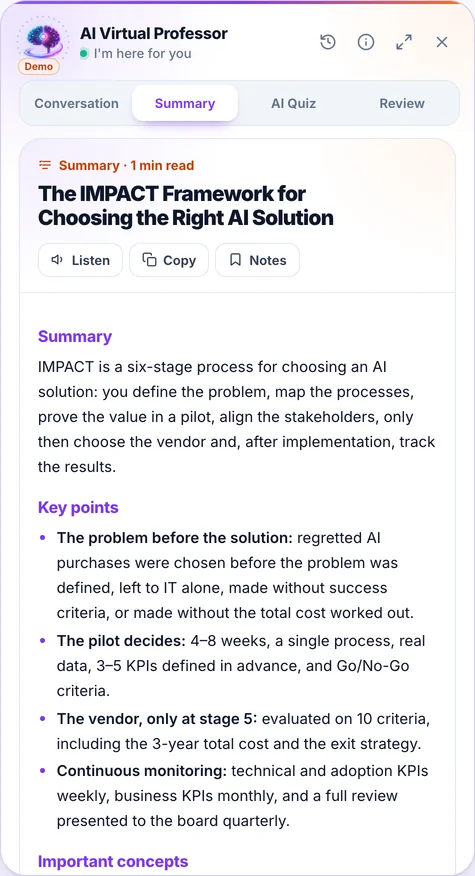
The ideas of the lesson, point by point, when you ask for them. You can listen to the summary or send it to your notes.

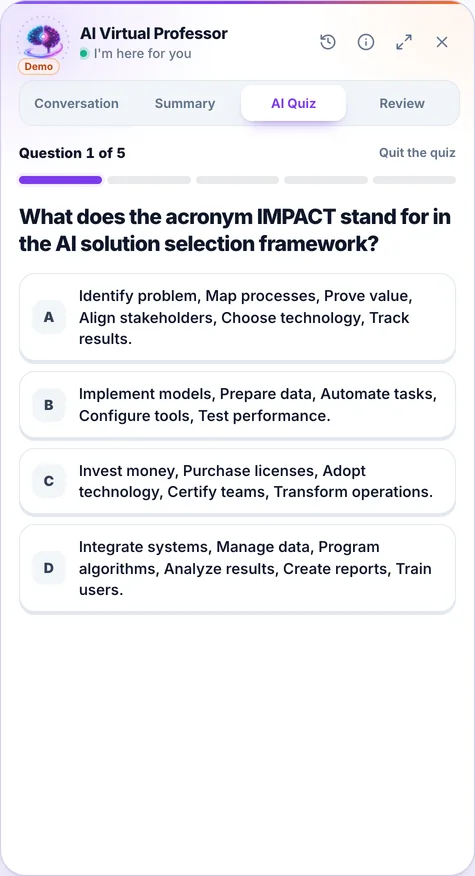
3, 5 or 10 new questions from the lesson you are reading, with an explanation for every answer.

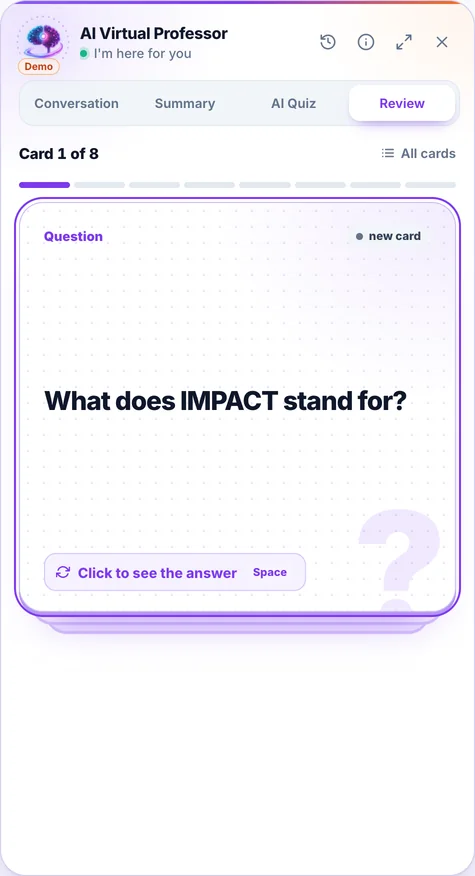
Flashcards made from the lesson: you flip the card and mark what you already knew.

Screenshot from the app, the AI Professor panel: In the lesson
Screenshot from the app, the AI Professor panel: Conversation
Screenshot from the app, the AI Professor panel: Summary
Screenshot from the app, the AI Professor panel: AI Quiz
Screenshot from the app, the AI Professor panel: Review

Screenshots from the app, taken in the demo lesson, with prepared answers.
What AI means for your work with JavaScript and TypeScript

The position of the language, what changes in your work, the tools and what you will be able to do at the end.

JavaScript and TypeScript in the age of AI

Your advantage

The JavaScript ecosystem has direct access to AI tooling: the Model Context Protocol has an official TypeScript SDK, the model vendors ship official TypeScript SDKs, and an evaluation tool such as promptfoo runs with npx. A TypeScript developer reaches all of these without changing language.

Where the risk is

The pressure comes from the interface side: prompt-to-app tools generate what you used to build by hand, pages, forms and integrations with a database or with payments. What they do not generate well is architecture, security, integration with existing systems and everything that belongs to operating a product with AI components. That is where your value moves.

What changes in your work with JavaScript and TypeScript

  1. The frontend becomes an interface for models

    Streamed answers, the intermediate states of an agent, showing tool calls and the sources of a RAG answer are now ordinary UI components. Whoever masters them builds AI products, not just pages.

  2. The Node backend orchestrates tools and context

    Tool use, structured outputs, retries, cost and rate limits are implemented in the same Node where you wrote REST APIs. The difference is that the answer is non-deterministic and has to be evaluated, not just validated.

  3. Realtime becomes a product surface

    A voice agent holds a persistent, bidirectional session over WebSockets or WebRTC, with interruptions and tool calls. Transport, latency and audio framing are web developer territory.

  4. Your editor is now an agent

    Cursor, Claude Code and MCP integrations change how you write and review code. What matters is giving them the right context, limiting their permissions and wiring verification into CI.

The AI ecosystem around JavaScript and TypeScript

  • Official OpenAI and Anthropic TypeScript SDKs Official, typed libraries from both vendors, with streaming and tool use.
  • The TypeScript SDK for MCP An official SDK of the protocol: you build MCP servers and clients directly in TypeScript.
  • Claude Code and Cursor Coding agents that work on JavaScript and TypeScript projects; Claude Code can be installed with npm.
  • Next.js and React Model calls on the server, so keys are never exposed, and streamed responses for conversational interfaces.
  • WebSockets and WebRTC The two transports behind realtime voice agents.
  • promptfoo Prompt and model comparison driven by a YAML file and run with npx, in the same CI pipeline as your tests.

What you will be able to do at the end of the JavaScript and TypeScript track

  1. Build conversational interfaces with streaming, on Next.js or on any framework
  2. Write MCP servers in TypeScript, tested and containerized
  3. Design the architecture of an AI product: model calls on the server, multi-tenancy, billing and rate limiting
  4. Use Claude Code and Cursor at a professional level, with controlled permissions and verification in CI
  5. Put answer-quality evaluation in the CI pipeline, with promptfoo

These are the skills you practise in the courses of the track; results depend on the time you invest and on your previous experience.

Start the JavaScript and TypeScript track

Pay only for the courses you want

The whole JavaScript and TypeScript track fits in a subscription of 15 courses: €359 a month, VAT included. You pick the courses and can change them at every renewal.

Pay for the tier, then pick the courses in your account. You can change them at every renewal.

Billing period
  1. 1 course One topic

    €99 a course

    €99a month €990a year, 12 months of access

  2. 3 courses First steps

    under €67 a course

    €199a month €1,990a year, 12 months of access

  3. 5 courses Your field

    under €52 a course

    €259a month €2,590a year, 12 months of access

  4. 10 courses Recommended A whole category For example, every AI Engineering course, or a mix of marketing and coding.

    under €32 a course

    €319a month €3,190a year, 12 months of access

  5. 15 courses Two fields

    under €24 a course

    €359a month €3,590a year, 12 months of access

  6. 25 courses A full track

    under €16 a course

    €399a month €3,990a year, 12 months of access

  7. Full catalog Nothing to pick, new courses included

    under €10 a course, across all 50

    €499a month €4,990a year, 12 months of access

Total prices, VAT included. Move up anytime and pay only the difference for the days left; move down at renewal. Renews automatically, you stop it anytime from your account; your progress and certificates stay.

Integrated
Secure payments powered by Stripe
We never see your card details
Accepted payment methods

Payments are processed by Stripe, a PCI DSS Level 1 certified provider, with 3-D Secure for payer authentication. The connection to this site is TLS-encrypted.

Compare all the subscriptions · The team library, priced per member · Give a month of access as a gift

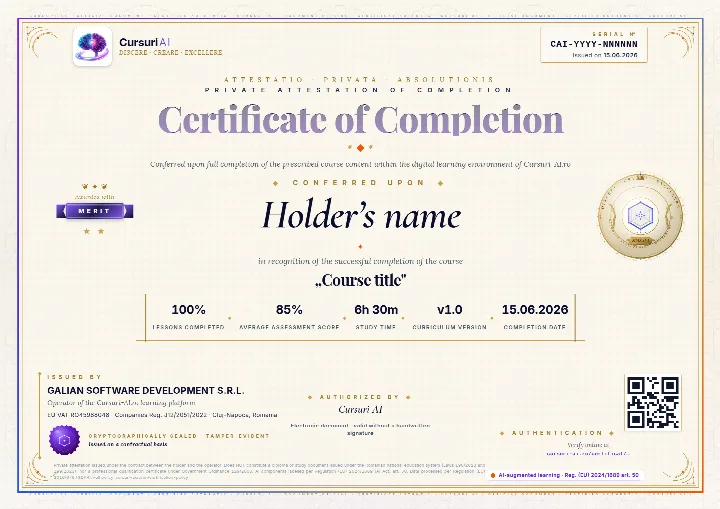
Certificate of Completion

Leave with verifiable proof for every course in the JavaScript and TypeScript track

When you finish the lessons of a course with an average of at least 70% on its quizzes, you issue the PDF certificate from your account, at no extra cost.

  • Verifiable by anyoneA QR code and a public verification page, no account needed.
  • On your CV and LinkedInA recruiter checks it from a link.
  • Pass, Merit or DistinctionThe tier and the unique number, written on the document.
Example of a Cursuri AI Certificate of Completion with sample data: the serial number and the issue date in the top-right corner, the holder’s name, the course, the tier awarded, the percentage of lessons, the average score, the study time, the course version, the issuer and the verification QR code
The real document, an A4 PDF, shown here with sample data: the name, the course and the serial number are placeholders, and the QR code in the image is decorative.

From the blog, for developers

Do you work in another language too?

The same skills, seen from each ecosystem. The languages close to JavaScript and TypeScript are highlighted.

Questions about AI for JavaScript and TypeScript

Do the courses have examples in TypeScript?

Some do. The MCP course has a module dedicated to building servers in TypeScript, the agents course builds an MCP server in TypeScript next to the Python one, and the LLM integration course implements streaming with Express and, on the client, with fetch. The vibe coding course works with tools that generate JavaScript applications. The remaining examples are mostly in Python, and the concepts carry over to the official TypeScript SDKs.

I am a frontend developer. Does this make sense for me?

Yes. The interfaces of AI products, streaming, agent states, showing sources, are frontend work, and prompt-to-app tools generate the kind of components you used to write by hand. The vibe coding course shows their limits, and the integration, MCP and AI SaaS courses move you into the position of building the product, not just the interface.

Can I use Claude Code or Cursor on existing JavaScript projects?

Yes. The dedicated courses cover working on large codebases, the git workflow, subagents, hooks and CI integration, with the emphasis on least-privilege permissions.

Which subscription opens these courses?

All the courses recommended here are IT courses. You pick them in a subscription by number of courses: usually 3, 5 or 10 courses a month for one language and stack; there are also 15 and 25 courses, a single course and the full catalog. You pick the courses and can change them at every renewal. The subscription renews automatically, and you can stop the renewal anytime from your account. Every price, VAT included, is shown below and on the pricing page. Every course has a free preview of its first lesson, readable without an account.

A free preview of the first lesson, without an account

Start the JavaScript and TypeScript track today

12 courses, ~302 hours, in a subscription of 15 courses: €359 per month, VAT included. You can change them at every renewal.

Secure payment through Stripe Immediate access after payment Stop the renewal anytime

ChatGPT, OpenAI, Claude, Anthropic, Gemini, Google, Microsoft 365 Copilot, Cursor, Midjourney and the other product and company names mentioned are trademarks or trade names of their respective owners. Cursuri AI is an independent training provider and is not sponsored or endorsed by any of them; our membership in Anthropic's Claude for Startups program does not mean that Anthropic endorses our courses.

Not sure how many courses you need?

Pick the line that describes you. The more courses you take, the less you pay for each one.

In every subscription
  • Interactive lessons with exercises and quizzes
  • The AI Professor inside every lesson
  • Certificate of Completion
Pick a line on the leftPick a line above

Still deciding? Get the guide by email

How many courses you need, what each subscription includes and the prices, VAT included.

  • Unsubscribe with one click
  • Address deleted automatically if you do not confirm

All prices include VAT. You pick the courses and can change them at every renewal. Billing is monthly and you can stop the renewal anytime from your account.

I’d rather see the subscriptions now
€359/month 15 courses · the whole JavaScript and TypeScript track · VAT included
Choose 15 courses